



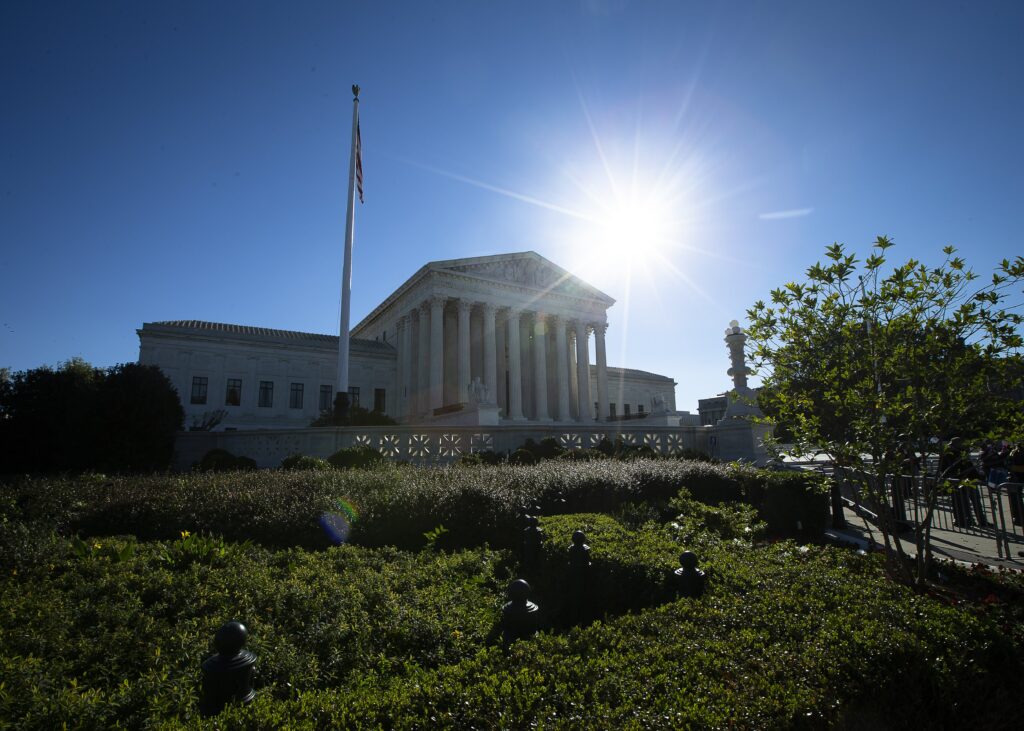
On June 24, 2022, the Supreme Court of the United States of America rendered its decision regarding Dobbs vs. Jackson Women’s Health Organization, a decision that overturned the High Court’s 1973 decision of Roe vs. Wade.
This current decision simply sets forth that the U.S. Constitution neither grants nor denies a woman’s access to an abortion as a constitutional right, that such access is in the power of the 50 individual states to determine. The decision in Dobbs in not so much a victory for the pro-life movement as it is for strict Constitutionalists, who desire the government to act in accord with the provisions of the Constitution. That laws are to be made by the legislative branch of the government – not by executive order, not by judicial decision.
The Dobbs decision places on each state legislature the responsibility to determine the legality of abortion. Dobbs neither outlaws nor bans abortion. Unfortunately, in our own state of New Jersey, abortion will continue, as many politicians have already pushed to ensure access to abortion. The work to end abortion has by no means ended. Abortion will remain a political issue for years to come, and there is a danger that not only the rhetoric but also the policies will become more extreme in the coming months.
On the day the decision was made public, a cry went forth that June 24, 2022, was a dark day in the United States. Many were claiming that women had been stripped of a “right” – that this decision was a setback in the advancement of women. There is a growing tendency to view pregnancy, and motherhood, as a hinderance to self-fulfillment, human-flourishing and happiness. Pregnancy and motherhood are oppressive burdens, not just to be avoided but a shackle to be thrown off. Sadly, the vast majority of abortions are selective and are not due to medical reasons, rape or incest.
It is important that the Church counter this current view. The Church offers a beautiful understanding of motherhood, of parenthood. The Church can and must help women with a crisis pregnancy or an unplanned pregnancy to understand that it is not the end; that such women can find fulfillment both as mothers and in pursuit of a successful career.
The Church offers pregnant mothers and women with children a community who can assist them in all their needs. It is important to recall that Church does not refer to bishops, priests, deacons and religious; the Church is all the baptized. The responsibility belongs to all the faithful.
Many on the 24th of June, and during the weeks leading up to the decision, commented that there are too many Catholics sitting on the Supreme Court. The majority of those justices in the majority opinion are Catholic; one is Episcopalian, all are Christian. This implies that the justices either imposed Catholic teaching or made their judgement by means of the Catholic faith.
This simply is not true. The judgment is founded on the rights either protected or prohibited by the Constitution and which government branch is to determine what is and what is not permissible. The judgment is not based on human beings being made in the image and likeness of God.
There is a tendency to view the position of the Church on many of the social issues in our nation as imposing the Bible, that is revelation, on society. Yet, the Catholic teaching on such issues is founded on faith and reason. The Catholic understanding is that there are truths that can be known by human reason; knowledge of truth helps human beings to seek the good and avoid evil. Some of these truths have been confirmed by revelation, such as the goodness and dignity of human life. It is this ability to know what is true and good that allows for human beings to form a just society and to live in harmony.
While the Dobbs decision did not do away with abortion, it can be seen as a turning point. For the justices put forth that abortion does not destroy “fetal-life” or “potential-life” but “unborn human life.” This has the potential for recovering the ability of human-reason to know reality, to know truth. Such a recovery will lead to a more just society, one in which the pursuit of happiness is founded on a good that leads not only to individual flourishing but that of society.
June 24 is not the dark day so many people claim it to be. Rather, it is the dawn of a new day, beginning with the first streams of the light of human dignity.
Father Jason Rocks is chancellor and adjutant judicial vicar for the Tribunal for the Diocese of Camden.




 at the bottom and then tap “Add to Home Screen”
