





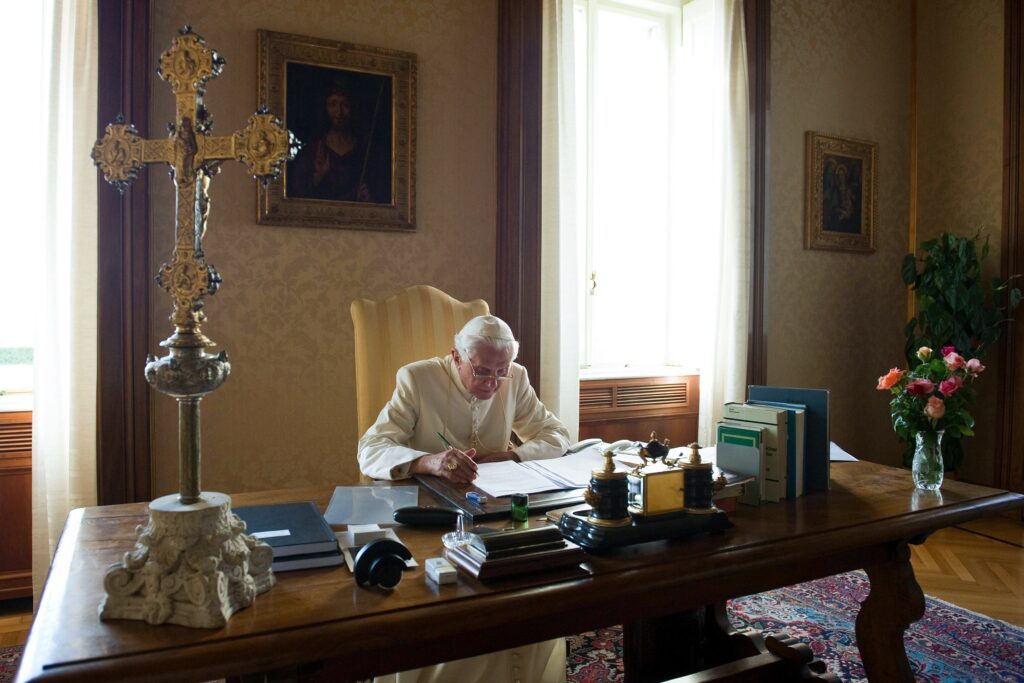
Pope Emeritus Benedict XVI is being remembered across the Diocese of Camden as a spiritual leader, theologian, teacher and defender of truth.
“As priest, theologian, bishop, cardinal and pope, Joseph Ratzinger served our Church with distinction,” Bishop Dennis Sullivan said upon news of the retired pope’s death. “His fidelity to our Lord, Jesus Christ, has been constant through each phase of his long life. His love for the Catholic Church has been exemplary and never wavered despite the many storms he faced during his life. Indeed, he was ‘a simple humble worker in the vineyard of the lord.’”
Pope Benedict XVI, who was given the anointing of the sick Dec. 28 in his residence, died Dec. 31. He was 95.
PHOTO GALLERY: The Life of Pope Benedict
Father Jason Rocks, chancellor of the Diocese of Camden, credited Pope Benedict for teaching both the Catholic faith’s rich history and its continued fruitfulness today.
“Pope Benedict encouraged all bishops, priests, deacons and seminarians, as well as the lay faithful, to reread the documents of the Second Vatican Council, through the lens of all that had come before, to see the teaching of the Council as drawing from the tradition, the faith that has been handed down from apostolic times, and not as something so new it was foreign to the faith,” said Father Rocks, who is also pastor of Holy Eucharist Parish, Cherry Hill.
He added that the pope “did not want the contents of the faith to be just nice words hanging in the air; rather he sought to show that God’s revelation and our understanding of it gives meaning to our lives. The entire theological program of Pope Benedict XVI,” Father Rocks said, “from his beginnings as Father Ratzinger through his being Pope Emeritus, has been to make manifest not just an understanding of the faith but its value in the world today.”
‘Brilliant Insights’
“Before his election as Pope in 2005, I and many other priests around my age came to know then-Cardinal Joseph Ratzinger through his writings,” said Father James Bartoloma, former diocesan chancellor. “We appreciated his brilliant insights on theology and the Sacred Liturgy, and as a great collaborator to Pope John Paul II.”
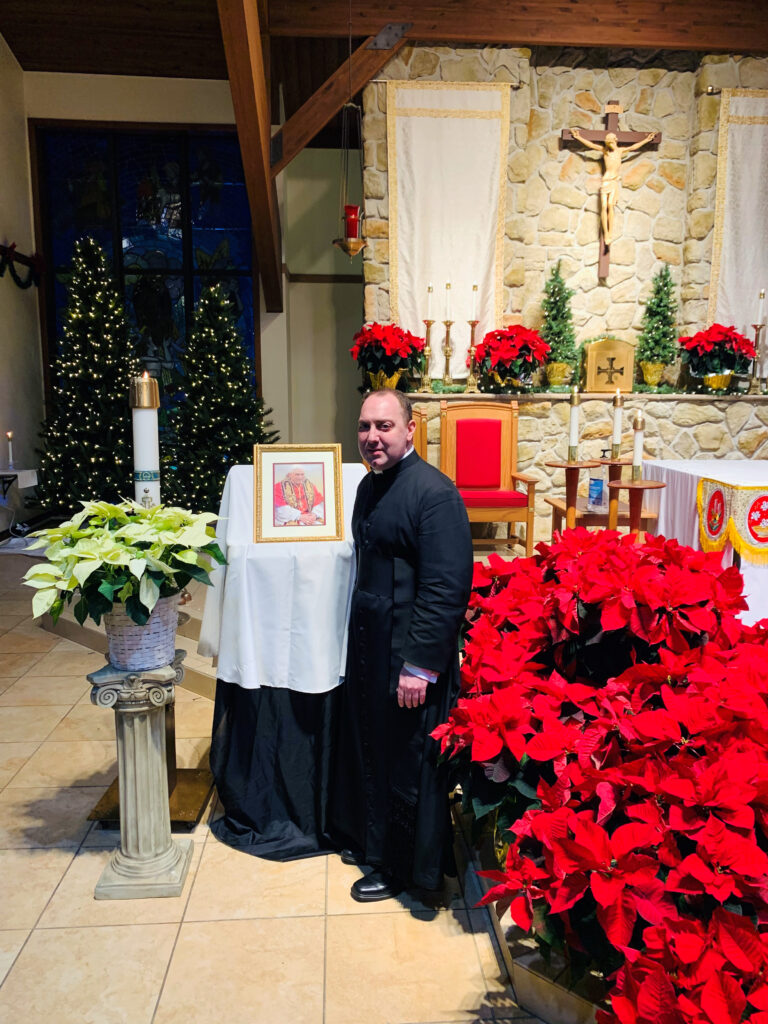
The priest, who is pastor of Holy Family Parish, Sewell, and director of the diocesan Marian Commission, continued, “From 2008 to 2011, I lived in Rome and did graduate studies in Canon Law. I was privileged to be in Pope Benedict’s presence a number of times for different ceremonies. … [He] celebrated Mass with great attention and devotion. Those Sacred Liturgies were among the most beautiful and uplifting I have ever been present for. His homilies were always, of course, outstanding.”
Father Bartoloma added, “Pope Benedict was a great theologian; modifications to and the application of Canon Law during his reign, which he would of course have been attentive to, were insightful. The papacy of Pope Benedict XVI was an optimistic time.”
‘Co-worker of the Truth’
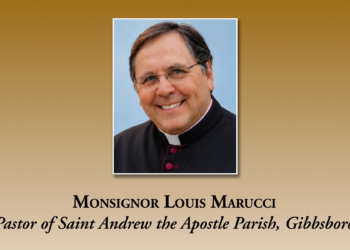
“Before his election, in his role as Prefect of the Congregation of the Doctrine of the Faith, [Pope Emeritus Benedict XVI] was fervent in his quest for truth,” said Msgr. Louis A. Marucci, pastor of Saint Andrew the Apostle Parish, Gibbsboro. “It is not surprising that the motto on his Coat of Arms was ‘Cooperatores Veritatis,’ which translates as ‘Co-workers of the Truth.’”
The late pope understood truth as means to enlighten the world, Msgr. Marucci continued, and fulfilling the mission of the Church to foster Christ’s teaching, preaching and healing of humanity. Priests, theologians and laity alike are challenged to both focus on Christ and turn away from worldly standards.
“In my opinion, one of Pope Benedict’s most significant challenges to the Church was to resist worldly powers,” Msgr. Marucci concluded. “Although he had an extraordinary intellect, I believe he was trying to teach the world a straightforward yet simple message about truth: Christ’s mission is always found in the power of love rather than the love of power.”
‘Humble Watchdog’
Father Jon Thomas, pastor of Christ the King Parish, Haddonfield, was ordained a priest during Pope Benedict’s papacy.
“Before his election as pope, I remember Joseph Ratzinger’s reputation as the Vatican’s ‘doctrinal watchdog,’ but I considered him a theologian with a gift for explaining the basics of the faith,” he said.
Father Thomas called the pope’s three encyclicals “beautiful and accessible encyclicals on the virtues of hope and love,” and that he loved sharing the historic Christian faith with modern audiences. Vividly remembering the pope’s Feb. 28, 2013, resignation, Father Thomas noted, “I was shocked like everyone else, but I also sympathized with him. He had one of the most challenging positions in the world, and he gave it his best. Then he had the humility to let someone else apply their efforts.”
Affirmative Orthodoxy, Ongoing Formation
The late pope’s legacy will be felt in the Camden Diocese, asserted Dr. Lee DelleMonache, director of religious education for the Diocese of Camden, with what writer John Allen referred to as “affirmation orthodoxy.”
“I hope that Pope Benedict is remembered for the emphasis he placed on presenting doctrine on what the Church supports rather than what the Church opposes,” she said. “The Catholic faith … is better understood and embraced when we learn and explore when and why the Church says ‘yes’ rather than throw our hands up because the Church says ‘no.’”
She cited Pope Benedict’s book “The Apostles” (2007) as a major influence in her approach to faith formation, aiding her to better understand that conversion of faith is a never-ending process.
“Through the example of Saint Peter, Pope Benedict explains that deepening one’s relationship with Jesus is ongoing,” she said, citing God’s selection of a broken man in need of forgiveness to be the foundation of our Church. “Instead of God transforming Peter on the spot, Benedict wrote, ‘God chooses the way of the transformation of hearts in suffering and humility. And we, like Peter, must convert, over and over again. We must follow Jesus and not go before him: it is he who shows us the way.’”
‘Call to Love and Trustworthy Hope’
Donna Ottaviano-Britt, diocesan director of discipleship and leadership and Secretariat for Pastoral Outreach, recalled Pope Benedict as a prolific writer.
“If his work was all I read for the rest of my life, I wouldn’t finish,” she said, citing two of the pope’s encyclicals as significant contributions in her life: “Deus Caritas Est” (God is Love) (2005) and “Spe Salvi” (In Hope We Were Saved) (2007).
Ottaviano-Britt said, “There is a line from [‘Deus Caritas Est’] that sits at the very top of the webpage for my diocesan office: ‘Being Christian is not the result of an ethical choice or a lofty idea, but the encounter with an event, a person, which gives life a new horizon and a decisive direction.’ This single line is a real clarion call to receive this immense love and to then, in turn, love others.”
Reflecting upon “Spe Salvi,” she quoted, “[The Pope tells us] ‘salvation is not a given, and redemption is offered to us in the sense that we have been given trustworthy hope by virtue of which we can face our present. The present, even if it is arduous, can be lived and accepted if it leads towards a goal, if we can be sure of this goal, and if this goal is great enough to justify the effort of the journey.’”
Ottaviano-Britt concluded that the pope had described the future as “a dark door thrown open,” and asked, “Who wants that dark door opened? We may not want it, but we can live with that door swung wide because we have hope, because we have faith. Pope Benedict XVI writes that we can live with this door fully opened because those who hope have been given a gift of new life.”




 at the bottom and then tap “Add to Home Screen”
