




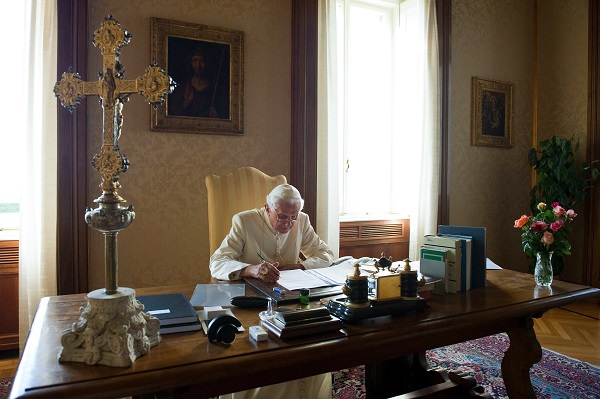
Early in his pontificate, Pope Benedict XVI stated, “As I prepare myself for the service that is proper to the Successor of Peter, I also wish to confirm my determination to continue to put the Second Vatican Council into practice, following in the footsteps of my predecessors and in faithful continuity with the 2,000 year tradition of the Church.” (Initial message of Pope Benedict XVI to the Cardinals, April 20, 2005).
With this statement, the “hermeneutic of continuity” was begun. Pope Benedict encouraged all bishops, priests, deacons, seminarians, as well as the lay faithful to reread the documents of the Second Vatican Council through the lens of all that had come before – to see the teaching of the council as drawing from the tradition, the faith that has been handed down from apostolic times, and not as something so new it was foreign to the faith. Ultimately, Benedict understood the teachings of the council to be a response to the questions, struggles and condition of contemporary man.
Pope Benedict had begun this theological program during his time as a professor. He formulated some of his lectures from his time at the university in Tüebingen, Germany, into a book, “Introduction to Christianity.” At the end of the preface, he wrote:
“This is where the present book comes in: its aim is to help understand faith afresh as something which makes possible true humanity in the world of today, to expound faith without changing it into the small coin of empty talk painfully laboring to hide a complete spiritual vacuum.”
He desired not only to make the apostolic faith found in the Church accessible to people, but to bring its true value to the people of today. That is, Pope Benedict did not want the contents of the faith to be just nice words hanging in the air; rather, he sought to show that God’s revelation and our understanding of it gives meaning to our lives.
Pope Benedict always held that the teachings of the Church are grounded in God. He also held that access to God is found in his revelation, particularly the Scriptures. Pope Benedict understood that the teachings of the Church lead human beings into a true communion, based neither on materialism nor forced economic systems, but on the Word of God. He wrote in “Verbum Domini,” “God’s word is given to us precisely to build communion, to unite us in the Truth along our path to God.” (#86)
Pope Benedict encouraged meditation on the Word of God and the teachings that flowed from the Divine Word. It is only by such reflection that we come into contact with the Word Incarnate. It is through our relationship with Jesus that we are able to enter into a relationship with God the Father and all his children. “Our relationship with God is established through communion with Jesus – we cannot achieve it alone or from our own resources alone. Christ died for all. To live for him means allowing oneself to be drawn into his being for others.” (“Spes Salvi” 28).
Being drawn into Jesus’ being for others draws us into the life of Christ and leads us into the Body of Christ the Church. Pope Benedict highlighted this ecclesial aspect in his homily on the Feast of Saints Peter and Paul: “The Church, established in the institution of the Eucharist, in her inmost self is a Eucharistic community, hence, communion in the Body of the Lord. Peter’s task is to preside over this universal communion; to keep it present in the world also as a visible, incarnate unity.” (June 29, 2006)
In this brief sentence, Pope Benedict highlights the connection between the Church and her union with Jesus, becoming one Body with the Lord, and the union of her members with each other in this ecclesial body. As Jesus gave his life for others, so, too, are we to give our lives for one another. This is made possible due to our communion with each other in the Lord Jesus; we form one body and are to lovingly care for each member.
Further, while he grounds the communion of the Church in the Eucharist, Pope Benedict also makes clear the role of Saint Peter and his successors: to maintain the visible communion of the Church. Here, Benedict is returning to his statement about understanding the Second Vatican Council in connection with the 2,000-year tradition of the Church. Here, we hear echoed what Pope Benedict wrote earlier: to present the faith without changing its substance while still responding to the needs of the times.
The entire theological program of Pope Benedict XVI, from his beginnings as Father Ratzinger through his being Pope Emeritus, has been to make manifest not just an understanding of the faith but its value in the world today. Faith brings us into union with Jesus, who transforms our lives. This transforming encounter leads one to state: “I believe in You, Jesus of Nazareth, as the meaning (logos) of the world and of my life.”
This last sentence in Chapter 1 from his “Introduction to Christianity” perhaps can be seen as Pope Emeritus Benedict XVI’s lasting influence on the Church and the world.
Father Jason Rocks is chancellor of the Diocese of Camden and pastor of Holy Eucharist Parish, Cherry Hill.




 at the bottom and then tap “Add to Home Screen”
