





CHERRY HILL – After 45 minutes of describing his mother’s experience in a Nazi death camp – and her heroic escape – Marvin Raab had a message for those in attendance.
“Tell the world what happened.”
From April 1942 to mid-October 1943, it is estimated that 250,000 Jewish prisoners were killed by the German SS (Schutzstaffel) at Sobibor, a death camp on the Eastern side of Poland.
As a witness to its atrocities, and as a member of the camp’s Jewish resistance, Esther Raab, until her death in 2015, shared her story with all generations and became a voice in denouncing discrimination and one in promoting hope and courage.
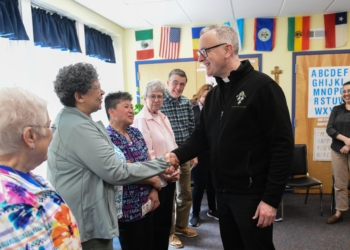
On Jan. 30 at the Catholic Community of Christ Our Light, Raab continued his mother’s legacy, telling the crowd of 125 gathered in the parish center about his mother through photographs, videos and his own personal narrative.
Born in 1922 in Chelm, Poland, to a middle-class family, Esther was taken prisoner by the Nazis at the age of 20 and imprisoned at the Sobibor death camp.
The threat of death at any moment permeated the camp. She was witness to many atrocities, such as prisoners lined up and systematically killed, or sent to gas chambers.
As an assigned worker at the sorting shed, she was responsible for organizing the effects of the dead.
On Oct. 14, 1943, after careful planning that included diligent observation of guards’ shift schedules, Esther was among the prisoners to lead an escape from the confines of Sobibor. She was one of 300 who fled the camp, an uprising that saw 100 re-captured, and only 50, including Esther, managing to evade seizure and survive the war.
Years later, Esther continued to make an impact. She was instrumental in the capture of the camp’s gas chamber master, and testified at his and others’ war crimes trials in Germany.
In the late 1980s, she served as a consultant on the movie, “Escape from Sobibor.” She would visit schools, urging young generations to share what they learned, and help others to understand the realities of the Holocaust.
After hearing some of Esther’s recollections of horror – such as seeing a guard kill a baby – and hope – being unexpectedly reunited with her brother after fleeing – attendees vowed to keep Esther and the story of Sobibor alive.
“We can’t let Esther’s story be lost,” said parishioner Mary Babiak, who attended the talk with her husband, Andrew, and friends Wayne and Linda Sawyer from Our Lady of Good Counsel in Moorestown.
Andrew Babia, the son of a Dachau concentration camp survivor, agreed, saying, “We’re going to share this experience with our sons.”
Noting the “heroic resistance” of Raab and others in Sobibor, Dr. Michael Sims, diocesan Director of Life and Justice Ministries, noted that Raab’s talk “was a good reminder to keep in mind the power of words,” and the way Adolf Hitler, through his rhetoric, was able to incite hatred toward the Jewish people.
“We need to tell and retell these stories [of the Holocaust] and remember that the only reason man is able to commit these atrocities is when we recognize others as not human,” he said.
Rita Cinelli, a member of Christ Our Light’s Life and Justice Committee, helped facilitate Raab’s visit to the parish. She said that in addition to continuing to share Esther’s message, the parish’s next steps will be a public showing of “Escape to Sobibor.”
“We’re not done,” she said.



 at the bottom and then tap “Add to Home Screen”
