




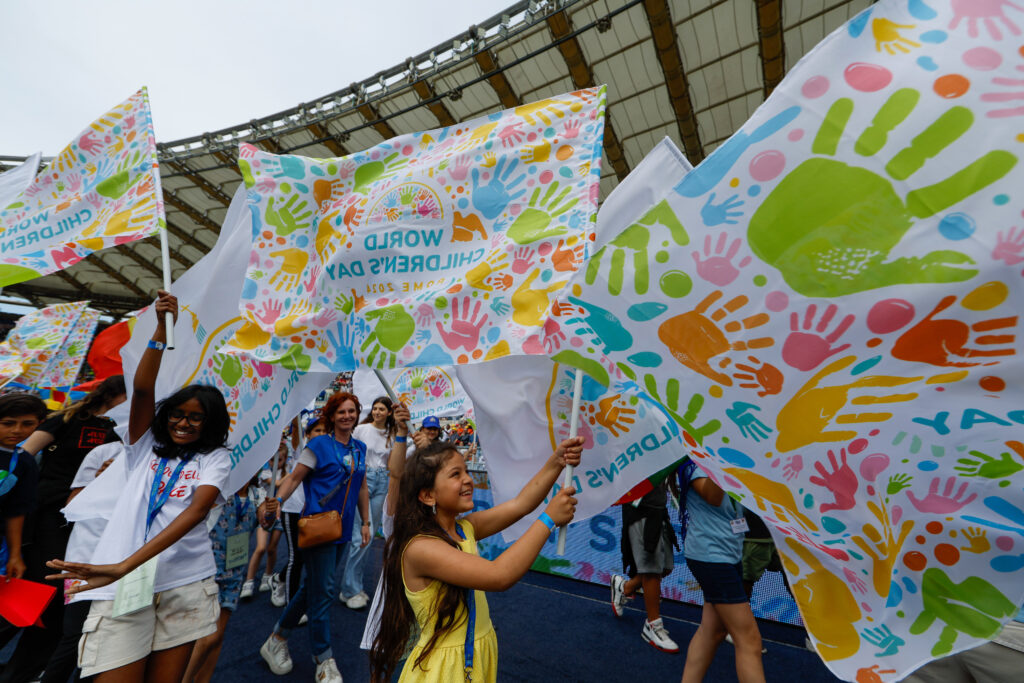
Under a crystalline blue sky in Piazza San Pietro, I joined more than 50,000 young people and their parents and caretakers May 26 for the inaugural World Day of Children Mass. The unofficial history is that a 9-year old child suggested the idea to the pope, who ran with it and established a whole series of events focused on these adolescent dreamers.
On Trinity Sunday, the pope was clearly energized by their presence, laughing and joking with them, and replacing his prepared homily with a question-and-shouted-response introduction to catechesis about the triune God and the role of Mary in our lives of discipleship. After talking about the Father and Jesus, the pope exhorted the crowd over and over again to repeat along with him: “The Holy Spirit accompanies us in life,” which became a sort of mantra. He also made sure that children remembered to pray for things like their parents and grandparents, their peers who are suffering or have disabilities, and for peace around the world.
After the Mass, actor Roberto Benigni from “La Vita e Bella” (“Life is Beautiful”) and “Pinocchio” fame, gave an impassioned monologue asking the children to dream big and to open their hearts to goodness. He said that the Sermon on the Mount was in many ways, “the most sensible thing he had ever heard in his life.” Italian Prime Minister Giorgia Meloni, a former minister of youth herself, was in attendance; her daughter Ginevra met with the pope during the course of the day, as did dozens of other children in various ways.
The pope spent a rather long time circling the piazza in the pope-mobile to exuberant shouts and chants from everyone. It was very evident that he was personally enjoying the lighthearted frivolity and joviality of the day more than some other more somber Vatican events in which I have been in attendance. It’s hard to be overly serious and staid amidst the laughter and squeals of tens of thousands of children, though the Mass did convey, as always, a sacred solemnity when he asked all present to pray in silence together for a few minutes.
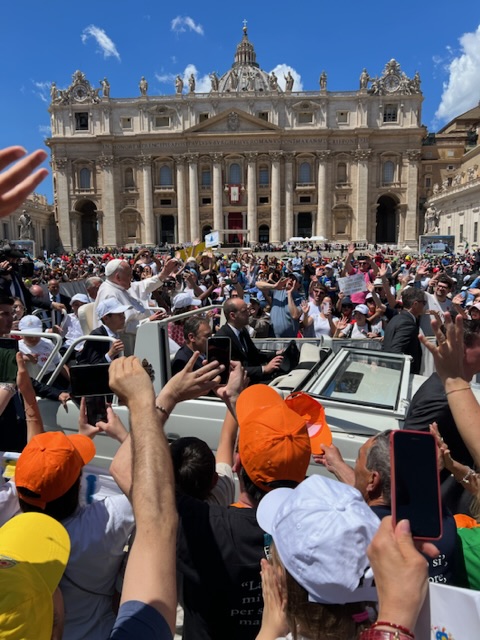
Though I came out of the day with a bit of a sunburn, since I didn’t cover my head with my program or prayer book as most of the kids did, I was thrilled to be present for the first of what will likely become a longstanding tradition in the life of the Church. Pope Francis has said elsewhere that the face of the Church is young, reflecting in some ways the spirituality of Saint Augustine that God is “Beauty – ever ancient, ever new.” We should never conflate the Church with God, who alone demands divine and Catholic faith. (Thus we “believe in” God in a different way than we “believe” the witness of the Church.) But these two sentiments fit together because just as God is not the Zeus-like caricature of a bearded old man zapping people with lightning or cancer, neither is the People of God a series of elderly and sleepy watchmen charged with protecting the relics of a museum. Both God and the community of faithful are vibrant, animated and dynamic protagonists involved in an inter-generational love story that continues in every age. This is echoed in the Gospels: “Unless you change and become like little children,” Jesus states unambiguously, “you will never enter the Kingdom of Heaven.” (Matthew 18:3)
As has come up many times over the course of the current pontificate, Pope Francis does not see children merely as the “future” of the Church waiting their turn to contribute. He has said instead, “You are the ‘Now’ of the Church,” or elsewhere, it’s “Today.” Just as our contemporary day knows movement and change and progress in so many spheres, so, too, do children “go forth” to the ends of the earth in the present, even when they are most in need or most struggling.
That is why the pope repeated in his message to the little ones at the World Day of Children Mass, “Don’t forget this. Jesus forgives everything and he forgives always.” He said the Italian words for “everything” (“tutto”) and always (“sempre”) multiple times each. As long as we have the childlike humility to admit our shortcomings, mistakes and errors, we can turn to the Lord in trust and confidence, “for to such as these belong the kingdom of God.” (Luke 18:16)
An alumnus of Camden Catholic High School, Cherry Hill, Michael M. Canaris, Ph.D., teaches at Loyola University, Chicago.




 at the bottom and then tap “Add to Home Screen”
