



Christ the King Parish’s Morgan Hall, Haddonfield. (Photos by Joe Warner)
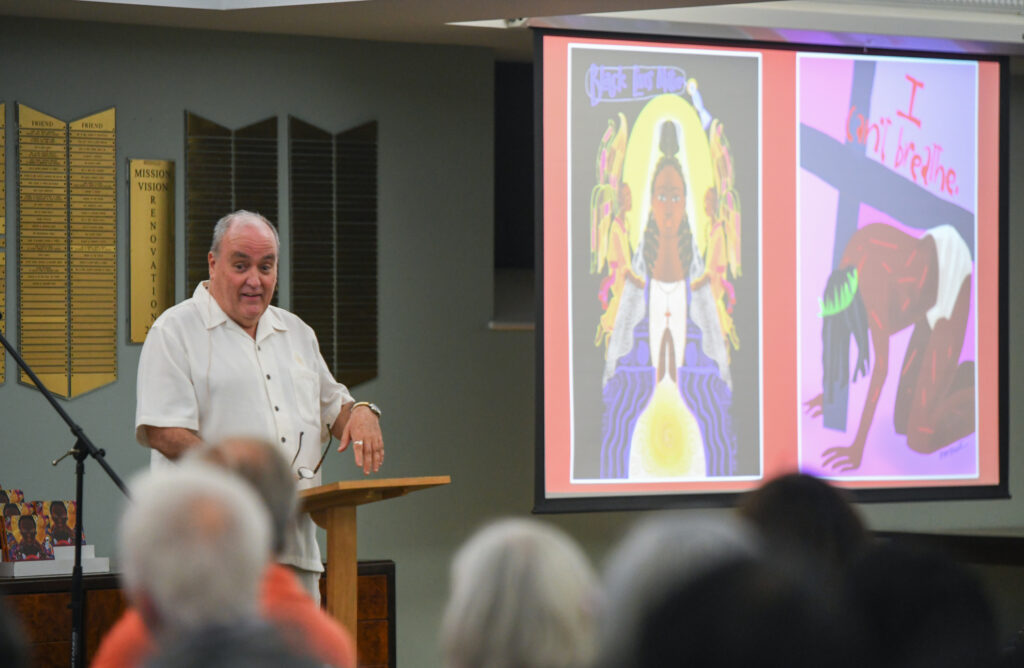
HADDONFIELD – Almost halfway through his Juneteenth presentation, Brother Mickey McGrath brought up a slide of his artwork that elicited gasps and then a powerful, rapt silence from the crowd.
On the left side of the screen, his artwork depicted a Black Virgin Mary, with the words “Black Lives Matter” written above and the light of Christ in her womb. On the right, his art of Jesus falling with the Cross and the words “I can’t breathe” – words spoken by George Floyd before his 2020 death while in police custody.
PHOTO GALLERY: Juneteenth Through Art & Music
These images – stark and challenging yet reminding all of the power that overcomes evil in all its forms – were demonstrative of the Oblate of Saint Francis de Sales’ mission to prove, through art and story, that “we are all one in Christ Jesus.”
“I have a lot of uncomfortable stories to share, but even more so, a lot of hope-filled ones,” Brother Mickey said.
More than 100 faithful, clergy and diocesan staff of various races, cultures and ages gathered June 19 at Christ the King Parish’s Morgan Hall to celebrate Juneteenth, which marks the 1865 abolition of slavery in Texas, and more generally, the ending of slavery in the United States.
Through paintbrush and word, Brother Mickey shared the stories of women and men who faced discrimination and struggle.
There was Saint Teresa Ávila, mystic, Carmelite nun and Church reformer, depicted at Jerusalem’s Western Wall, because “we put walls around each other,” Brother Mickey said. Born in the 16th century, Saint Teresa was the daughter and granddaughter of conversos – Jews who converted to Catholicism under pressure from the Spanish monarchy.
Another of his drawings showed Pope Alexander VI, who issued a papal decree authoring Spain and Portugal to colonize the Americas and its Native peoples as subjects.
Brother Mickey shared the stories of the Kongolese Freedom Fighters, who led the Stono Rebellion in South Carolina in 1739. Invoking Mary as their protector, the Black Catholics set out for Florida and freedom on September 8, the feast of the Nativity of the Blessed Mother, and serve today as examples of faith and courage amidst struggle and oppression.
One of his personal heroes, Brother Mickey said, is Venerable Mother Mary Lange, who co-founded the Oblate Sisters of Providence in 1829, the first religious congregation of Black women in the Church. Ministering in Baltimore in the days of slavery, she educated Black youth, offered career development classes for women, and operated homes for widows and orphans.
He echoed her words in one of his paintings: “I believe in God. I hope in God. I want to live and die for God.”
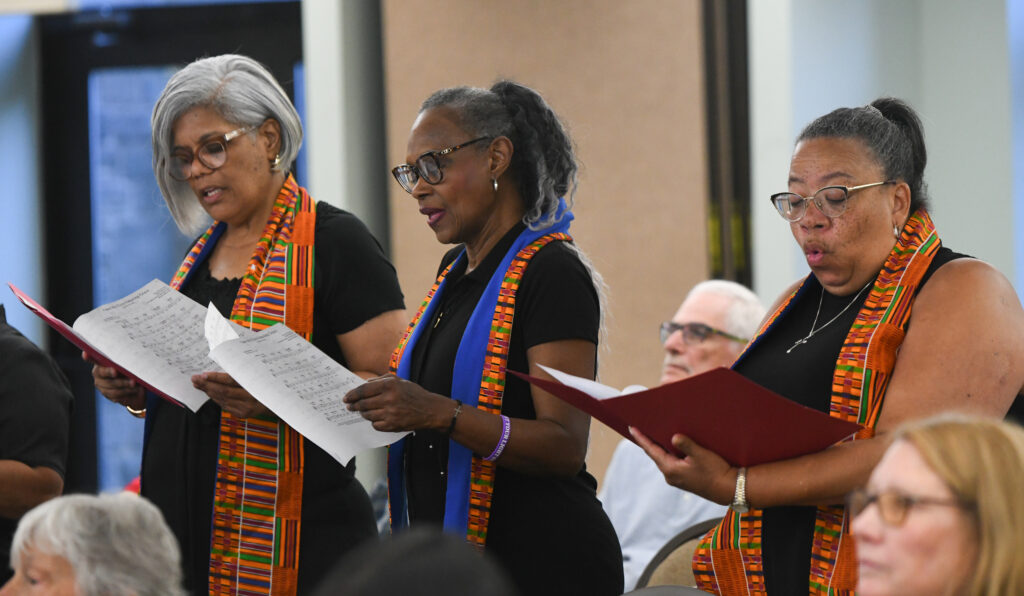
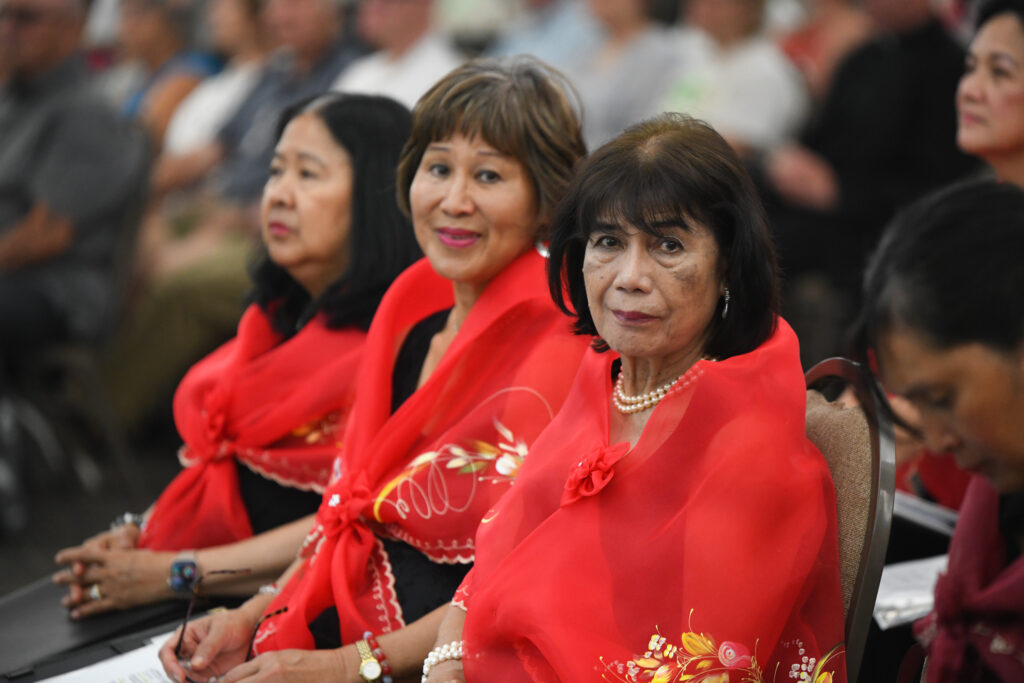
In-between Brother Mickey’s words were the united voices of the Diocese’s Filipino Choir; the Gospel Choir of Saint Bartholomew Church, Sacred Heart Parish, Camden; and the choir of Our Lady of Guadalupe Parish Shrine, Lindenwold, all of whom sang inspiring tunes such as “Amazing Grace” and “Hold On to Love.”
Father Vince Guest, pastor of Camden’s Sacred Heart Parish, Camden, and coordinator of the Black Catholic Ministry Commission and Racial Justice Commission for the Diocese of Camden, which sponsored the evening, called the Juneteenth celebration “critically important to come together as a family of faith and celebrate our diversity.”
“Days like this allow us to know our history and celebrate that freedom from slavery … [to] grow, to eradicate prejudice and racism that still exist in our Church and communities.”
Looking around the room, he expressed pleasure at seeing “Asians, Black Americans, European Americans, Africans, African Americans … coming together in conversation” and camaraderie. Everyone present are markers of “the joy of us being together as a family of faith. We’re better when we’re together,” he said.
Thanking Brother Mickey for “giving us something to think about,” Cheryl Wright, chairwoman of the Black Catholic Ministry Commission, said she hoped all those who attended would remember how not only her ancestors, but those of so many, were treated throughout history. “Yet they still survived, they continued, they believed in God. Out of the horrific things that happened, they gave thanks to God, and we give thanks to God, because we’re here.”




 at the bottom and then tap “Add to Home Screen”
