






Like October, with its feast of the Holy Rosary, and May, with its spring festivals and crownings of the Virgin, August contains a number of Marian devotions that draw our mind to the Mother of God’s role in the Catholic tradition.
The most familiar of these bookend the octave between Aug. 15 (the Assumption) and Aug. 22 (the Queenship of Mary). The latter is particularly tied to the storied Latin hymn, the “Salve Regina,” which is usually translated into English as “Hail, Holy Queen.”
Though not a particularly ancient universal feast (Pius XII established it in 1954), there are longstanding roots to recognizing the connection between the royal and maternal roles that the mother of Jesus inhabits for believers.
Art all over the world has attested to these aspects of Mary for millennia. The most powerful expression is probably found in the prayer known as the Magnificat, where Luke communicates through his text of Mary many of the themes that dominate his account of Christ’s life, mission and reign throughout his Gospel and the connected Acts of the Apostles.
Mary there exclaims: “My soul proclaims the greatness of the Lord, my spirit rejoices in God my savior. For he has looked with favor on his lowly servant.” Later, Mary paints more vividly what exactly this favor looks like: “He has scattered the proud in their conceit. He has cast down the mighty from their thrones, and lifted up the lowly. He has filled the hungry with good things, and the rich he has sent away empty.”
If there is one consistent theme running through this prayer, and thus in many ways through Mary’s sovereign role as Queen of Heaven and Ruler of the World (Regina Mundi), it is the embodiment of what theologian Paul Lakeland once called “ecclesiological humility.”
The root words for “humble” and “human” are connected, both coming from the word humus, or “earth.” It is the inverse of “hubris,” which is rather connected to the Greek word for “excessive pride,” and ultimately “violence” against the gods or one another.
The prayers and hymns coming from Mary’s own lips, and those we express in veneration of her, very often refer to her “lowliness,” which may seem a contradiction in terms with proclaiming her majesty and nobility in titles like Queen or even Lady/Madonna/Domina. However, Mary holds authentic humility and royal dominion together in her personhood in much the same way that as the first and perfect believer, and mother of the Church, she holds together the inward and outward impulses of mission (“out” of the community) and healthy internal structural reform (“within” the community).
Being truly humble, as a person and as a body of believers, implies a willingness to be genuinely reciprocal. Mary’s queenship is not set over and against the pilgrim people of God, but rather incorporated into their dynamic empowerment, in a free exchange of gifts. That is the reason the Psalms tell us: “the Lord crowns the humble with victory.” (Ps. 149:4)
Jesus himself says, “For those who exalt themselves will be humbled, and those who humble themselves will be exalted.” (Mt 23:12) If we hold him at his word, when we recognize Mary’s exalted status in Paradise, then we somehow always simultaneously recognize her humility.
Yet, Mary’s humbleness and modesty do not manifest an empty vessel spirituality, where she has nothing to offer or somehow submissively abandons any claim to her dignity and personhood. The fiat (or “Yes”) that changed human history enabled her to be not less, but more fully herself, in constant and unencumbered touch with the ground of divine being that is the origin and destiny of every human person. Not merely yielding and deferential, she is, rather, the model for all real and legitimate revolutionaries. Thus, the Assumption and coronation are in some aspect preludes to what we profess each week in the Creed, when hopefully we, too, will be raised body and soul into the life of the world to come, and crowned with the imperishable garland of victory, alongside she who is “super omnes speciosa” (“lovely beyond all others”).
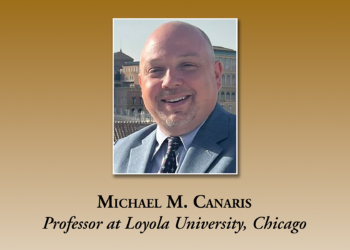
An alumnus of Camden Catholic High School, Cherry Hill, Michael M. Canaris, Ph.D., teaches at Loyola University, Chicago.



 at the bottom and then tap “Add to Home Screen”
