




By D.D. Emmons
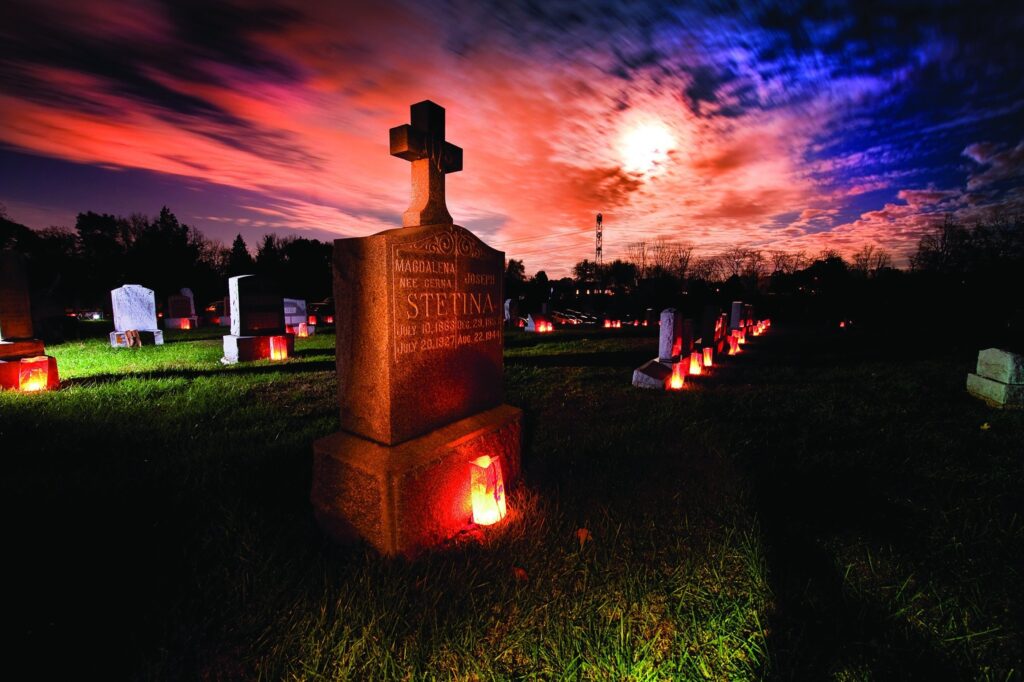
It seems unusual that the Catholic Church’s liturgical calendar schedules two major celebrations on days that are back-to-back. But that is precisely the situation with the solemnity of All Saints on Nov. 1, a liturgical feast, and the Commemoration of the Faithful Departed on Nov. 2 – All Souls – a liturgical observance.
During these early November celebrations, those of us still living (the “church militant”) unite our hearts with, and in a special way remember, the faithful departed, whether they be in heaven (“church triumphant”) or in purgatory (“church suffering”).
All Saints’ Day, which began most likely as All Martyrs’ Day, can be traced to the earliest Christians. By the third century, the followers of Christ were annually honoring their brothers and sisters who had given their lives (martyred) while witnessing for and defending Jesus Christ. Typically, on the anniversary of a martyr’s death, those living would gather to remember and offer prayers at the tomb or place where the deceased had died.
Tombs were sometimes decorated and altars built over the tomb. According to Church historian Henry Chadwick, “From the third century, the anniversary of a martyr’s death, called his ‘birthday,’ was commemorated at his grave by a celebration.”
The belief among the first Christians, which continues today, is that believers who died defending Christ were borne by angels to heaven and are face-to-face with the living God, in the presence of the beatific vision.
Today, All Saints’ Day is a solemnity and holy day of obligation on which the universal Church honors the martyrs, the saints and the confessors, including all known and unknown, all who have gained the reward of heaven.
All Souls’ Day evolved onto the Church calendar long after All Saints’ Day. Sometime between 998 and 1030, Saint Odilo, the abbot at the Benedictine monastery in Cluny, France, encouraged all the monks to pray for the souls of those who had died, those awaiting the joys of heaven. He instituted this commemoration on the day after All Saints’ Day, and soon other religious orders and churches began, on that same date, to annually remember all who had died.
Remembering and praying for the faithful departed is tied directly to Catholics’ belief in purgatory. On All Souls’ Day, the universal Church prays for all those in purgatory, people who were much like us, whose offense may have been less than ours. By pleading for them, we are inspired to lead purer lives.
On that day, and during the entire month of November, we remember the departed – those close to us and those we may have neglected during the year.



 at the bottom and then tap “Add to Home Screen”
