




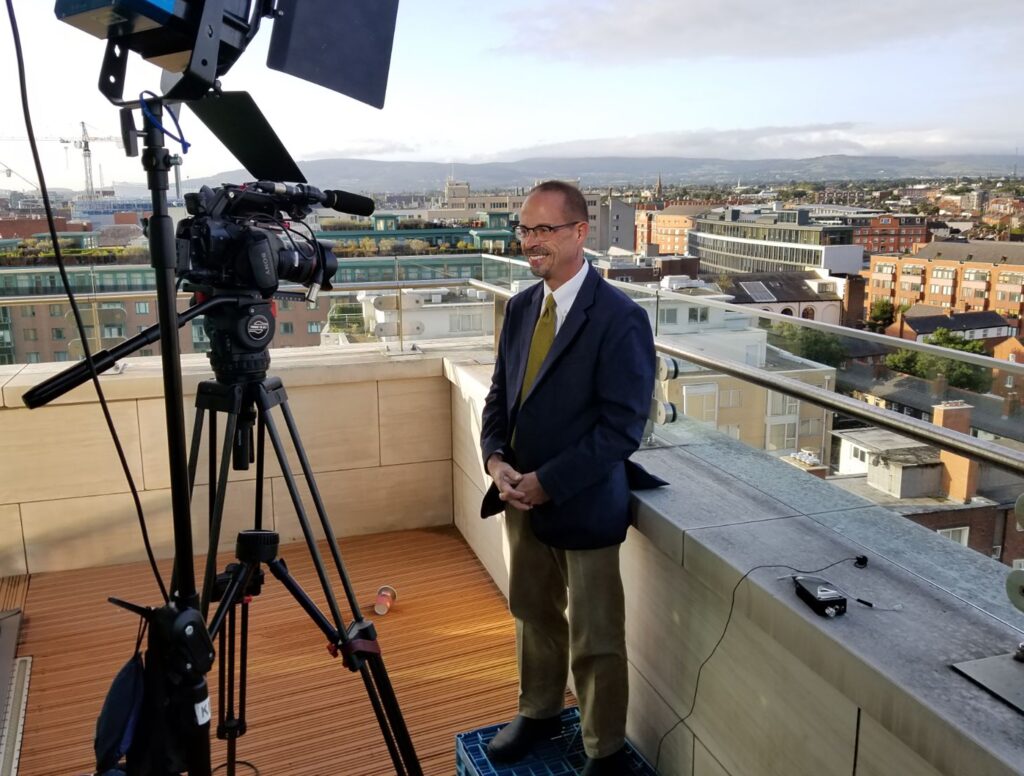
Last week marked the passing of the unofficial but widely recognized “dean” of Vatican journalists in the English-speaking world, John Allen. The former National Catholic Reporter and Boston Globe reporter, who then ran Crux as CEO and editor-in-chief for a decade, passed away Jan. 22 from cancer a few days after his 61st birthday.
While certainly not among his inner circle of close friends, I was always thankful that John was so gracious to me, regularly hosting conversations with my graduate students in the summer, usually connected in some way with our mutual affection for the Lay Centre community. His wife, Elise Ann Allen, senior Rome correspondent for Crux, recently penned a groundbreaking biography of Pope Leo after a series of interviews with the Holy Father, along with a moving tribute to her late husband that I would encourage people to find online.
In remembering John, it struck me that many of the qualities that seem to be defining Pope Leo were the same that drew audiences to John. Chief among these were a willingness to listen carefully and thoughtfully to those he encountered, an encyclopedic fluency in the intricacies of Vatican structures and minutiae, and a commitment to breaking through the familiar ideological camps that are such a part of our political and ecclesial lives in the 21st century. John was broadly respected precisely because he wrote and spoke in ways that transcended well-worn “partisan” divides.
Pluralism and complementary theological perspectives have in fact been part of Christianity since the followers of Jesus first told others about the Resurrection. It’s why there are four Gospels instead of one. Finding a way to work through existing polarities, even when parties have a great deal of emotional or spiritual investment in whatever is at stake, is a constitutive element of belonging to a believing community.
A popular folk hymn in the 1960s written by Father Peter Scholtes argued, “They’ll know we are Christians by our love.” The refrain was reformulated from what was reportedly an ancient assertion that the bonds that connected the community mysteriously continued to magnetically attract new members. “Behold, see how they love one another” was in many ways tied to the Carthaginian theologian Tertullian’s claim that “the blood of the martyrs is the seedbed of the Church.” This is because the mutual concern that forged the relationships with one another and with Jesus Christ in the early Church could not be extinguished even with waves of terrible persecutions. It was precisely their care for one another and willingness to die for the faith that caused people to investigate what exactly was afoot here two millennia ago, with a newly opened mind to conversion.
John Allen and Pope Leo XIV seem to me to be arguing that we need to recapture some of this spiritual charism, and realize that those either within the Church – or in other walks of life around the globe who differ from us in various ways – are not first and foremost our enemies. Their willingness to talk to just about anyone in the hopes of coming to a clearer understanding of divergent perspectives can teach us all a lesson in these times of intense tribalization and fuming finger-pointing. Both of them have, in a sense, taken seriously the charge to teach an entire generation what it means to be part of the Catholic Church.
I pray that the peace that surpasses this world – which believers pray in sure and certain hope – now enfolds John Allen. I also pray that this peace – which the pope consistently preaches to a world too often plugging its ears to such a message – be shared in small but lasting ways with those of us still longing and laboring for it here on earth.
An alumnus of Camden Catholic High School, Cherry Hill, Michael M. Canaris, Ph.D., teaches at Loyola University, Chicago.




 at the bottom and then tap “Add to Home Screen”
