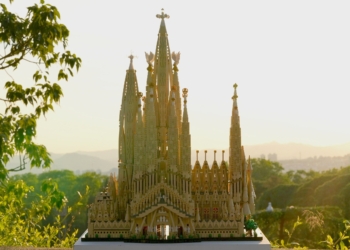





Hagia Sophia, one of the most beautiful and older edifices in the world, continues to draw attention as yet another chapter in her tumultuous history unfolded this past week with it being converted once again into a mosque this past July 24. It is yet another hiccup in the difficult and sometimes violent relationship between Christianity and Islam over the many centuries. Orthodox Christians from throughout the world decried the decision by Turkish President Recep Tayyip Erdogan to return Hagia Sophia back to a mosque after an 86 year designation as a museum dedicated to fostering interfaith unity. Many feel that it was a political move by the Turkish president to curry favor from Muslim voters. The conversion back to a mosque also received worldwide condemnation by the UNESCO World Heritage organization, world leaders and various church bodies. Pope Francis said it caused him “great sadness” upon hearing of the conversion back to a mosque.
Orthodox bishops throughout the world observed a day of mourning on July 24. They lamented the return of the Hagia Sophia to a mosque, built in 537 AD as the cathedral of the Ecumenical Patriarchate of Constantinople, captured and converted into a mosque in 1453 AD, and designated a museum in 1934 by the new Turkish government.
Orthodox believers were asked to pray the ancient Akathist Hymn at the same time that the Muslims are chanting their first prayers at the Hagia Sophia that Friday morning. The Akathist is a devotional chant dating back to at least 600 AD. The hymn sings the praise of the Virgin Mary, Mother of God, the Theotokos, and was often invoked to protect the city of Constantinople, now Istanbul, from any danger. It is commonly chanted in Orthodox churches during the five Fridays in Lent and is considered a spiritual preparation for Holy Week and Easter.
Here in the U.S. the Greek Orthodox Archdiocese of America issued a statement, in part calling the conversion a “program of cultural and spiritual misappropriation” which consists of “a violation of all standards of religious harmony and mutual respect.” The United States Conference of Catholic Bishops announced that they were joining the Greek Archdiocese of America in observing a “day of mourning” on July 24 for the Hagia Sophia. They invited all faithful Catholics to join them in the day of mourning, asking that “every church toll its bells, every flag be raised to half mast and that the Akathist is chanted or the rosary recited in the evening.” Our own Bishop Sullivan wrote a letter of support to Orthodox Archbishop Evangelos, Archbishop of New Jersey and the Mid-Atlantic States, in part saying, “be assured that you, my brother Bishop, your faithful Orthodox of the Metropolis of New Jersey and the pan Orthodox community, remain in my prayers for healing during this difficult time for you all.”
Just released was a Syrian government announcement that it will build a replica of the Hagia Sophia in the city of Suqaylabiyah in the Hama province of Syria. More than 17,000 residents of Suqaylabiyah are Greek Orthodox.
Talk of creating a replica of Hagia Sophia began in mid-July when a leader of the pro-Syrian government National Defense Forces militia, Nabeul Al-Abdullah, announced his donation of a plot of land for the implementation of the project. Russia has stepped forward in announcing that it will help the project financially.
Russian support for the construction of a Syrian Hagia Sophia was confirmed by a Russian official Vitaly Milonov. He said Moscow will provide funding for the project “to show the importance of ‘peaceful dialogue’ between faiths.” He added, “Unlike Turkey, Syria is a country that clearly shows the possibility of peaceful and positive interfaith dialogue. President Bashar al-Assad would never transfer a cathedral from one denomination to another. This will truly be a landmark event for all Orthodox people: I am sure that every Orthodox Christian wants his name to be inscribed in at least a stone or brick of the new Hagia Sophia.”
The conversion of the beautiful Hagia Sophia is rife with political and religious intrigue and angst. Turkey has unleashed a torrent of emotions by this unilateral decision that should have included a wider discussion among leaders of Christianity and Islam. Let us pray that open dialogue that respects the spiritual sensibilities of all Turkish citizens and religionists returns to bring about greater peace in our world today. May Mary, the Mother of God, the Theotokos, intercede for a peaceful solution.




 at the bottom and then tap “Add to Home Screen”
