


Sitting with our good friends from Mexico recently sipping Micheladas (a sort of beer-based Latin version of Bloody Marys), the conversation meandered from the conclave into the popular May 3 celebration known as the Fiesta de las Cruces (Festival of the Crosses).
Though I know the basics of the story, I connect it more with the Sept. 14 feast of the Exaltation of the Holy Cross in the current liturgical calendar. But I was particularly struck by the stories, and my own subsequent reading, about how construction workers there often mark this unique feast with prayers and the erection of decorated crosses on their building and worksites.
It’s well known that the mother of the first Roman emperor Constantine, whose name in English is usually translated as Helen or Elena, visited the holy sites associated with Jesus in the 320s AD and, since she had the full Roman army at her disposal, brought some of the relics she found back to Rome. These traditionally include instruments of the Passion, the steps on which Jesus was condemned by Pontius Pilate, and even the finger of doubting Thomas, which may or may not have been thrust into Christ’s wounds (as the Scriptures never say he actually did what Jesus suggested before crying out “My Lord and my God”). Most prominent among the artifacts she found was the Cross of Calvary. Three centuries is likely not long enough for people to have forgotten the historical areas where certain events happened, and so most scholars give at least some plausibility to the veracity of her reconnaissance.
The May 3 date apparently dates to a sliver of that same cross being brought back to Jerusalem by the Byzantine emperor Heraclius in 629. The Celtic and Gallic marking of this event became associated with the celebration of “Roodmas,” with “rood” being an archaic term for the “rod” on which the Savior of the world was hung. Thus, this remembrance of the Finding or Re-Finding (or sometimes strangely called the “Invention”) of the True Cross in May still grips the imaginations and colors the popular piety of believers in numerous places like Spain, parts of Latin America, the Philippines and Scotland.
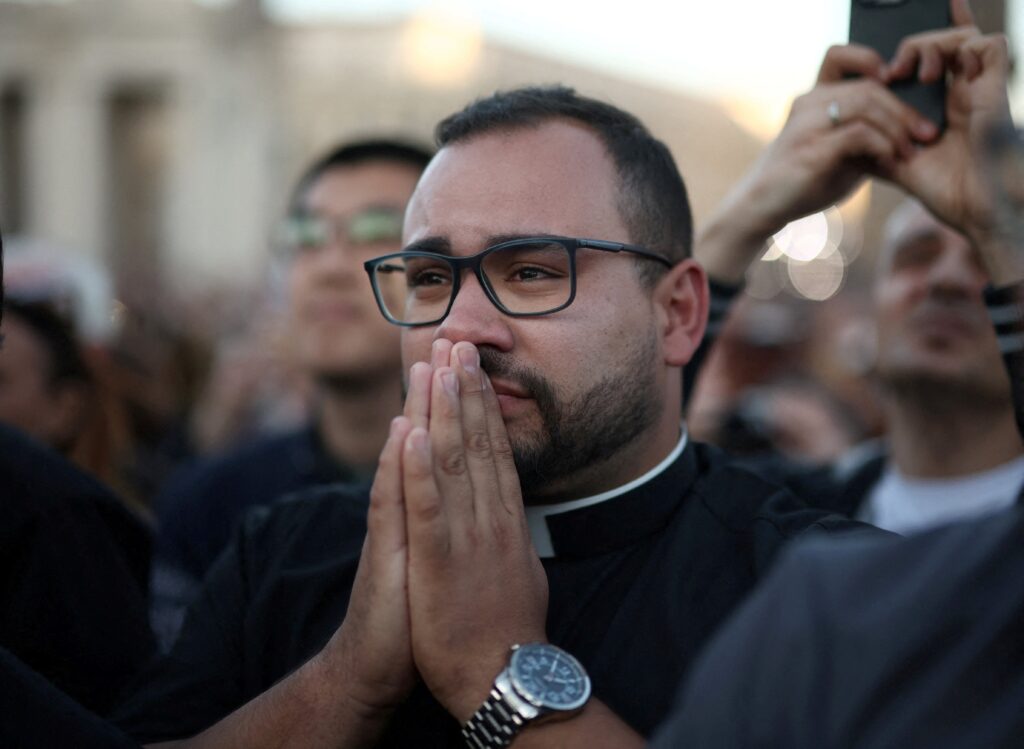
By the time this goes to press, we will likely have a new pope or will be on the verge of such historical developments. Many of the world’s prayers are rightly directed to the Holy Spirit, who in the words of John Henry Newman “does nothing in vain. He knows what he is about.” But I encourage all of us to also realize what a crushing burden and very likely lifetime cross is about to be laid upon someone’s shoulders.
Pope Francis booked a roundtrip ticket to the 2013 events and was never destined to set foot in his native country again on this side of eternity. Long since passed are the days when the office reflected the infamous claim: “God has given Us the papacy, let Us enjoy it.” The global, ecclesial and ecological problems facing the new successor, not of Francis, but primarily of the Galilean fisherman, need not be enumerated here. But I think all can agree are certainly legion. It is only in emulating Christ’s willingness to embrace His Cross that any reasonable person could, with dry mouth and churning stomach, respond with a clipped “Accepto” to such a chalice.
I find it completely relevant that the Fiesta de las Cruces glorifies not a masochistic reveling in suffering, but instead the dignity of workers, co-laboring for the good of society and the projects through which they earn their bread with the sweat of their brow. May our next Holy Father exert himself with all his heart, soul, strength and mind to preach and live out the Gospel in a world in dire need of the saving, authentic, and liberating message of the Cross and its inseparable connection to the empty tomb.
Stat Crux Dum Volvitur Orbis. (“The Cross stands while the world turns.”)
An alumnus of Camden Catholic High School, Cherry Hill, Michael M. Canaris, Ph.D., teaches at Loyola University, Chicago.




 at the bottom and then tap “Add to Home Screen”
