





On Feb. 11, the Church celebrates the memorial of Our Lady of Lourdes. This commemorates the first of several apparitions of Our Lady in southern France to a poor girl, Saint Bernadette Soubirous.
During one of those encounters, the Blessed Mother asked Bernadette to dig in the ground and uncover a fresh-water spring, which, even to this day, has miraculous healing powers. In fact, thousands of healings have been reported to have occurred there in the past 168 years, 80 of which have been verified by thorough medical investigations to be genuinely miraculous, that is, unexplainable by natural science.
In 1992, Pope Saint John Paul II designated Feb. 11 as World Day of the Sick, “a special time of prayers and sharing, of offering one’s suffering for the good of the Church, and of reminding us to see in our sick brothers and sisters the face of Christ, who, by suffering, dying, and rising, achieved the salvation of humankind.” (Letter instituting the World Day of the Sick, 13 May 1992)
How fitting he should have done so, for on May 13, 1981, the memorial of Our Lady of Fatima, the Holy Father came very close to death after having been shot by a would-be assassin in Saint Peter’s Square. One bullet struck him in the left index finger and another in the abdomen, narrowly missing major organs. He suffered a severe loss of blood. In fact, if the bullet had continued on its trajectory, it would have certainly struck major organs, but as the Pope later claimed, a “motherly hand” deflected the near-fatal shot at the last moment. Exactly one year later, on May 13, 1982, Pope John Paul II placed the bullet that almost killed him in the crown of the statue of Our Lady at Fatima in Portugal.
When he was elected to the papacy in 1978, Karol Cardinal Wojtyla – at the age of 58 – was known to have been a very robust, athletic man who enjoyed skiing and hiking. But after his near-brush with death two years later, the pope was a changed man, never quite fully recovering. He suffered with ever-worsening arthritis, and Parkinson’s disease in the last several years of his pontificate. It was thus inevitable that he should develop an affinity and sympathy with the sick. It is no wonder that he named the memorial of Our Lady of Lourdes as World Day of the Sick.
Serious illness and general physical debility is such a personal experience that one who suffers often feels quite alone. This fact remains even though many good people express empathy and try to offer their help and support. Also, no two conditions of sickness, even though they share similarities, are ever exactly the same. Jesus understands that perfectly well, as his suffering on the Cross was the most unique and intense of anything ever endured by anyone. Also, it has been said that the worst suffering of the crucified Christ was the feeling of utter loneliness and desolation as he felt the pangs of every sin ever committed.
When one is stricken with a serious sickness, the first question usually asked is: “Why? Why me? What did I ever do to deserve this?” How close the one afflicted is then to our crucified Lord, who cried out the same question as he hung dying on the Cross, “My God, my God, why have you forsaken me?” (Mt. 27:46)
Theologians attempt to give an explanation by talking about original sin and how it has permanently marred the perfection of God’s creation. Such a cerebral explanation leaves us dry and dissatisfied, maybe even angry. Where is your heart, dear God?
It is not surprising that Saint John Paul II wrestled with those issues too, and he expressed his thoughts on the meaning of human suffering in an apostolic letter in 1984. In it he wrote: “Christ does not explain in the abstract the reasons for suffering, but before all else he says, ‘Follow me! Come! Take part through your suffering in the work of saving the world, a salvation achieved through my suffering! Through my Cross!’ Gradually, as the individual takes up his cross, spiritually uniting himself to the Cross of Christ, the salvific meaning of suffering is revealed before him. He does not discover this meaning at his own human level, but at the level of the suffering of Christ.” (“Salvifici Doloris,” paragraph 26)
The beauty, therefore, of our Catholic teaching on suffering is that it is not useless but meritorious. So, while Jesus did not answer the question why about suffering, He did indeed answer the question how, that is, how we are to deal with it by uniting our suffering to His on the Cross for the salvation of the world.
When Jesus cried out his plaintive why to the Father on the Cross, He was quoting Psalm 22. While it begins in desperation, it concludes with hope: “The Lord has not spurned nor disdained the wretched man in his misery. Nor did he turn his face away from him. But when he cried out to him, he heard him.”
It is thus so important to remember that there is always hope for those who are sick and suffer.
World Day of the Sick is Wednesday, Feb. 11.
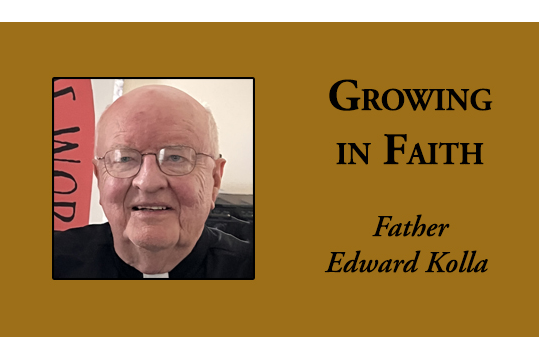
Father Edward Kolla is a retired priest of the Diocese of Camden.



 at the bottom and then tap “Add to Home Screen”
