








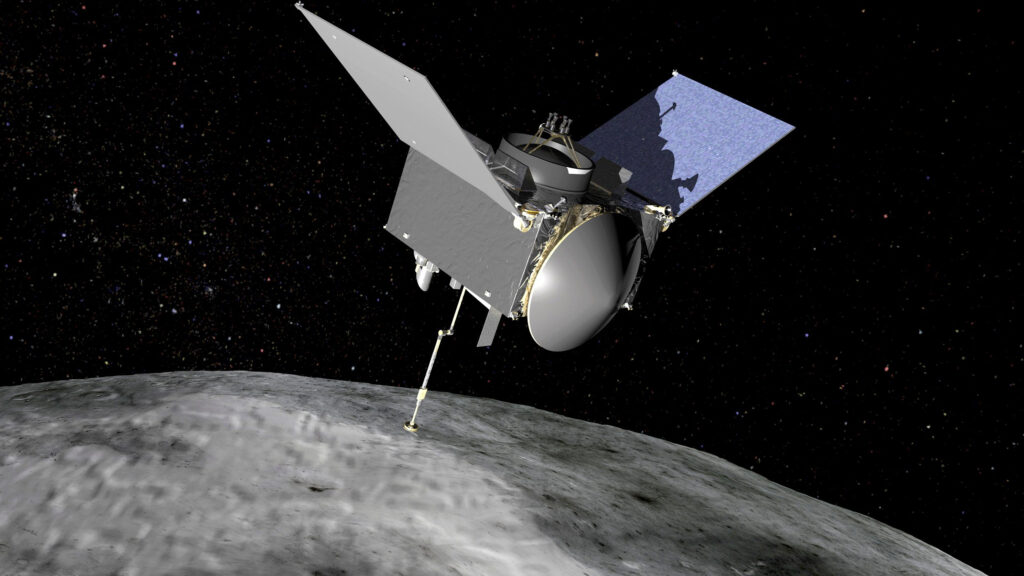
On Sunday, Sept. 24, while many of us were attending Mass or gathering with family and friends to watch a game or relax, an important milestone took place in American history. For the first time, our nation was able to extract and return a sample from an asteroid for scientists here on the earth to study.
The team working with OSIRIS-REx, short for “Origins, Spectral Interpretation, Resource Identification, Security-Regolith Explorer,” were able to transport the sample from deep space first to the Utah Test and Training Range, and then later to NASA’s Johnson Space Center in Houston. Scientists will be able to advance their understanding of the universe’s origins, development and makeup by studying the 250 gram sample collected by the Jetsons-sounding explorer.
The next attempt will be to take further collections from Apophis, which could be of even greater significance. That near-earth object categorized as number 99942 was eventually renamed Apophis after the mythological Egyptian deity of chaos and destruction. That apocalyptic moniker was intentional, as it is one of the objects most likely to eventually collide with earth. Careful mathematical formulations have convinced scientists that we are in the clear for at least a century, but that is much less than the blink of an eye in cosmological time. Estimates given its size and speed suggest that an impact would cause destruction over a million times more powerful than the energy released by the nuclear bombs dropped on Hiroshima and Nagasaki.
As we know from the quantity of matter moving about in space at high velocities and from previous impacts like the one that wiped out the dinosaurs and set the stage for mammals to develop as the preeminent intelligent species on the earth, it is a matter of “when” not “if” other objects will strike our planet’s surface. On average, scientists estimate this happens once every 80,000 years, but of course with irregularity and not in perfect cyclical patterns. Since all of recorded human history has taken place over the last 6,000 years, this means it has unfolded largely without such a massive disruption as an asteroid impact would cause.
When pondering this timeline, Christian cosmology offers a different version of creation than many of the mythical accounts of the ancient world. In other traditions, very often some kind of pre-existent matter was given form and shape by a pantheon of deities or powers, frequently in dualistic conflict with one another. But Christian philosophers interpreted the Scriptures to mean that creation was not a re-ordering of a prior reality, but instead occurred ex nihilo, or “out of nothing.” A loving and intentional God created everything that exists outside of His own divine ineffability, including at least the condition for the possibility for what we would eventually recognize as vultures, and viruses, and vending machines and also of time itself.
The triune God creates deep time across billions of years; He is not a developmental product of it. And creation is from a theological perspective not a past phenomenon that took place in the distant and misty origins of the galaxies by a deist divine clockmaker, but instead continues apace today when everything that exists participates in the creative “Being-ness” of God, lest it immediately fall into “non-Being.” That is why Christians recognize God as the only non-contingent Being, whose essence is His existence and vice versa, as Saint Thomas Aquinas put it.
There are thorny theological questions at play when considering such scientific discoveries: the intersection of chance and providence, of species death and intercessory prayer, of divine design and free will, of Christ’s humanity and our potential stewardship of a vast created reality that we cannot ultimately hope to control. But Christians in the 21st century are children not only of Revelation, but also of the Enlightenment. John Paul II said as much when he wrote “Faith and Reason are like two wings on which the human spirit rises to the contemplation of the truth.”
Today, those wings cooperate to take us as a global race not only toward the limits of the earthly horizon, but even beyond them into the grand and mysterious darkness of space, to meditate more fully on the Psalmist’s claim that “the Heavens declare the glory of God, and the sky proclaims the work of His hands.” (Psalm 19:1)
An alumnus of Camden Catholic High School, Cherry Hill, Michael M. Canaris, Ph.D., teaches at Loyola University, Chicago.






 at the bottom and then tap “Add to Home Screen”
