



By now, readers are likely aware that Pope Leo XIV, previously known as Cardinal Robert Prevost, has roots stretching from Chicago to Philadelphia to Peru’s Lambayeque region at the foot of the Andes. In his new role, he has decided to keep the basic coat of arms and motto he used as bishop of Chiclayo, Peru, and then through his curial position in the Dicastery for Bishops. These images and words may quench some of the globe’s apparent thirst for information about the man inheriting Saint Peter’s Chair.
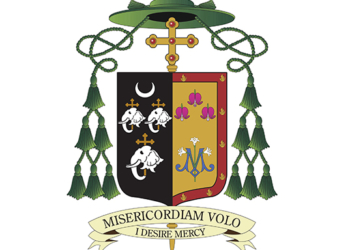
The coat of arms is divided, with the upper section showing a simple fleur-de-lis, in a nod to the Virgin Mary’s purity in her role as the Mother of the Church, to whom he is very devoted. He also has New Orleans and even freed Black Caribbean creole roots, though this was apparently little discussed in his personal family life, compared to his French paternal grandparents. He also made his first visit outside of the Vatican to an Italian shrine of Our Lady of Good Counsel in his first hours as pope, verifying that this devotion is still central to him. All these threads seem to come together in the symbol.
More unique is the lower half, with a pierced and flaming heart resting atop a book. As the first pope from the Order of Saint Augustine, this image draws to mind the fifth century bishop from Hippo, whose conversion experience he described as having his heart pierced by the Word of God.
If there are two texts to guide people who want to know the new Papa León, they would seem to be Saint Augustine’s “Confessions” and Pope Leo XIII’s 1891 encyclical, “Rerum Novarum” – which in English is either translated as “On New Things” or sometimes as “Concerning Revolutionary Change.” The first is a soul-searching psychological and deeply spiritual memoir that has rightly earned its place as a classic of Christian theology. The second deals with the Church’s engagement with the dawn of the contemporary world, and its many ills, launching what has come to be called Catholic social teaching. Both seem to be front and center in these early days of the pontificate.
The Bishop of Rome has also decided to keep a bishop’s mitre atop the coat of arms rather than a regal papal tiara, as have his two immediate predecessors.
The words beneath the crest are even more intriguing. “In Illo uno unum” is a profound and relevant sentiment speaking to our current moment. Taken from Saint Augustine’s reflection on Psalm 127, it reads, “In the One, we are one.” It has some echoes then to another familiar Latin phrase we see in secular life: “E Pluribus Unum,” or “Out of many, one.” Both highlight the unity that holds a diverse and disparate body together in some ways. The latter in terms of civic bonds, the former in spiritual ones.
It seems to me that is not scandalous to say that we live in a state of tribalism and toxic political division, not only in the United States, but across the globe. Yet, I believe in my heart that people today long deeply for a unity that neither absorbs nor annihilates all difference. This does not mean uniformity, but rather fullness of being in genuine relationship – as theologians have long expressed about the Trinity. This new pope has spent his first days in office speaking about building bridges, and highlighting communion, participation and mission – clear imperatives flowing from Pope Francis’ vision of a synodal Church. As the great bishop and doctor of the Church, Saint John Chrysostom, put it: “Church and synod are synonymous.”
In this new papal motto (or new use of his existing motto), we see clearly an eagerness to draw people of different backgrounds, contexts, perspectives and opinions together in a unity of the human race across geographical, cultural and socio-economic divisions, in the overarching unity of the Transcendent God.
The world will wait to see what Pope Leo XIV says through word, gesture and image. But these early days certainly set a tone – who can forget Pope Francis paying his hotel bills in person and visiting the Italian island of Lampedusa to decry a “globalization of indifference?” Though the new Holy Father’s heraldic shield and Latin motto do not tell us everything we may want to know about his priorities or plans, they might give a close observer a small glimpse into where we might be headed as a Church community in the years, and potentially decades, ahead.
An alumnus of Camden Catholic High School, Cherry Hill, Michael M. Canaris, Ph.D., teaches at Loyola University, Chicago.




 at the bottom and then tap “Add to Home Screen”
