


As the father of two young children, Leo Flynn admits he is concerned for the Catholic Church.
It’s one reason why he wanted to be part of the synod committee in his parish, Saint Thomas More, Cherry Hill.
“This synodal process is the way forward for the Church – to strengthen it from within but also to grow it, especially as times keep changing and challenges keep evolving,” Flynn said. “Part of my responsibility as a parent is for my children to be raised in the Church. How can I sit back in good faith and not get involved when I see the Church suffering, having difficulties?”
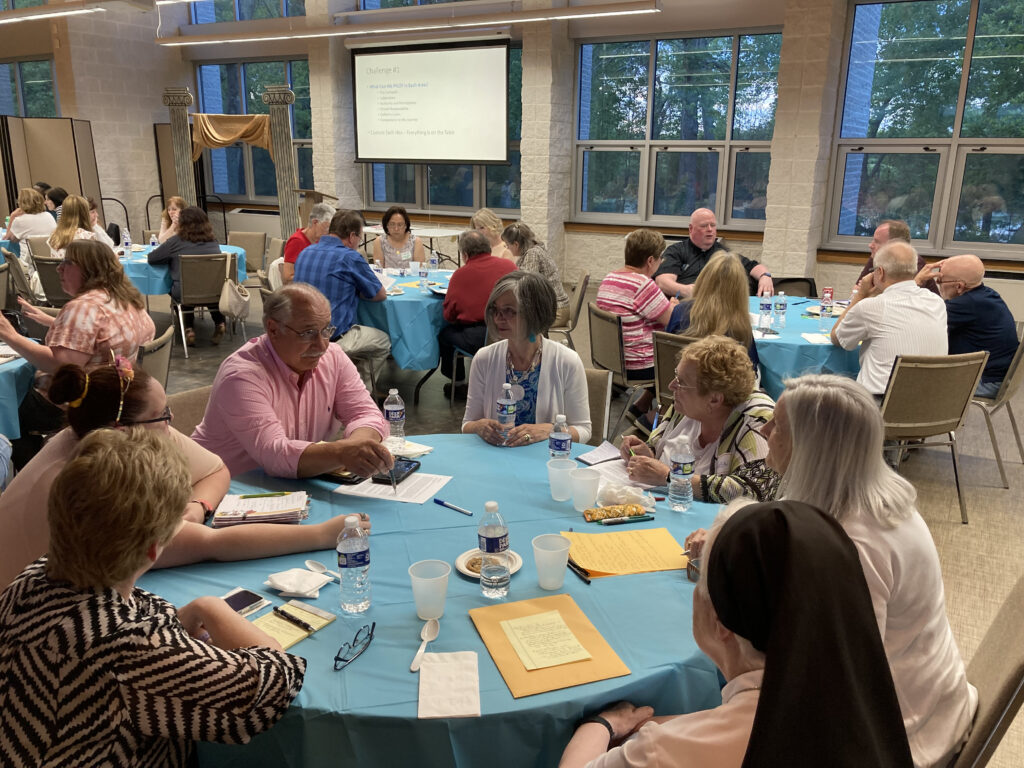
Flynn was among the five dozen parishioners from across the Diocese of Camden who attended a synod delegate meeting June 9 in Saint Anthony of Padua Hall, Saint Mary of Mount Carmel Parish, Hammonton. Led by Father Robert Hughes, Vicar General and Moderator of the Curia for the Diocese, and Donna Ottaviano-Britt, head of the Secretariat for Pastoral Outreach, the gathering was an opportunity for delegates to review some of the key points to come out of the Diocese’s synod report.
The report – the result of work from the parishes and deaneries – is part of the worldwide Synod on Synodality called for by Pope Francis. The two-year process of listening, prayer and dialogue began with Catholic laity being heard in the parishes across the Diocese; a report, along with those from every Diocese, will be sent to the U.S. Conference of Catholic Bishops for synthesis into one national report.
In the coming year, the reports received from every region of the world will become a working document by the Vatican. With an eye on greater participation at the diocesan, national and global levels, a final working document will be presented and discussed at the General Assembly in Rome in October 2023.
“The synod provides us a tremendous opportunity in these post-pandemic days, a real reboot of what we started in 2019 with the Convocation of Catholic Leaders: The Joy of the Gospel in South Jersey,” Ottaviano-Britt said. “Each of us is called to be a missionary disciple, and we are expected to be an outward sign and to go out. Well, now we have actually talked to and listened to people through this process. We have a lot of ways to accompany the mystical body and begin again.”
In presenting common themes of the report, Father Hughes focused on six main areas: Understanding the Eucharist, the Celebration of the Eucharist, Authority and Participation, Shared Responsibility, Called to Listen and Companions on the Journey. For example, he highlighted the three-year National Eucharistic Revival that begins on the Feast of Corpus Christi, and culminates with the National Eucharistic Congress in 2024. Along the way, there will be diocesan, regional and parish events to increase Catholics’ understanding of the Real Presence in the Eucharist.
“What can parishes do?” Father Hughes asked. “Whether it’s Adoration or having a retreat for your extraordinary ministers … all of you are creative and have the ability to come up with new ideas on how to get others to think about what it really means to have a connection to the Eucharist.”
Along the same lines, he explained how the ideas of co-responsibility and lay participation in decision-making were in every parish synod report received.
“Our people are so generous, not just with their funds, but with their time and talent,” he said. “People want to participate in the life of the parish. We have to find them and support them.”
He admitted that some priests have difficulties determining “what they should let go of versus how much they should control,” adding, “I tell priests all the time: ‘It’s not your parish. It’s the people’s parish.’”
“The future of your parish rests on you, the laity,” he told those gathered, “because pastors and parochial vicars are regularly transferred.”
Another area that Father Hughes spoke on was Companions on the Journey. “The reality is we have all kinds of people who are part of the Church community, and they need to be made to feel welcome and know that they are part of the Church.”
Before the evening’s end, delegates met in small groups to talk through the report’s findings and how they could take the information back to their parishes for action and further discussion.
Ottaviano-Britt’s advice: “We get so tied up in ‘that won’t work,’ or ‘we can’t afford that,’ or ‘no one will do that.’ Don’t let any of that prevent you from the creativity of this process.”
Agnes Bross of Saint Maximilian Kolbe Parish, Marmora, said she appreciated gathering with fellow delegates. “I really like that there is follow up. Sometimes you are asked a bunch of questions but never see the results. So it’s nice to see that the process is going somewhere … that we are going to work toward improving things.”
Encouraged for the task at hand in his parish, Flynn called the gathering a “mini synod.” “The more opportunities we have together, the better. Meeting regularly helps reinforce ideas and re-energize us and the process.”



 at the bottom and then tap “Add to Home Screen”
