


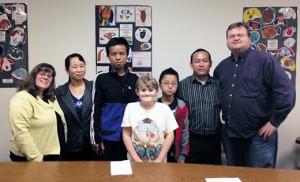
Photo courtesy of the Rosvold family
Encountering Mercy: Welcoming the Stranger
“Encountering Mercy” is a series that explores the corporal works of mercy during the Jubilee Year through the people whose lives exemplify them. The first is “Welcome the Stranger” and features profiles of refugees living in the Diocese of Camden.
Luke Rosvold is a 12-year-old who has undergone 11 surgeries in his young life. He was born with a severe cleft palate.
No one is better able to understand what Joseph Po, a 9-year-old born with a similar cleft palate who underwent major surgery this week, is going through. Luke had the same surgery at about the same age.
“I had really wanted to get into working with kids that had the same thing as me, helping them and informing them of what would happen,” Luke said.
An opportunity to do just that arose when Priscilla Adams, refugee academic success coordinator for Catholic Charities’ Refugee Resettlement Program and a friend of the Rosvolds, reached out to them about Joseph.
The Po family are refugees from Myanmar (formerly Burma). Joseph’s father, Po Reh, lived for 10 years in a refugee camp in Thailand where he met Joseph’s mother, Me Meh, who lived in the camp for seven years. They had fled civil war and the violence of a military government that persecuted their ethnic group, the Karenni, in Myanmar.
Joseph was born in the camp and had one surgery there.
Both of his parents speak limited English.
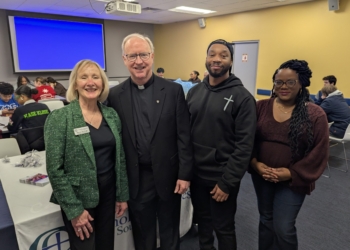
Adams arranged a meeting between the Po and Rosvold families at Catholic Charities’ offices in Camden last week in advance of the surgery so that Joseph could meet Luke, and his parents could share some advice.
“There’s nothing like having someone who’s been through it,” said Luke’s mom, Jill Rosvold. “We had a family who helped us and they got us through so much. I think it helps to go in with a more positive outlook, knowing what kind of a wonderful outcome you can have from the surgery. That can really translate to a better recovery.”
Similarly, the Po family was put much more at ease by the meeting.
“Before we met with the Rosvold family we were pretty worried about Joseph Po’s surgery. They let us know about the situation, how to prepare for surgery, that helped us ease our worry,” said Me Meh, Joseph’s mother, through an interpreter.
During the meeting, Luke told Joseph about what he could expect after surgery and the parents asked and answered questions.
“Having cleft can be a little bit isolating,” Jill said. “For me, the best thing was being able to help another mother advocate for her child’s wellness. I could tell by the way she was questioning, because I’ve been there, where her concerns were, that she had these on her heart. I could tell that when she left there was more light,” she said.
A Burmese Catholic Charities case worker accompanied them to the surgery this week to interpret and guide them through hospital processes.
In a program that receives just enough funding to support the basic needs of the families it serves, the specialized work of such volunteers is critical to enriching the services Catholic Charities is able to provide to refugees, according to program staff.
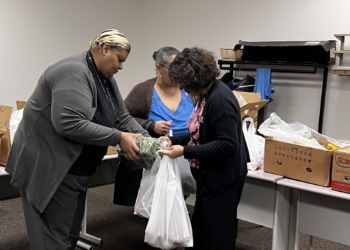
“We really have very few paid staff and we have many clients and a huge variety of needs,” Adams said. “Being a volunteer support for a family or helping the program – taking people to appointments or helping in the office, working with donations, volunteering to come in and teach children or teach adults – those kinds of things are just invaluable. And doing these things not only helps in a very concrete way; it also shows the refugee families that they’re cared about and that’s so important.”
For refugees who come to the United States, often with limited knowledge of English and a new culture to adapt to, any and all knowledge provided by volunteers is useful, Adams said. She cited the presentations by volunteers from local libraries and schools who have helped refugee families understand U.S. institutions.
According to Adams, volunteers with the refugee program often say their service provides a two-way benefit.
“We always learn when we’re with new people or have new experiences. We learn things that enrich our own lives and teach us both about ourselves and the world,” she said. “It’s not the same as visiting another country, but it’s learning a little piece of what else is beautiful and wonderful in the world and different from what we’re used to.”
The Rosvold family had a similar experience during their meeting with the Po family, who they hope to keep in touch with following Joseph’s surgery.
“In our conversation I kept thinking, ‘How would I handle this if I were them?’ I’m so taken with how strong you have to be to do this,” Jill said.
In the refugee camp, the Po family had access to such specialized treatment only one time per year when a hospital brigade of specialists came to the camp. They were prohibited from leaving the camp and from working during their years there.
For Luke, the experience has inspired him to do more. When he’s older he hopes to travel to other countries with the medical brigades that help children with cleft palates.
“You feel isolated if you don’t have anyone around you that has it; you feel like you’re the only one,” Luke said. “It’s really nice for kids to see other people who have the exact same thing as them, especially if they’re in another country.”
For more information about how to help Catholic Charities’ Refugee Resettlement Program, visit CatholicCharitiesCamden.org/Refugee-Immigration. To volunteer a specialized skill or learn more about existing volunteer opportunities, contact Priscilla Adams, 856-342-4148, Priscilla.Adams@camdendiocese.org.
**************************************************************************************************
The mercy of embracing refugees
In May, 2013, Pope Francis addressed a group that was meeting for the Assembly of the Pontifical Council for the Pastoral Care of Migrants and Itinerant People. In his speech he urged the group to focus on the humanity and hope of those experiencing any kind of forced migration.
“I would like to ask you all to see a ray of hope as well in the eyes and hearts of refugees and of those who have been forcibly displaced. A hope that is expressed in expectations for the future, in the desire for friendship, in the wish to participate in the host society also through learning the language, access to employment and the education of children. I admire the courage of those who hope to be able gradually to resume a normal life, waiting for joy and love to return to brighten their existence. We can and must all nourish this hope! …
“They are human people, I stress this, who are appealing for solidarity and assistance, who need urgent action but also and above all understanding and kindness. God is good, let us imitate God. Their condition cannot leave us indifferent. Moreover, as Church we should remember that in tending the wounds of refugees, evacuees and the victims of trafficking, we are putting into practice the commandment of love that Jesus bequeathed to us when he identified with the foreigner, with those who are suffering, with all the innocent victims of violence and exploitation.”



 at the bottom and then tap “Add to Home Screen”
