

Photos: Saints Alive, Sea Isle City

Bishop's Schedule

The Bishop’s Schedule, Nov. 3 – 11

by Staff Reports
October 30, 2026
0
ShareTweet

Black Friday Sale

Advertising Black Friday Sale 2026

Featured

Pray, encourage others during Vocation Awareness Week this Nov. 1-7

by Staff Reports
4 days ago
0
ShareTweet

When there is no grave: What will our descendants find?

by Debra A. Moore
5 days ago
0
ShareTweet

Feast of All Saints: Holiness close to home

by Father Michael A. de Leon, AM
1 week ago
0
ShareTweet
  • Contact
  • Advertise
  • Subscribe
  • Home
Friday, November 6, 2026
Catholic Star Herald
  • News
    • From Bishop Williams
    • Parish Life
    • Diocesan News
    • Sports
    • Columns
      • From Bishop Sullivan
    • Obituaries
    • World/Nation
  • Catholic Schools
  • Español
  • Features
    • Special Supplements
      • Thank You Bishop Sullivan
      • Welcome Bishop Williams
      • Jubilarians
    • Entertainment
      • Movie Reviews
    • Photo Galleries
    • Talking Catholic
    • Latest Videos
    • Health and Wellness
  • Advertise
  • More
    • Classified
    • Subscribe
    • Contact Us
No Result
View All Result
Catholic Star Herald
No Result
View All Result
Home Columns

Faith, history and the stories written over time

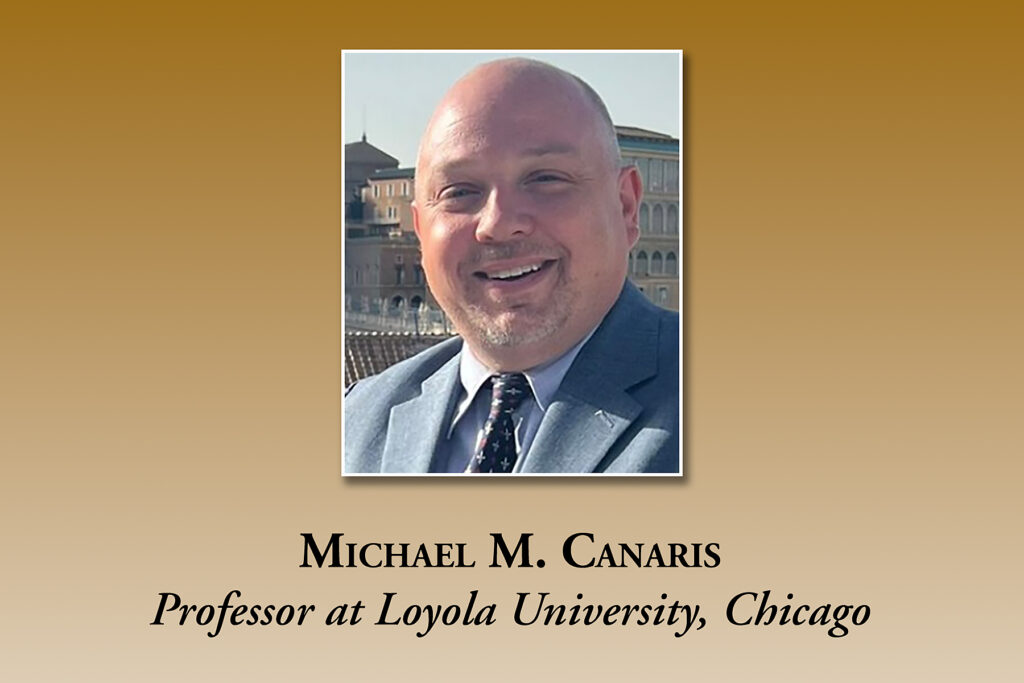
Michael M. Canaris by Michael M. Canaris
July 13, 2026
in Columns
Reading Time: 4 mins read
0
0
VIEWS
Share on FacebookShare on Twitter

Pope Leo marked the 250th anniversary of his native country with a visit to Lampedusa, an important site for his immediate predecessor – who first went there shortly after his election to awaken the world to what he termed the “globalization of indifference” regarding the plight of migrants. That same evening, in Rome for a few days of meetings, I celebrated with a few friends from across the Americas (including Brazil) sharing aperitivi and Syrian food on a rooftop terrace enjoying views of the church of Santi Quattro Coronati.

Like so much else in the Eternal City, the church of the “Four Crowned Martyrs” is a historical palimpsest – the ancient manuscript pages where traces of earlier texts appear as others are “written over” them. The simplest version of a complex story is that the four original martyrs were marble workers named Claudius, Castorio, Sinfroniano and Nicostrato; they were executed during the Diocletian persecutions for refusing to carve an idol of Asclepius, the god of healing. For their crime, they were sealed in lead coffins and thrown into the river. When their bodies were recovered by another early Christian, Simpliciano, he, too, was martyred. Then another four – Secondo, Carpoforo, Vittorino and Severiano – were killed elsewhere and also included in the veneration, and the legends all merged over the centuries. 

When Saint Augustine of Canterbury left Rome for England, he brought the tradition with him, where it spread across the English-speaking world, especially among masons and stone-workers.

The basilica on Via dei Santi Quattro, today home to a community of Augustinian nuns, is one of the oldest in Rome. Because it sits between the Colosseum and the Lateran, where the popes lived for the first thousand years of Christianity, it took on prominence, especially after renovations to its fortress-like structure under Pope Leo IV in the 800s AD. The previous church was badly damaged by the Norman Sack of Rome led by Robert Guiscard in 1084. In addition to relics from the four/nine early martyrs, the rebuilt basilica now also houses the skull of Saint Sebastian.

But the true priceless masterpiece of the church is the Chapel of Saint Sylvester. Another complicated piece of Church history, the cycle of frescoes from the 1200s shows Constantine afflicted with leprosy. In a famous scene, he rejects his pagan priests’ suggestion of bathing in the blood of innocent children for a cure, and turns instead to baptism. He is healed through the intercession of Sts. Peter and Paul, Rome’s famous patrons. As a sign of gratitude, the Emperor offers Pope Sylvester all the trappings of feudal homage, thereby “donating” to the Church all the wealth, power and influence of the imperium. The implication is clear, the Church has been granted all the rights of authority to temporal rule, along with the riches this brought with it. This was the dominant narrative, even leading into the debates about the modern “Roman Question,” after the unification of Italy as a modern nation, which weren’t entirely settled until the signing of the Lateran Accords with Mussolini in 1929, incidentally taking place right down the street.

Modern scholars have proven that much of this was a historical legend. Everything from the propaganda around bathing in blood to the emperor’s baptism (which likely took place instead on his deathbed) to his “donation” has been proved to be later stories “written over” what actually took place in a period of immense turmoil and turnover in the Roman world – from pre-Christian republic to a churning series of short-lived pagan emperors to the eventual spread of the faith across the lands they conquered.

As an example, the Constantine the Church so reveres as “Great,” without doubt killed or had killed at a minimum his nephew, two brothers-in-law, father-in-law, and very likely his son and second wife, after divorcing the first, to solidify his power. (I have read a lot about him, as my paternal grandparents were Constantine and Helen, which to theologians is like saying they just happen to be independently named “Bonnie” and “Clyde.”)

Today Bernini’s image of Constantine astride his horse peering up at the cross greets visitors entering the Apostolic Palace through the Scala Regia. Like the Santi Quattro, and so much else, it is the contradictions, confusions, and paradoxes of the messy complexities of real life, not imagined unalloyed purity, that draws us both to Rome and to the faith itself.

The human experience, in the Church and in the United States for a quarter of a millennium, continues to be one of palimpsests, ellipses and questions much more than prepackaged and ready-set answers.

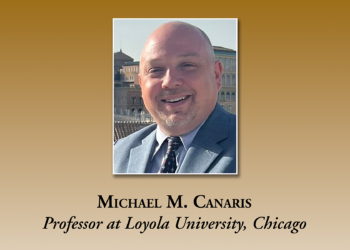
An alumnus of Camden Catholic High School, Cherry Hill, Michael M. Canaris, Ph.D., teaches at Loyola University, Chicago.

Previous Post

Pope Leo XIV to launch exhibit on water at the Vatican Library

Next Post

Couple marks four decades of dedicated parish service

Related Posts

Columns

Supporting the ‘living stones’ of the Holy Land

November 3, 2026
Columns

Unconditional love does not mean acceptance of misdeeds

November 2, 2026
Columns

When there is no grave: What will our descendants find?

November 1, 2026
Columns

A key to sainthood: Let Christ’s light shine through

October 31, 2026
Facebook Twitter Instagram LinkedIn Youtube

No Result
View All Result

Latest News

Catholic Charities, Rowan collaborate to provide for pets

CCSJ receives funding renewal to support sober living

ManUp attendees urged to bring gift card, toiletry donations

Meet Talking Catholic’s new co-host: Dr. Vinnie Mancuso

The Mews at Saint Mary receives housing development award

Latest Videos

View livestream of NJ Bishops celebrating Mass for Life Oct. 8 in Trenton

Bishop Joseph Williams celebrates 25th Annual Blue Mass

Livestream: Archbishop Fulton Sheen Beatification

Bishop installs Father Rivera as new rector of Cathedral

View Ordination of Nickolas B. Naticchione in Cathedral

Around the Diocese

  • The Diocese of Camden
  • Talking Catholic Podcast
  • Catholic Charities
  • Advertise
  • Catholic Cemeteries
  • VITALity Healthcare Services
  • Housing Services
  • Camden Deacon
  • Camden Priest
  • South Jersey Catholic Schools
  • Man Up South Jersey
  • Catholic Business Network

Additional Resources

  • New Jersey Independent Victim Compensation Fund
  • Quick Guide to Reporting Sexual Abuse
  • List of Credibly Accused Priests and Parish Resources
  • Bishop’s Commission Report on Catholic Schools

Reorganization of the Diocese

  • Chapter 11 Claims filing info
  • Chapter 11 Prime Clerk Filing

© All Rights Reserved | November 06, 2026 | Catholic Star Herald of the Diocese of Camden

En español/Sa Tagalog
  • <
  • <
  • <
  • <
  • <
  • <
  • <
  • <
  • <
  • <
  • <

Add the Catholic Star Herald to your home screen

For Android users(Chrome) tap the at the top right vertical 3 dots then tap “Add to Home Screen”

For iPhone tap:at the bottom and then tap “Add to Home Screen”

  • This field is for validation purposes and should be left unchanged.

If you need assistance with submitting your subscription, please call Neal Cullen at 856-583-6139, or email Neal.Cullen@camdendiocese.org

  • News
    • From Bishop Williams
    • Parish Life
    • Diocesan News
    • Sports
    • Columns
      • From Bishop Sullivan
    • Obituaries
    • World/Nation
  • Catholic Schools
  • Español
  • Features
    • Special Supplements
      • Thank You Bishop Sullivan
      • Welcome Bishop Williams
      • Jubilarians
    • Entertainment
      • Movie Reviews
    • Photo Galleries
    • Talking Catholic
    • Latest Videos
    • Health and Wellness
  • Advertise
  • More
    • Classified
    • Subscribe
    • Contact Us
No Result
View All Result

© All Rights Reserved | November 06, 2026 | Catholic Star Herald of the Diocese of Camden