




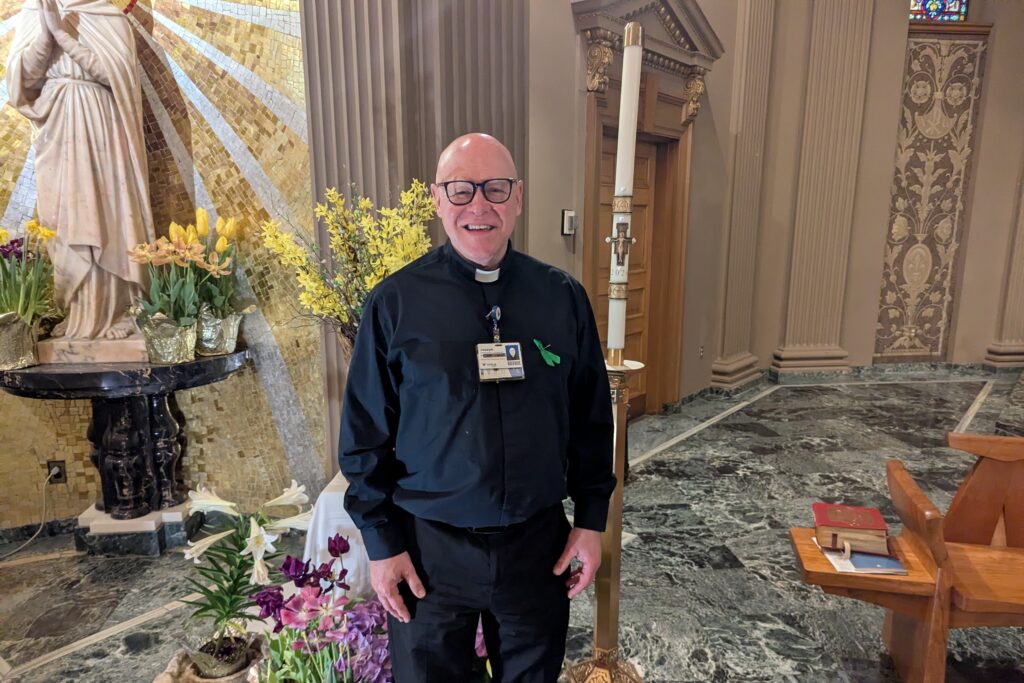
As Father Joseph Monahan, TOR, reflects on the Jubilee Year of Saint Francis of Assisi, he says he is reminded of the Jewish words of condolence at the death of a loved one, “May their memory be a blessing.”
“According to the Jewish tradition, to remember the names of our departed loved ones means they will not be forgotten,” said Father Monahan, director of pastoral care at Virtua Our Lady of Lourdes Hospital in Camden. “Here we are 800 years after the death of Saint Francis, and we have not forgotten his message of humility, simplicity, peace and care of creation.
“He has also taught us how to die well, even addressing death as his sister to complete his beautiful ‘Canticle of Creation,’” he said of the saint’s hymn. “As a hospital chaplain, I believe part of my ministry is to create an environment for people to die well. ‘Be praised, my Lord, for Sister Death, in whom no mortal can escape.’”
However, being called to hospital chaplaincy, or for that matter, to the priesthood, was never part of Father Monahan’s plan.
Franciscan Influence
It was in the midst of the social turmoil of the early 1970s that a chance meeting with a Franciscan brother set then-Bucks County high school student Joseph Monahan on the path to the priesthood.
“I went to public school, but a lot of my friends went to Bishop Egan High School [now Conwell-Egan Catholic High School] where the TORs taught, and I met one of the brothers,” Father Monahan said.
This Franciscan brother and a group of students would visit churches singing songs from the Broadway show and movie “Godspell,” which was popular at the time. The teenage Monahan ended up joining the group. Not long after, he attended a screening of the movie, “Brother Sun, Sister Moon.” The movie about Saint Francis of Assisi left a lasting impression.
“I just fell in love with the story of Francis and peace, and it kind of fit,” Father Monahan said.
He got to know some of the other brothers and priests in the order and, a year out of high school, was invited to the friary in Loretto, Pa., where he met with vocation directors.
“This was a real breath of fresh air, what Church could be for me,” he said. “This was just joyful, the singing and praise and happiness that I saw in [the brothers].”
He set his sights on becoming a brother, as he had no intention of being a priest. It wasn’t until he was helping at a parish with a weekend ministry that he began considering the priesthood.
“It wasn’t any kind of magical moment. It just kind of evolved as I grew and matured and studied,” he said.
Father Monahan was ordained a priest in May 1990.
“Our main charism is a continuing conversion that everything, every day, is an opportunity for us to turn our hearts more toward God,” Father Monahan said of the Third Order Regular of Saint Francis of Penance, or TOR.
Start of a Vocation
While working on a master of divinity degree in Toronto (his second of what would become three master’s degrees), Father Monahan was required to do a unit of clinical pastoral education, spending a summer in a hospital.
“At the end of the summer, my supervisor said to me, ‘You’re going to be a hospital chaplain someday,’ and I’m like, ‘I don’t think so.’”
However, right before his ordination, Father Monahan had been given three job offers. One was teaching high school, a second was campus ministry at Saint Francis University. The third offer, he accepted: hospital ministry in Fort Worth, Texas, where he earned national certification for hospital pastoral care.
Father Monahan’s next journey came when his mother became ill; he moved to West Virginia to help care for her. While there, he took on the position as director of pastoral care at Wheeling Hospital in Wheeling.
“I was there for five years,” he said. “My mom passed away in 1998 at the age of 60, so I stayed another year.”
When a chaplain’s position opened up at Mercy Hospital in Pittsburgh, he took it, as it would give him easier access to the order’s mother house in Loretto, about an hour and 20 minutes away.
“I thought it was going to be two years, and it turned out to be nine years, and I loved it,” he said.
Having earned his third master’s degree, from Neumann University in pastoral counseling, Father Monahan moved on to Saint Francis Hospital in Wilmington, Del., where he stayed for five years.
By 2013, he was well-established in hospital ministry as a member of the National Association of Catholic Chaplains and was looking for another position when he received a call from Sister Rosemarie Kolmer, former director of pastoral care at Our Lady of Lourdes Hospital.
“The fact that Our Lady of Lourdes Hospital was founded by Franciscan sisters, that it was in a city that was struggling, one of the poorest cities in the country, and, at that time, one of the most dangerous cities in the country, I just thought it was a place that kind of fit,” he said.
Unseen Hurts
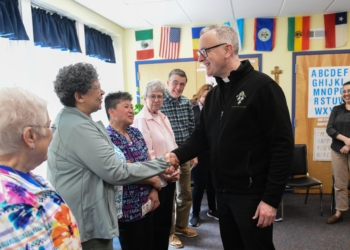
When it comes to hospital chaplaincy, Father Monahan and his team serve as many people as they can.
“I go to Catholics, Protestants, Jews, Muslims, Hindus, Buddhists and tree huggers,” he said. “It doesn’t matter. We’re here for your emotional spiritual needs. Some people choose to live that out in a formal type of religion, but anyone who has ever asked the question, ‘why am I here,’ or ‘why am I sick,’ or ‘why do babies die’ … that’s really where we try to meet people.”
He continued, “We deal with some hurts that aren’t as visible as the ones that [doctors and nurses] care for. The scars are not as visible, but they’re there.”
In May, he will have been at Our Lady of Lourdes Hospital for 13 years, “which is the longest I’ve been anywhere in my life,” he said.
Father Monahan said that a Presbyterian minister he knew from his time at Neumann University gave him a definition of vocation.
“His definition of vocation is, and I’m paraphrasing: ‘When your deepest passion and the world’s greatest hunger meet,’” he said. “Being able to find that, how blessed and lucky am I?”




 at the bottom and then tap “Add to Home Screen”
