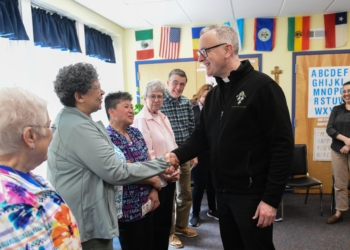




Joanna Gardner, Social Ministries Communicator for Catholic Charities of the Diocese of Camden, recently travelled to the Philippines as the recipient of Catholic Relief Services’ Egan Journalism Fellowship. Her report follows.
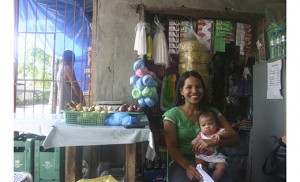
Photo by Joanna Gardner
TOLOSA Philippines — In November 2013, Mary Jane Castil was a small business owner — she ran a tiny shop called a sari-sari store that carries snacks and household necessities — in a coastal town called Tolosa on Leyte Island in the Philippines. She supplemented her income by raising and selling pigs behind her house. The youngest of her three children was only a year old. Her husband Eduardo was a computer technician for a public contractor.
They lived in a tiny single-story house of wood and concrete in a neighborhood where most of their neighbors were poor fish vendors, day laborers on nearby coconut farms, or pedicab drivers. The front of their house was the store and the family of five lived in the other two rooms, drawing their water from a hand pump behind the house.
They had lived through tropical storms before — the Philippines gets more than 20 a year — but nothing had prepared them for what was coming. On Nov. 8, 2013, the strongest storm ever to make landfall in recorded history at that time would smash squarely into Leyte Island and over their town with eight feet of water and 195 mph winds.
Unlike so many others who were totally unprepared for the devastation, Eduardo heard at work about the magnitude of the storm. Late in the day, the family decided to evacuate the house.
A school that served as an evacuation center across the street was already full, so they went to the nearby two-story house of a friend’s relative. They packed into the house with seven other families to wait out the storm.
On the islands of Leyte and nearby Eastern Samar, the storm surge caused the greatest devastation. Water pushed by the monster hurricane was funneled into a bay formed where the two islands almost touch and produced a wall of water like a tsunami, as high as 20 feet in places.
Typhoon Haiyan was the deadliest storm in the Philippines in more than 130 years. Some 6,300 people died, more than 1,000 were missing after the storm, 4 million people were displaced, and estimates of the wounded were as high as 28,000.
The next day, Mary Jane and Eduardo returned to the spot where their house once stood, and nothing was left — not even debris. Their house, with the store and all of its contents, fell into the category of absolute destruction: a “wash-out.” It had all been swept away in the floodwaters.
They cried, but they were grateful to be alive. In the school-turned-evacuation center across the street there were many casualties, due to exposure to the water and cold temperatures. Many of those who died were children.
Destruction from Typhoon Haiyan
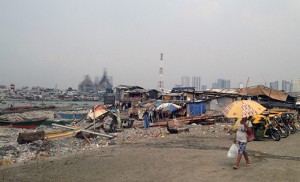
Photo by Joanna Gardner
The Church Responds
The response of the Catholic Church, along with other non-governmental and governmental organizations across the U.S. and the world, was swift.
Within four days, Catholic Relief Services (CRS), the official international aid agency of the church in the United States, was on the ground delivering emergency aid and providing shelter to survivors on the islands of Leyte and Samar.
In the first three months, CRS provided 43,000 families with temporary shelters and household items. They paid workers who had lost all sources of income and livelihood to clear away debris. They handed out emergency aid kits and supplies at the sites of the mass graves.
In the immediate aftermath of the storm, bishops across the United States called for parishes in their dioceses to take up collections for victims of Typhoon Haiyan. In total, U.S. Catholics had sent more than $24.5 million to the Philippines as of April, 2014. The Diocese of Camden contributed nearly $260,000. A portion of the funds was given to the Catholic Church in the Philippines for rebuilding its churches and facilities, and the rest went to Catholic Relief Services for emergency relief and recovery.
Today, CRS is in the midst of a five-year, multi-faceted long-term recovery operation that aims to serve a total of 100,000 families between the initial response and the long-term recovery process. The length of their response is made possible largely because of the support of the church in the U.S., which the program’s directors say is their single largest source of funding.
The U.S. Government’s international aid amounted to a total of nearly $91 million in the same time period. Of these funds allocated to private humanitarian agencies and non-governmental organizations working in disaster relief and recovery, the single largest grant went to Catholic Relief Services.
A Comprehensive Approach
Speaking with Mary Jane now, it’s difficult to imagine the scale of the horror and destruction that once was. She sits with her newest child on her knee, just three months old, in a rebuilt and restocked store that is even more successful than before. Her home has been repaired and made safer and stronger with the additional income.
She is a beneficiary of Catholic Relief Services’ typhoon recovery program targeting those who lost their livelihoods in the disaster. Community leaders say that at this stage of recovery, livelihoods remain the area of greatest need.
Across the Philippines, 5.6 million people lost their livelihoods because of Typhoon Haiyan. CRS focuses on the poorest of these on the islands of Leyte and Samar, which sustained the greatest losses. They’ve targeted 9,000 families for livelihood recovery.
Mary Jane began as the recipient of a small gardening grant for seeds, tools and fertilizers that allowed her to plant a plot of vegetables with some of her neighbors. She lacked the capital to start her business again, but she was able to feed her family at a time when food was scarce.
In June 2014 the livelihoods program entered stage two in her town. CRS created a menu of options, which includes animal husbandry, intercropping (planting seasonal vegetables in the time it takes new coconut trees to grow), and aquaculture, as well as small business development. Each option requires beneficiaries to make their own in-kind contribution (building animal pens, providing labor, etc.), while CRS provides investment capital and skills development training.
When it came time to submit her business proposal, Mary Jane proposed a new twist on her old business: she would open a feed and agricultural supply store.
Hers was the first feed store in a town where dozens of sari-sari stores eventually reopened. She supplies to those CRS beneficiaries who chose agricultural options from the livelihoods menu.
“The menu of options is important for diversification,” said Joshua Kyller, CRS’ Typhoon Haiyan Emergency Coordinator. “Let the market decide what people’s livelihoods should be.”
Aside from livelihoods, other key focuses of CRS’ Typhoon Haiyan response are rebuilding household infrastructure, community disaster risk reduction, and strengthening their community partners.
Household infrastructure includes both shelter and sanitation projects. In many of the poor typhoon-affected communities where CRS works, there was no prior access to proper sanitation. Open defecation was common because families lacked access to anything more than a hole in the ground or a bag.
In these communities it has been necessary to build latrines and septic tanks where there were none before, and to provide residents with hygiene education. This is often done by training volunteers from the communities themselves who then promote these messages among their neighbors.
In late October, just weeks before the two-year anniversary of Typhoon Haiyan’s landfall, CRS reached their goal of providing 20,000 families with safe and durable shelter, either through cash assistance to rebuild or houses CRS has constructed. Thousands more benefitted from community trainings on the pillars of building typhoon-resistant homes.
CRS helps towns prepare for future disasters, developing contingency plans and their own early-warning systems, by providing trainings to community leaders and individual households. All of their activities will eventually be handed over to partners, particularly the local church. Strengthening and developing the capacity of these partners is part of their long-term strategy.
Trauma and Resilience
The trauma of a disaster like the one experienced by Mary Jane and her family is long-lasting. Her now 3-year-old son, who was 1 at the time of the storm, is afraid of water. He can’t go to the beach or look at the sea.
But Mary Jane is not afraid. She smiles and laughs now as she tells her story. At 30 years old, she is one of the more successful storeowners in her town, the mother of four, and a shrewd entrepreneur.
She says she wants to see her business grow, maybe one day open a grocery store. She believes that treating people well and assisting the community are the keys to her successful business. That, and her fair prices.
But the first thing Mary Jane says when she’s asked what she wants to say to the people who will read her story:
“I want to express my gratitude to CRS, for helping me.”




 at the bottom and then tap “Add to Home Screen”
