





Many Catholics have been inspired by Pope Francis’s tireless advocacy for migrants over the last seven years. He continues to prioritize pastoral care and advocacy for those desperately seeking security and a better life, in every place around the world and in particular for the multitudes arriving by (or dying in) the seas around the Italian peninsula. In the coming weeks, the calendar provides us the opportunity to reflect on two lesser-known saints who can be seen as unofficial patrons of so many of these victims, whose faces and names are often lost to the world.
The first is a Turkish farmer known as Saint Foca the Gardener, whose feast day is July 3. During the Diocletian persecutions which took place throughout the Emperor’s reign from 284-305 AD, he was condemned for his Christian faith, his life of piety, and for sharing the meager fruit of his crops with the poor. The local governor sent a few of his guards to find and slaughter him. While the two scoured the countryside, an old man offered them food and hospitality during their search. Hearing of their intentions, the man went and dug a hole in his field while they slept in his small house. In the morning, it became clear that the host was himself Foca, and that he had willingly prepared his own grave to shed his blood for Christ.
The martyr’s shrine that arose after his death and burial led to accounts of miracles in the area, and his veneration spread in particular to Calabria, Sicily and Puglia in Southern Italy. Since the word “foca” is the word for seal or sea lion in Latin, Italian and Spanish, the saint was invoked for protection by seafarers and sailors. He is also obviously closely associated with horticultural and agricultural workers, and so seems a particularly powerful witness and intercessor for contemporary migrant communities, whether those working in low income jobs in fields and factories around the world or risking their lives to set sail for new shores.
Another anniversary this week is of the recognition by John Paul II in 1985 of a miracle attributed to Giuseppe Maria Tomasi di Lampedusa, an 18th century caridnal. Shrewd readers will be aware that Pope Francis’ first visit outside of Rome was to the tiny island of Lampedusa, the “borderland” of Europe where he mourned the countless deaths of migrants in his famous condemnation of the “globalization of indifference.” Tomasi was in fact related to the local aristocracy of Sicily and Lampedusa, as was the famous Italian author Giuseppe Tomasi di Lampedusa, who centuries later was the author of the Italian classic novel “Il Gattopardo” (“The Leopard”). The earlier saint was by all accounts a profound church leader, who brought his close connections with the poor from Sicily and Lampedusa to Rome to advocate for reforms like greater use of local and vernacular languages in Catholicism, and personal participation of the People of God in the liturgy.
His biography on the Vatican website makes clear that Saint Giuseppe Maria was in many ways a forerunner of the Second Vatican Council, two centuries before it came to fruition. He was particularly renowned for living a life connecting wisdom and charity, that is to say understanding that education (literally “drawing [potential] forth from”) can never be detached from compassion (literally “suffering with”). He spent countless hours complementing his rigorous academic study with devotion to the sick, hungry and dying in Rome.
These two saints, with whom most American Catholics will likely have little familiarity, can speak in profound ways to our current moment, even if separated across the centuries from one another, and from us. They are testaments to the radically diverse ways that Christian witness can express itself: from the fields of northern Turkey to the universities and hospitals of Rome to the seas of the Mediterranean. Whether in direct acts of mercy in the face of pervasive suffering, or in the tireless work for more just, accessible, and inclusive structural systems — or both — we each can draw inspiration from figures like these and so many others in our tradition to more whole-heartedly follow our collective and individual vocational call to holiness.
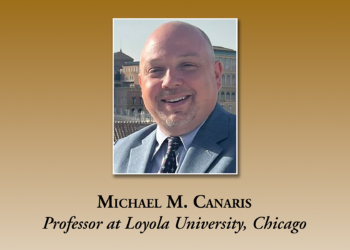
Originally from Collingswood, Michael M. Canaris, Ph.D., teaches at Loyola University, Chicago.




 at the bottom and then tap “Add to Home Screen”
