


In the Catholic tradition, the reality of the communion of saints argues that our times are not alone in attempting to contemplate the divine mystery and working to aid one another in the process of becoming better human beings. Rather, there is an “inter-generational” component that recognizes that the bonds forged in life are not broken even at death, as the funeral rite prayers beautifully profess. Sometimes, this can lead us to find ancestors in the tradition who seem still to be speaking to us today in profound ways across both the centuries and the “Great Divide.”
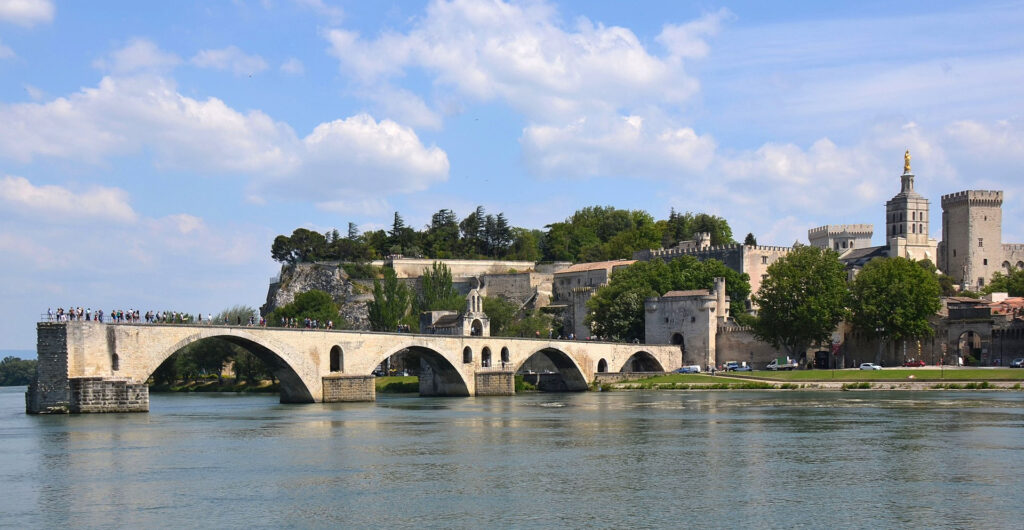
One such figure I recently came across is Bénézet, a 12th century French saint who is sometimes referred to as “Little St. Bennet.” During a solar eclipse, the young shepherd boy heard a voice instructing him to build a bridge over the Rhône River at Avignon, where the current made crossings impossible. When the local bishop and civil authorities doubted his claims to have been inspired, Bénézet reportedly lifted an enormous block by himself to lay the first foundations. Thus, most artistic images of him portray this scene with the boy shouldering a heavy square slab. He eventually convinced authorities of the sanctity of the mission and personally oversaw the construction of the project for seven years, before his death in 1184. The bridge eventually became the site of untold miracles and was used by pilgrims crossing Europe to visit numerous holy sites. His feast day occurs each April 14, and is still celebrated in the city.
Bénézet left numerous monuments to his holy life. The first was the Fratres Pontifices, the “Bridge-Building Brotherhood” of the following centuries. Legends say the brotherhood combined donors (or chivalrous “knights”), clergy and artisans in a collaborative effort to aid in civic planning, particularly as it involved building crossings used by the faithful venerating shrines and relics. Whether the references are exaggerated in terms of historicity and scope, we see a close connection between the traditional “bridge-building” efforts of the ancient and medieval world and the aspects of the episcopate and particularly the papacy, as popes inherited the title of Pontifex Maximus, or “Supreme Bridge Builder,” for their unique role connecting both the human and the divine, and the holy faithful people of God with each other.
The second legacy is more local. The French Huguenot family of the Benezets – who one can speculate very likely had some circuitous connection to the local saint at a distant point in their family history – eventually migrated to Philadelphia. Anthony Benezet joined the Religious Society of Friends (the Quakers) and eventually led the William Penn Charter School, one of the first schools in the nation to offer education to people of all religions, genders and races. This latter Benezet was one of the most important abolitionist voices in our area, working tirelessly to advocate against slavery to influential early American leaders like Benjamin Franklin and Benjamin Rush.
When Saint Bénézet died, his body was originally interred on the bridge he had built until a catastrophic collapse sent the small chapel into the frigid waters below, another somewhat strange attestation that while history doesn’t repeat itself, it sometimes “rhymes” in mysterious ways. Eventually the saint’s tomb was found, and it became clear that his body was miraculously incorrupt, hundreds of years after his death. His relics were taken to the French Church of Saint Didier, where they remain today.
While the dramatic events of the lives of the saints sometimes spellbind our imaginations about the distant times they inhabited, the most crucial aspect of our respect ought not to be their alterity or “otherness.” Rather, why they are held in such esteem in our tradition is that each of us can strive to emulate them: discerning God’s socially focused Gospel in a quiet, individual whisper – laboring to bridge those on “opposing shores,” and living out our faith in simple ways that can resound across our society, and maybe even across history.
An alumnus of Camden Catholic High School, Cherry Hill, Michael M. Canaris, Ph.D., teaches at Loyola University, Chicago.




 at the bottom and then tap “Add to Home Screen”
