
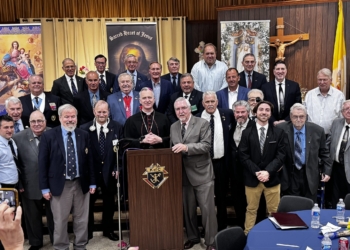





The 1,700th anniversary of the Council of Nicaea was celebrated May 3 at the Co-Cathedral of Saint Robert Bellarmine Co-Cathedral in Freehold. I was in attendance, and two of our seminarians, Nicholas Esposito and Benjamin Suarez, were servers for the beautiful prayer service. The gathering brought together bishops, priests, ministers and lay faithful from the Roman Catholic, Orthodox and Protestant ecclesial communions from throughout the state. It was a service of prayer, song and the proclamation of the creed that was forged at Nicaea in both the original Greek and in English.
Homilies were given by both Bishop James Massa of Brooklyn, who is also rector of Saint Joseph’s Seminary in Yonkers, N.Y., and Metropolitan Antony of the Ukrainian Orthodox Church of the USA. Bishop Massa once served as the executive director of the United States Conference of Catholic Bishops Secretariat for Ecumenical and Interreligious Dialogue.
The Council of Nicaea, convened by the Roman Emperor Constantine the Great in 325 AD, was the first ecumenical council in the Christian Church. Its primary purpose was to address the Arian Controversy, a theological dispute about the nature of Jesus Christ, and to establish a unified creed. The council’s most significant outcome was the Nicene Creed, which affirmed the divinity of Jesus and condemned Arianism. The council was called in response to a growing disagreement within the Christian
Church regarding the relationship between God the Father and Jesus Christ. Arius, a priest of Alexandria, believed Jesus was a created being, subordinate to God the Father, while others, like the great Saint Athanasius of Alexandria, argued that Jesus was divine and co-eternal with the Father.
Emperor Constantine I, while not a bishop, played a key role in convening the council and presiding over it. His support was crucial for resolving the conflict and establishing a unified Christian faith within the empire. The council was held in Nicaea, which is in modern day Turkey, a strategically located city that allowed bishops from across the Roman Empire to attend. Approximately 300 bishops participated from various regions and factions within the Church. The Nicene Creed, formulated by the council, remains a foundational statement of Christian belief for most Christian denominations. It affirmed the divinity of Jesus Christ, stating that He is “God of God, Light of Light, true God of true God, begotten, not made, of one Being with the Father.”
The council’s condemnation of Arianism and its affirmation of the divinity of Jesus Christ marked a turning point in early Christian history. While the debate continued for some time, the council’s decision helped to establish the orthodox understanding of the Most Holy Trinity. The Council of Nicaea established a precedent for future ecumenical councils, where bishops from around the world would gather to address theological and doctrinal issues. It demonstrated the importance of church councils in shaping Christian doctrine and unity. The Council of Nicaea was the first council in the history of the Christian Church that was intended to address the entire body of believers.
Nicaea failed to agree on a uniform date for Easter, and because of the objection of some of the council fathers, did not adopt a policy on the celibacy of the clergy. Although Church teachings emphasized the importance of clerical celibacy, many priests and even some bishops had wives as late as the 10th century. Clerical marriage would not be formally abolished until the first and second Lateran Councils in the 12th century.
Father Joseph D. Wallace is diocesan director of Ecumenical and Inter-religious Affairs and pastor of Christ the Redeemer Parish, Atco.



 at the bottom and then tap “Add to Home Screen”
