




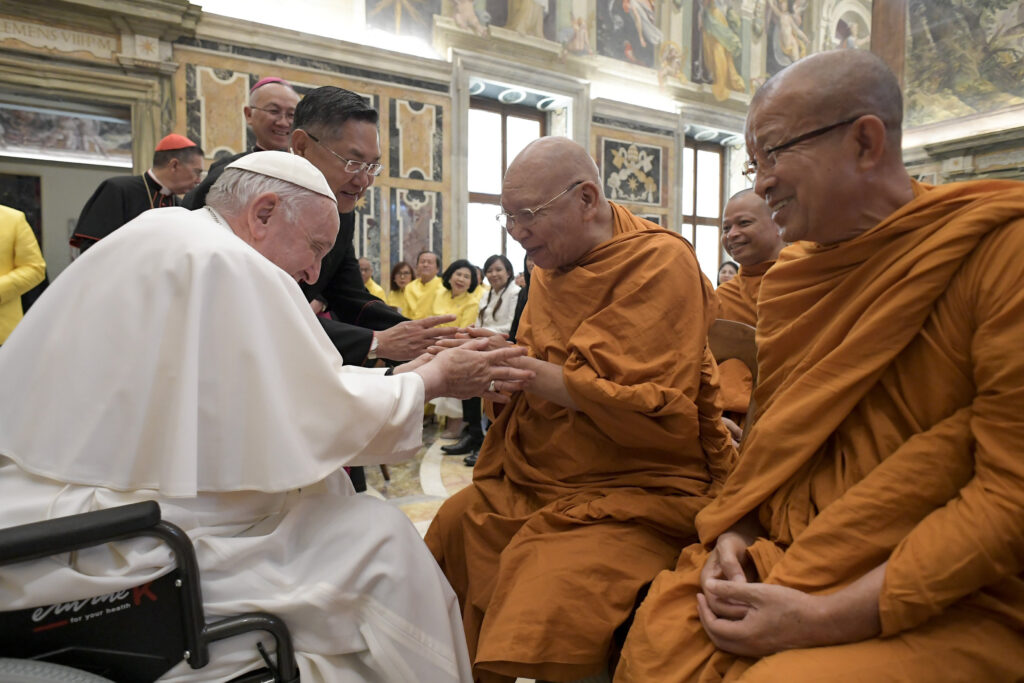
Last week, Pope Francis met with the Buddhist Delegation of the Sangha Assembly in Chetuphon, Thailand, at the Vatican.
In attendance was Thailand’s Supreme Buddhist Patriarch, or Sangharaja, Somdet Phra Ariyavongsagatanana IX. The delegation included more than 30 prominent Buddhist monks, about 60 lay Buddhists and representatives of the Catholic Church in Thailand. They were in Rome attending a June 17 conference titled, “Friendship between Buddhists and Christians for a Culture of Encounter,” sponsored by the Rome’s Pontifical Urbanian University and the Vatican Dicastery for Interreligious Dialogue.
This visit comes just after Pope Francis made a rather bold proclamation: “For me, today, World War III has been declared.” He continued, “This is something that should give us pause for thought. What is happening to humanity that we have had three world wars in a century? This is bad for humanity; it’s a calamity.”
Of course, the Holy Father was talking about the war in Ukraine, but he also pointed to conflicts in parts of Africa, northern Nigeria and in the north of the Congo, “where war is still raging, and no one cares. The world is at war!”
Pope Francis spoke to his Buddhist guests about the similarity of the teachings of Jesus and Buddha. He said, “Sadly, on all sides, we hear the cry of a wounded humanity and a broken earth. The Buddha and Jesus understood the need to overcome the egoism that gives rise to conflict and violence [in our world].” He added, “The Dhammapada sums up the Buddha’s teachings thus: ‘To avoid evil, to cultivate good and to cleanse one’s mind.’”
“Jesus told his disciples: ‘I give you a new commandment, that you love one another. Just as I have loved you, you also should love one another,’” Pope Francis said quoting from John 13:34.
“Our task today is to guide our respective followers to a more vivid sense of the truth that we are all brothers and sisters. It follows that we should work together to cultivate compassion and hospitality for all human beings, especially the poor and marginalized,” he continued.
Pope Francis also thanked the participants for coming to Rome during the 50th anniversary of the historic meeting between Pope Paul VI and the Most Venerable Somdej Phra Wannarat, the 17th Supreme Buddhist Patriarch of Thailand, which occurred June 5, 1972.
He echoed the words of Pope Paul VI on that occasion, saying, “We have a profound regard for the spiritual, moral and socio-cultural treasures that have been bestowed on you through your precious traditions.” He added, “We recognize the values of which you are the custodians, and we share the desire that they should be preserved and fostered. We hope there will be increasing friendly dialogue and close collaboration between the traditions that you represent and the Catholic Church.”
For those unfamiliar, Buddhism is one of the world’s largest religions and originated some 2,500 years ago in India. Generally, they believe that human life is a cycle of suffering and rebirth, but that if one achieves a state of enlightenment (Nirvana), it is possible to escape this cycle forever. Siddhartha Gautama was the first person to reach Nirvana and was, and is still today, known as the Buddha.
The Buddha taught about the Four Noble Truths: “Suffering (dukkha),” which teaches that everyone is suffering in some way; “Origin of suffering (samudaya),” that all suffering comes from desire; “Cessation of suffering (nirodha),” that it is possible to stop suffering and achieve enlightenment, and “Path to the cessation of suffering (magga),” which is about the Middle Way – the steps to achieve enlightenment.
Father Joseph D. Wallace is diocesan director of Ecumenical and Inter-religious Affairs and pastor of Christ the Redeemer Parish, Atco.




 at the bottom and then tap “Add to Home Screen”
