



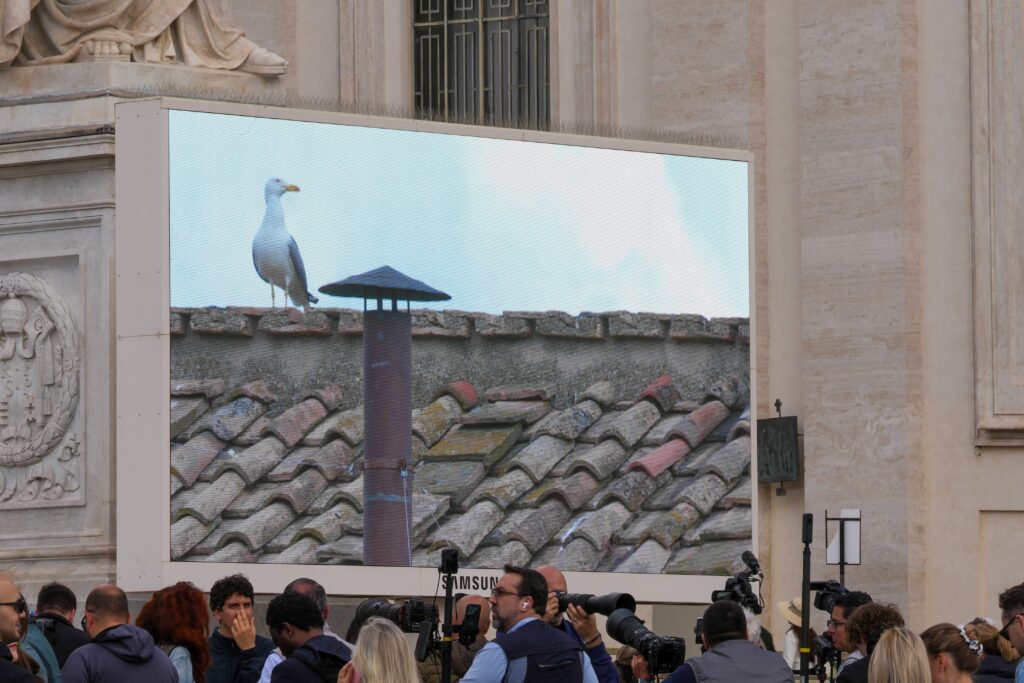
On Wednesday, May 7, my wife had the Vatican news feed of the Sistine Chapel projected on the board of her fifth-grade class, watching for smoke as they went about their lessons. One student raises his hand and asked, quite seriously, “Why did they put those birds up there? What do they mean?”
With a deadpan face, my wife responded, “They flew up there.”
Sometimes, I suppose, things do not have meaning. They just are, and many times we look for meaning when perhaps there’s none.
I thought about that on Thursday, May 8, just a little before noon as I was working at my desk and had the Vatican news feed on my phone, occasionally glancing over to see if I could catch any action from the smoke stack.
How funny, I thought, that the world was transfixed on a hunk of metal, temporarily placed, waiting, anticipating, hoping, wanting to be there as witnesses when the white smoke appears.
Isn’t that, though, how we are as Catholic Christians? Waiting, anticipating, hoping, wanting to be there as witnesses of Christ’s return? That’s what the season of Advent is all about, right?
Then, something caught my eye: a seagull perched on the rooftop, then a second, and there was something else there, too. I turned my complete attention to my phone and noticed that there was also a baby seagull. I watched as it was being fed by an adult seagull.
Immediately, Psalm 84 came to mind: “As the sparrow finds a home and the swallow a nest to settle her young, my home is by your altars, LORD of hosts, my king and my God!”
Watching the bird feed its young also brought to mind the image of the pelican piercing its own breast with its beak to feed its young with its blood, which is a symbol of Christ’s shedding his blood for our salvation. This image is seen in early Christian art to illustrate the Eucharist and redemption through the sacrifice of Christ.
Then came the first wisps of white smoke, and, as it became heavier, the seagulls flew away.
I couldn’t help but think about that student’s question in my wife’s class: “Why did they put those birds up there? What do they mean?”
What could they mean? So, I decided to do a little digging.
There is a tradition that seagulls can be associated with Saint Peter. First of all, he was a fisherman who would encounter seagulls daily, so we can see the connection there. But then I read about a legend that once, when Saint Peter was imprisoned in Rome, a seagull came to him with keys to unlock his chains.
Seagulls can be found in art that depict Saint Peter and could symbolize his protection and intercession. Was I watching Saint Peter’s intercession on a rooftop under which his successor was being chosen?
Also, seagulls can be associated with Saint Francis of Assisi, who is the patron saint of animals. There is a legend that a flock of seagulls once listened intently to Saint Francis preaching before peacefully flying away. Was I seeing an image that invokes the name Francis on a rooftop under which his successor was being chosen?
Was this mystical meaning or mere coincidence?
The answer to me is that it doesn’t matter. What does matter is recognizing God in whatever context we find ourselves in. And if that context, whether smoke stacks or seagulls, leads us to pray for the intercessions of Saint Peter and Saint Francis for the shephardhood our new Pope Leo XIV, then that is meaningful.
Deacon Dean Johnson serves at Church of the Holy Family, Sewell.



 at the bottom and then tap “Add to Home Screen”
