



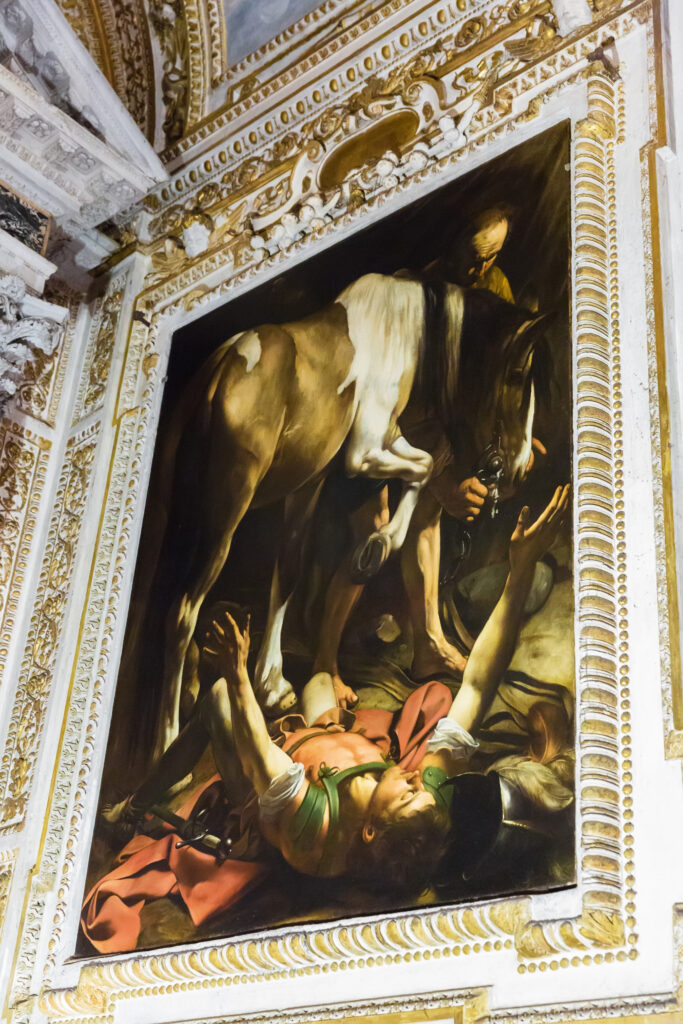
In secular spaces, we often hear that the “scales fell from his or her eyes” when someone comes to a sudden realization or epiphany. Astute Christians know this to be a reference to Saint Paul’s experience on the road to Damascus when he was temporarily blinded by the unapproachable light of the Risen Lord, whose followers had been the focus of the former tent-maker-turned-Pharisee’s rigorist fury.
It is, of course, the painter Caravaggio more than the biblical authors who has impressed upon our imaginations that this swoon had anything to do with a horse, for the text simply says that he “fell to the ground.” But we know that in that moment, perhaps the single most influential figure in the early Christian movement went from “breathing threats and slaughter against the disciples” (Acts 9) to the “Doctor Gentium,” the “Teacher of the Nations,” as Paul is frequently called.
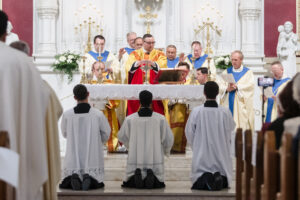
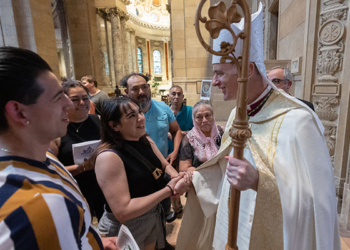
Not only does our new Coadjutor Bishop Joseph Williams hail from the Minnesota region named for Saint Paul, but his episcopal ordination took place on the very feast of this conversion, January 25. That date is an important one in the annals of Christian history, for it was on that day in 1959 that Pope Saint John XXIII shocked the world by calling for an ecumenical council, which would eventually become known as Vatican II. Not coincidentally, this announcement took place at the tomb of the Apostle to the Gentiles.
Most historians claim that the council had twin – and inextricably related —methodologies: ressourcement or renewal (returning to the roots of Christian life through a deeper study of early Church writings and the experiences of the pre-Constantinian Church) and aggiornamento (or bringing up to date the community’s ability to effectively evangelize, minister and believe in a contemporary age).
Both traditional interpretations of Vatican II’s goals can be seen as aspects of its call for conversion: a shift away from the spiritually blinding and narrow focus often criticized as the Church’s triumphalist, clericalist and legalistic tendencies. Thus, Good Pope John had in mind an eye-opening, descaling, perceptive willingness to gaze anew at the ecumenical brother and sister, the non-Christian believer, the newly blossoming mass media and the world at large.
In the post-apostolic Church, the nuptial imagery was robust and widespread concerning the lifelong relationship between a bishop and his local diocese. That spousal analogy is not quite as prevalent today, given the relatively common shuffling that takes place out of necessity in our era. But in his Epistle to the Ephesians, Saint Paul makes clear that Christ “nourishes and tenderly cares” for the Church as a whole in what we can assume is a permanent, monogamous, loving and sacramental relationship. Thus, we can pray that the bonds of collaboration, affection, and mutual respect that exist between the People of God and the bishop called to serve in their midst continue to mirror this lofty and admirable analogy in our own context and experience. We can return often to the Pauline letters, and his own wayfaring church-planting expeditions, for inspiration on this front
The conversion of Paul not only enabled him to bring the Good News to the far-flung cities of Israel, Turkey, Greece, Malta and Italy – and eventually even to a restricted and respectful but real disagreement with the first pope (cf. Acts 15) – but it also strengthened him for what he surmised would eventually be the ultimate cost of his mission, his own martyrdom. That public witness and willingness to suffer on behalf of his community indelibly marked his own autobiography and thus our tradition, and was one of the primary reasons Rome came to be recognized as the center of the Catholic world.
May we realize that God today repents neither of such demands nor of such potential rewards, as we set off on a new and exciting endeavor together as the Church in and of Camden, the United States, and an interconnected world, one ever more attuned not only to the central elements of our shared past, but also to the peripheries and the peripheral in our present.
An alumnus of Camden Catholic High School, Cherry Hill, Michael M. Canaris, Ph.D., teaches at Loyola University, Chicago.





 at the bottom and then tap “Add to Home Screen”
