




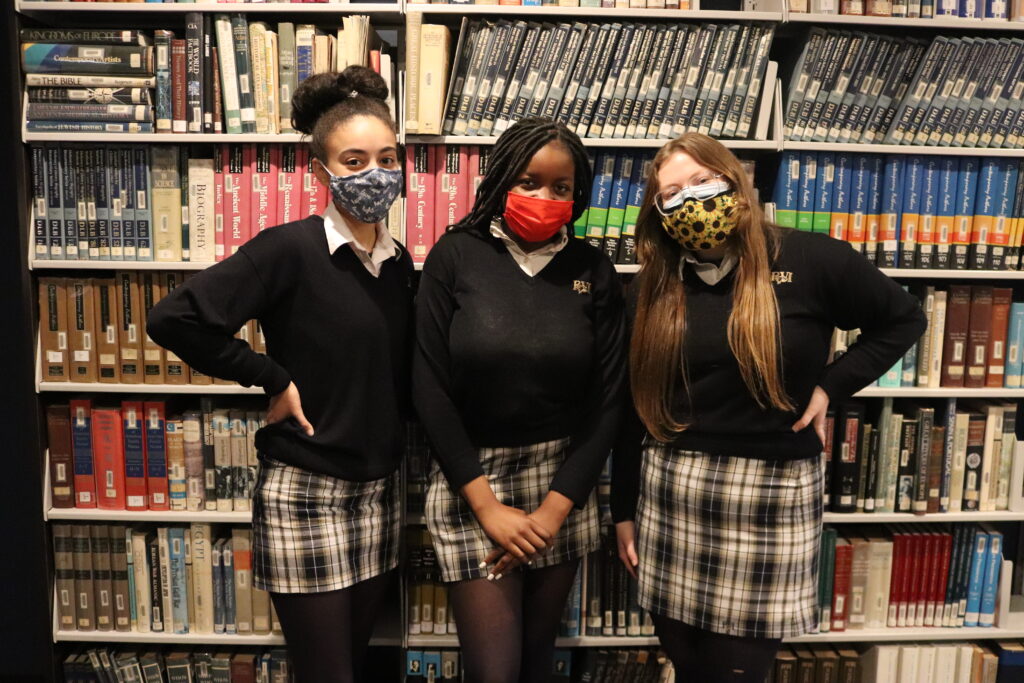
The Catholic Star Herald recently met with students and faculty moderators at three diocesan high schools to learn about the role of Black History Month in their schools and the ways students help with planning. While students value Black History Month and believe it is important to focus on the contributions of African Americans, they see it as part of a bigger picture about the need for inclusion, diversity and understanding all year long. They cherish open conversations and feel supported by leadership in their school.
Camden Catholic
“Conversations are so important,” says Suzy Ndandji, president of Together Honoring Everyone — simply T.H.E. Council — at Camden Catholic High School in Cherry Hill. Student initiated and led, T.H.E Council is dedicated to celebrating cultural diversity through a respectful exchange of ideas.
Council co-vice president Justin Seo said T.H.E. Council has served an added purpose during the pandemic, stressing the importance of inclusivity at a time when people are feeling separated and isolated.
Throughout Black History Month, members of T.H.E Council researched and shared school-wide the contributions of several African Americans. They chose individuals who interested them personally. For Ndandji, it was a favorite author, Zora Neale Hurston.
Drawing on his devout Catholic faith, Seo was enthusiastic about sharing information on Cardinal Wilton Gregory of Washington, highlighting his work on social justice issues.
“Black History Month is a celebration of culture, and that really defines what the T.H.E. Council’s purpose is. We do that day in and day out with our meetings,” said Ndandji. “It’s a celebration of American culture.”
Seo said it’s important for leaders to introduce topics without showing bias to ensure open discussions. “We want to hear your opinion,” he said. “We don’t want you to change your opinion just because you’re part of T.H.E. Council.”
Seo also invests significant energy in a series of videotaped, “uncomfortable conversations,” most recently exploring curriculum and identity. Now he is working on conversations for Women’s History Month.
“You don’t have to interview the most famous person to understand the message that conversations are important,” he said.
Ndandji believes T.H.E. Council’s work has particular significance in a Catholic school. “The idea that we’re created in God’s image and likeness is at the crux of this school,” she said. “We really value that. We try to incorporate religion into everything we do. It always comes back to God.”
T.H.E. Council’s work this year has led to the development of an African American Humanities course. “We are trying to instill a future for T.H.E. Council, especially with the African American course,” said co-vice president Nayeli Gomez. “We want to leave a legacy for everyone to be reminded that in the eyes of God we are all equal.”
The student leaders credit faculty moderator Jeffrey Bruckner for helping them move the course forward.
These three students can make anyone feel good about the future of our society, said Bruckner. “They exemplify seeing others as children of God.” Co-moderator Joya Oasin says the team has done a great job mentoring younger students, who are emerging as new leaders.
Gloucester Catholic
It’s no coincidence that Gloucester Catholic High School holds its Racism and Justice Retreat during February, Black History month. The Be a Latino for a Day retreat is held during Hispanic Heritage Month, and Welcome the Stranger is a retreat opportunity during Immigrant Heritage Month. But as faculty moderator Alaina Silber is quick to point out, related conversations are important all year long.
The retreat series began about six years ago, when a student shared with Silber his experience as a person of color in the school. “He was really open about feeling like he was an outcast. He wasn’t being represented,” she said. So Silber gave him an opportunity to take action. Together, they planned the first retreat, which has grown into a series of retreats and events led by students designed to spark conversation and embrace diversity.
Senior Jadon Schoolfield recalls sharing his story at the Racism and Justice Retreat during his junior year. “I was the [retreat] leader and I told a story about a time I was racially profiled,” said Schoolfield. He said it was easy to share because he felt comfortable with, not judged by, fellow students.
“I’m known for being kind of like a goofball. I joke around a lot,” he said, adding that it felt good to reveal a more serious side of himself. Schoolfield, who has been at Gloucester Catholic since freshman year, admits he didn’t always feel as secure with his classmates.
“Just the image of me being from Camden made people a little intimidated, or alerted,” he said, reflecting back to his early days in the school. But he said that changed as people got to know him, and he has found a comfortable home at Gloucester Catholic.
While full-day retreats have not been possible this year because of the pandemic, Gloucester Catholic has kept the conversation alive with shorter, in-school gatherings. In their recent session on race and justice, students shared their experiences managing issues related to mental health, sexual orientation, religion and race.
“I told a story about when they would say the N-word,” said senior leader Sam Barber. Barber transferred from a large public school as a junior and said he’d found the transition easy, the school welcoming. But unspoken were his feelings about the use of the N-word (presumably in a spirit of camaraderie). After speaking openly about it, a classmate came to him and said, “I’m sorry. I never knew it really bothered you.” Barber said he was grateful for the acknowledgement and glad he had spoken out.
As they prepare to graduate from Gloucester Catholic, Barber and Schoolfield said the retreats have been an important part of their high school experience.
“People should be open and not be in a bubble and scared to speak their mind,’ said Schoolfield.
Paul VI
At Paul VI High School in Haddonfield, student planners see Black History Month as an important element in a larger story. “I feel like a lot of people forget that Black History is part of American history,” said Nyasia Miller, a leader in the school’s African American club.
To celebrate the month, students came up with a list of inventors, scientists and other figures who have made important contributions to American ulture, but might not be household names. They live-streamed featured stories on the school’s daily news show during homeroom.
Miller and Santos, along with classmates Angwi Moutcia and Abbigail Ealer, moved quickly beyond the scope of Black History Month, agreeing that they have seen a shift in attitudes and interest during their four years at PVI.
Moutchia credited COVID and a summer of protests for generating more engagement in conversations about racism and diversity.
“I also feel like the basis of the club changed,” she said. “At first it was more like a safe place for African American students to meet.” Now, Moutchia said, the club has broader appeal.
Santos said students and teachers have done more to “learn on their own time, especially with the climate of the world right now. That opened up opportunity for everyone to come together and grow as a whole as well as individually. It gave us more to talk about and to work with.”
The foursome, all seniors and members of the school’s anti-racism committee, hope their legacy lives in recommended curriculum changes. Ealer explained they plan to meet with history and literature teachers to talk about changes “that can include a more diverse history and literature with Black authors, Black figures to study, Asian authors, Asian figures to study … people of color that need to be included within our curriculum.”
Ealer says she has already seen a greater comfort level with “more difficult conversations when it comes to race.”
Miller said school administrators are open to input from students. “Going to a Catholic school, especially PVI, we’re more of a family school, so everyone knows each other and is comfortable,” she said.
“We could have had an administration that didn’t care about these issues, or because they couldn’t relate weren’t empathetic. But Mr. Burke and Sister Marianne (McCann), our principal, definitely put this at the top of the list of priorities,” said Moutchia.
Moderator Joe Burke complimented the team’s leadership and said several teachers have started coming to meetings “simply to listen” to what’s on students’ minds.
“I will never forget these students in this club for what they’ve done for me as a person, to broaden my knowledge, my experience, to give me more empathy,” said Burke.




 at the bottom and then tap “Add to Home Screen”
