



The need to form professional ministers imbued with a spirit of missionary discipleship, an increasingly important task in recent decades with the shrinking number of ordained priests in many places, has only been exacerbated by the demands of the pandemic. The shifting landscape of global Catholicism in the 21st century mandates appropriate pastoral responses to the challenges of our day. Loyola University Chicago’s Institute of Pastoral Studies has been engaged in this work across not only our graduate programs, but also in terms of the process of life-long learning in our continuing education and professional certificate programs. I am delighted to be teaching the opening module for the fourth cohort of one such program we have developed in partnership with the Archdiocese of Liverpool, in service to the local church across the whole of England and Wales.
The customized certificate consists of 10 six-week modules delivered in an online format, allowing up to 50 participants the freedom and flexibility of study in their own home. Faculty from both the United States and the United Kingdom offer short courses on vocational discernment, scriptural interpretation, particular contexts (in this case, British church history), the Second Vatican Council, Catholic Social Teaching, and parish-building and renovation strategies.
The participants include lay ministers specializing in various services to the church and world, as well as permanent deacons in formation. Partners on the ground help seek out potential registrants from parishes and diocesan offices, and provide opportunities to gather for prayer, reflection and creative engagement with the overall themes and skill sets being developed.
I spoke this week with the program’s lead voice, Assistant Dean for Continuing Education, Mariana Miller, who is herself keenly aware of the global need for such collaborative projects, coming to Loyola from Argentina via Boston College and Creighton University.
She explained: “These kind of flexible, life-long learning programs are ideal both for people who already have a ministry degree and want to sharpen their skills and also for people coming from other professions who are looking for either a retirement occupation or are looking for formation in order to get more involved in their parishes. We also believe programs like this would be wonderful in the U.S. for different dioceses to offer in complement to our graduate degrees, but directed towards those who are more focused on seeking to develop necessary practical skills for ministry and outreach work. The program is customized and we have the capability to deliver it in Spanish, as well as in English. The other dimension that’s been very positive for the UK program is that deacons in formation study and reflect alongside lay people from around the country there. Both the deacons and the lay students have shared that this has been extremely enriching.”
There has been discussion about crafting similar online certificate programs for Catholic school teachers and those involved in work with migrants and human trafficking victims. We already offer a distinct certificate in Restorative Justice Ministry, in collaboration with Cook County criminal justice, legal, and correctional facility partners.”
Programs like these fulfill the Second Vatican Council’s exhortation that the entire church community “read the signs of the times” if evangelization is to take root in every generation. The ability to teach and learn across an ocean, and to exchange the successes and failures, the longings and laments of lay leadership in various contexts, has proved transformative for the nearly 200 people who enrolled in the program, and the dozens of faculty and administrators who have worked to refine and improve it since its founding.
More information can be found at: www.luc.edu/ips/continuing-education.
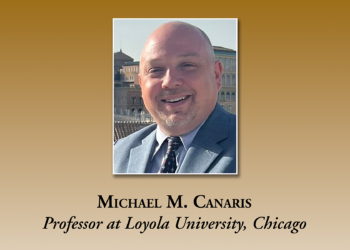
Originally from Collingswood, Michael M. Canaris, Ph.D., teaches at Loyola University, Chicago.



 at the bottom and then tap “Add to Home Screen”

