



Each Sept. 21 marks the feast of Saint Matthew, the tax collector-turned-evangelist. And while the two “bifocals” of Ignatian and Franciscan spirituality are the most common lenses through which scholars frame understanding Pope Francis, there is undoubtedly an under-appreciated “Matthean” one present there as well.
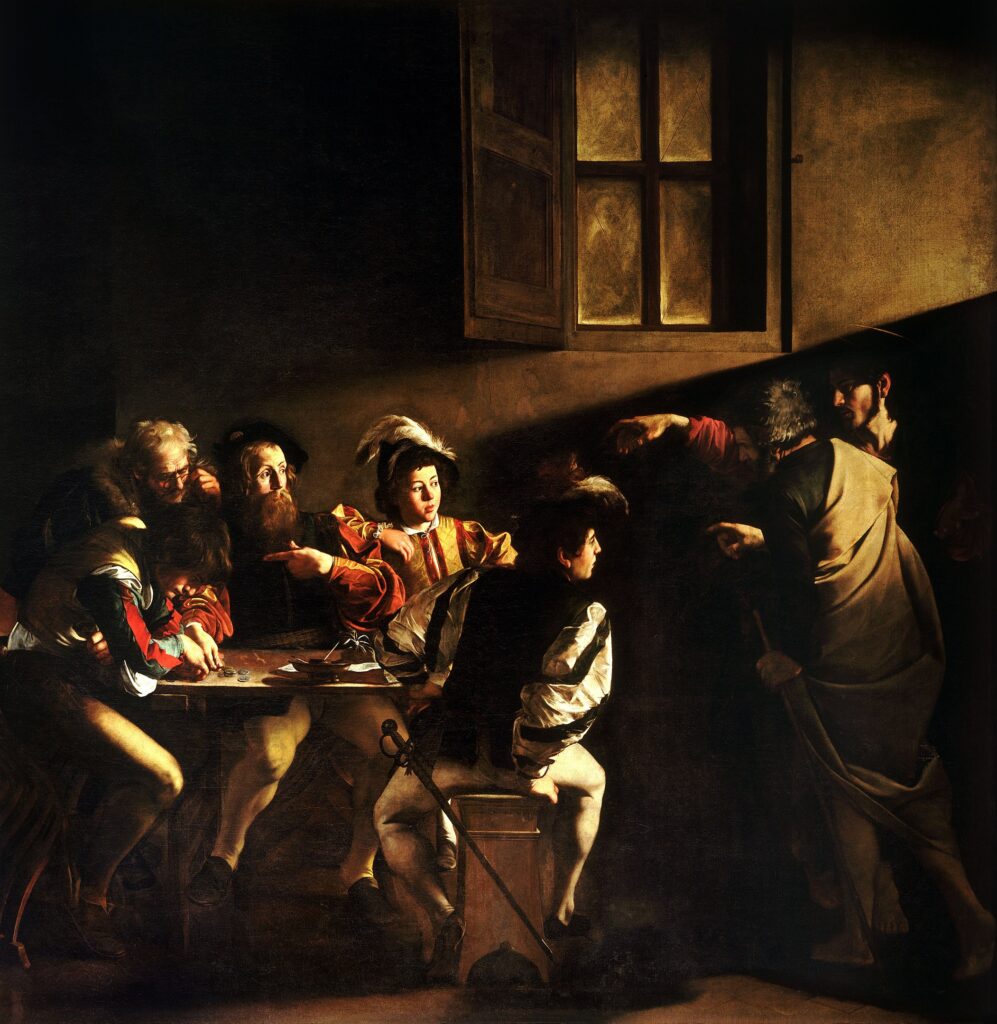
Much of this stems from one of two works of art that the pope has said are among his favorites — Caravaggio’s “The Calling of Saint Matthew” located in the church of San Luigi dei Francesi, not far from Rome’s Piazza Navona. The other is “Mary, the Undoer of Knots” in Bavaria’s Perlach church.
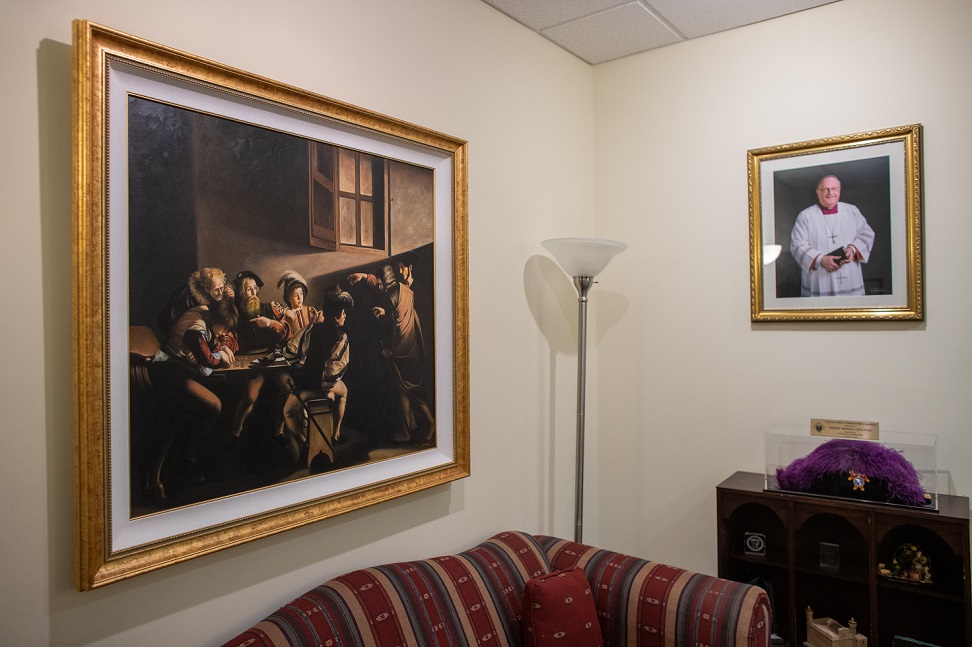
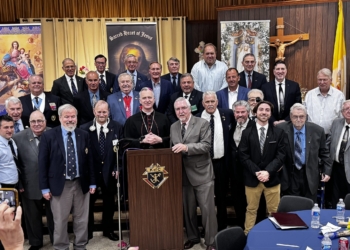
(At a press conference in 2013 to announce that Pope Benedict had appointed Bishop Dennis Sullivan as bishop of Camden, Bishop Sullivan also spoke of the painting, saying that Saint Matthew’s reaction reflected his own feelings.)
In an interview given with Antonio Spadaro, S.J. in the days immediately following his inauguration ceremonies, Pope Francis said that he always cherished his visits to contemplate the Caravaggio painting when he was passing through Rome from Argentina.
He comments in that interview, with intervening commentary from the questioner:
“That finger of Jesus, pointing at Matthew. That’s me. I feel like him. Like Matthew.” Here the pope becomes determined, as if he had finally found the image he was looking for: “It is the gesture of Matthew that strikes me: he holds on to his money as if to say, ‘No, not me! No, this money is mine.’ Here, this is me, a sinner on whom the Lord has turned his gaze. And this is what I said when they asked me if I would accept my election as pontiff.” Then the pope whispers in Latin: “I am a sinner, but I trust in the infinite mercy and patience of our Lord Jesus Christ, and I accept in a spirit of penance.”
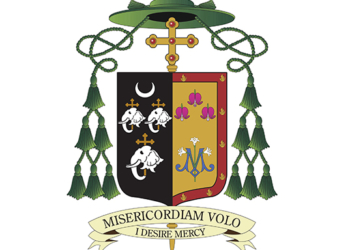
This connection goes even deeper, as Francis’ motto on his coat of arms is Miserando Atque Eligendo, a notoriously difficult phrase to translate into English. Usually it comes to us as something like “Mercying him, he chose him.” The original Latin is taken from Saint Bede’s Commentary on the Gospel of Matthew, so these interlocking thematic building blocks of mercy, vocation and conversion have deep personal and ecclesiological significance for Bergoglio the man and for his vision of the church.
In Caravaggio’s painting, Christ’s hand is an almost direct replica of the earlier Michelangelo’s famous and familiar “spark of life” where God the Father touches the outstretched Adam’s in the moment of creation. But in Caravaggio’s, Peter’s hand, which modern technology has taught us was added late in the painting’s development, weakly imitates Jesus’s imitation of the Sistine ceiling. Some posit that this is a commentary by Caravaggio on the excesses of the church in his day, that too often official representatives serve as debilitated and distorted impediments to the clarion call of Jesus’s mission in the Gospel, rather than aids to it. I would not be presumptuous enough to think that this merely referred to popes, bishops and cardinals, and not to other teaching voices in the church — such as academic theologians. It is a piercing critique which can in fact speak to all Christians about the need to interrogate our lives regarding whether we manifest or block the gracious, unmerited and astonishing Light of the World, pouring into the image to brighten the dark shadows of the money-counter’s table. One can also notice the allusion to the inescapable demands of the cross in the window above him, and that Christ’s feet are turning already toward the door, because he has much work left to be done.
Other scholars have posited whether the figure traditionally thought to be Matthew with his famous “Who me?” pose is not instead pointing to the young man to the viewer’s left, so entranced with his coins that he doesn’t even look up at Christ. Not “Who me?” but rather “Surely not him?” If it’s the latter, the central character is still undoubtedly in a moment of sinful confusion preceding graced recognition, where he mistakenly thinks only certain kinds of people might be considered acceptable conduits of such a prophetic message. Perhaps it is intentionally ambiguous, and we are meant to find ourselves in both characters.
In Saint Matthew’s Gospel, Jesus is presented as the New Moses, the fulfillment of the Law given to the Israelites on Mount Sinai, moving the people beyond the distortions that had seemed to imply that human beings were made for the Sabbath, and not the reverse. Of course, this can never be understood as an indictment of the Jewish people, but rather points to the human disfiguring temptation to idolatry that threatens all of us to exchange love of God for a lesser good in every moment, every passion, every profession and every relationship.
Matthew’s is also the only Gospel where Jesus provides Peter with the keys of governance, to loose and bind on heaven and earth, and for that reason was chosen to ring the dome above the high altar at Saint Peter’s Basilica. Francis undoubtedly feels the weight of that responsibility, albeit while exhibiting an entirely new way of exercising that Petrine (and Matthean) authority.
Originally from Collingswood, Michael M. Canaris, Ph.D., teaches at Loyola University, Chicago.





 at the bottom and then tap “Add to Home Screen”
