


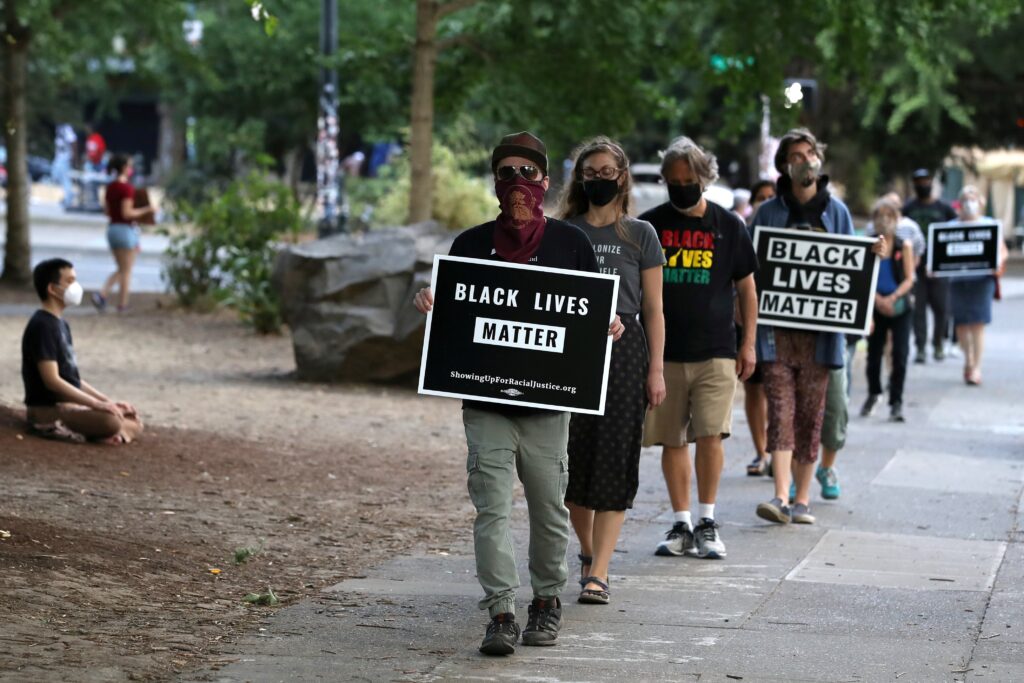
Does “Black Lives Matter” need to be said in our country?
The expression “Black Lives Matter” certainly elicits a speedy reaction. We are a society in love with speed and we tend to form quick and often passionate opinions. However, a passionate opinion is not the same as an informed opinion.
Our brains make an enormous number of decisions in a day. In order to successfully navigate things like a business meeting or identify risks while driving, the brain takes many shortcuts. These shortcuts, or biases, are absolutely essential for living, but they are not always helpful. For example, when we hire a person, our biases often lead us to people like ourselves.
We generally lean toward a candidate who went to the same school, has a similar family, speaks with the same accent, has the same skin color, religion or favorite sports team. Conversely, we lean away from people who speak with a different accent, went to a school we competed against or, worst of all, root for the Dallas Cowboys; they are just a sliver less likely to be selected. These slivers add up. When the majority of decision makers share common traits like race or gender, what started out as mostly harmless biases become a system of injustice against people different from the ones making decisions — without anyone, or very few, meaning for this to happen.
Notably, although 60% of the population of the U.S. are white and 13% are Black, the following statistics are eye opening:
— U.S. Senate Composition: 89% white, 3% Black (Source: 116th U.S. Congress)
— U.S. Governors Composition: 92% white, 0% Black (Source: Wikipedia)
— Book publisher editors: 85% white, 5% Black (Source: https://blog.leeandlow.com/2020/01/28/2019diversitybaselinesurvey/)
— College professors: 76% white, 6% Black (Source: pew research us college faculty student diversity)
And further:
— A Black person is five times more likely to be arrested and convicted for a crime than a white person (source: U.S. Dept of Justice, U.S. Census)
— A Black person is twice as likely to live in poverty (source: usapoverty.org)
— A Black person is three times more likely to be killed by police (Also DOJ and U.S. Census).
— According to 2017 data analyzed at https://policeviolencereport.org/ Black people are 4.5 times more likely to die at the hands of police when they are unarmed and not attacking than white people. (Hispanic people are 3.5 times more likely).
If this data is true, then we must at least admit the possibility that our institutions — overwhelmingly controlled by white people — have injustice baked into them. This is the definition of institutional racism. It is in this context that Black Lives Matter is born.
One of the difficulties in the current debate is the term “racism” itself. The vast majority of us are appalled at the thought that anyone would consider us to be racist. The picture that we draw is one of overt racism, people who violently put down people of color or believe in white supremacy. Although this is a terrible evil, it is not the main source of our problem today. Our built-in institutional discrimination is the result of historical overt racism and natural biases that lead law makers, teachers, news editors, police officers, judges, juries and even ourselves to unwittingly perpetuate injustice.
Although we may not feel the sting of racism, many of those we love or are called to love, do and they are hurting. My grandson is biracial. He has spent much of this spring saying, rather loudly, “You’re not listening to me,” when he tells me of his several experiences that he believed were racially motivated. As he continued to relay these stories, he finally got me to consider that maybe he wasn’t just imagining racism, but that he had really experienced it. My daughter’s fiancé is Black. He will not walk in my neighborhood (95.4% white) at night. He considers it too dangerous. A colleague at work relayed to me how uncomfortable it was to have “the talk” with her teenage sons when they got their driver’s license about how to minimize the danger they might face in a routine traffic stop.
The preamble of the U.S. Constitution begins, “We, the people, in order to form a more perfect union, establish justice, insure domestic tranquility, provide for the common defense, promote the general welfare, and secure the blessings of liberty to ourselves and our posterity. …”
Institutional racism does violence to all of these promises and disrupts the unity and love that Jesus commands. In Paul’s letter to the Ephesians, speaking of Christ’s sacrifice so that all may be one, he writes: “For he is our peace, he who made both one and broke down the dividing wall of enmity, through his flesh.”
So, yes, Black Lives Matter needs to be said, and we need to slow down enough to hear it, to check our biases and privileges, then use the influence of our positions of authority, and our spoken and written opinions to promote the justice that we are called to as Americans and Catholic Christians.
Deacon Bob Hamilton serves at Holy Eucharist Parish, Cherry Hill.




 at the bottom and then tap “Add to Home Screen”
