





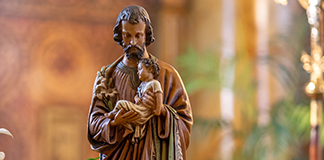
As we transition into March, Catholics are collectively moving into the month normally dedicated to Saint Joseph. In 2021 this takes on added significance during the extraordinary year called by Pope Francis to especially memorialize his veneration. March 19 will then not only mark the eighth anniversary of the inauguration of the current Holy Father to the role of pontiff (whose choice of that day was intentional), but also serves as the spiritual capstone feast around which this whole special year is envisioned.
Exactly 150 years ago, Pope Pius IX named Saint Joseph the patron of the universal church, responding to calls to seek his intercession because of what were then viewed as traumatic events of the 18th and 19th centuries. (We must be careful in how we honestly assess these events in light of history, because among some of these concerning “threats” from the Vatican’s perspective during this era would be things like the French and American revolutions and Darwin’s theses about evolution). But the connection between the community’s ongoing trials in the world and the veneration of Christ’s foster father during his earthly life continue to have relevance in our day.
In his document calling for the year of dedication, titled Patris Corde (“With a Father’s Heart”), Pope Francis reminds us that Joseph plays a special role in protecting the church in the contemporary era from issues that continue to plague us today. Whether it be themes of migration, the lack of dignified labor, the pandemic, or the demand to raise children with physical and emotional presence, attention and care, Joseph is uniquely positioned to inspire us in the demands of our Christian life in the 21st century.
The pope has made known that for more than 40 years he has closed his daily morning prayer of Lauds with a special request to “San Jose.” He has asked him every day to “Let it not be said that I invoked you in vain, and since you can do everything with Jesus and Mary, show me that your goodness is as great as your power.”
There are numerous regional traditions associated with Joseph around this time of year. A Sicilian one which has spread all over Italy and even to our shores is to eat zeppole (crème- or ricotta-filled fried donuts) on this feast day to mark the abundance that the patron provides to those that turn to him in times of need or want. Polish families often eat sauerkraut and meatless dumplings to celebrate even within the traditional Lenten fast. In New Orleans, Saint Joseph’s altars are elaborately decorated with food, religious trinkets and gifts that are eventually shared with the poor. And in Spain, his feast quite naturally marks a Christian way of choosing when to celebrate Father’s Day.
Joseph is also the patron saint of a happy death, as it is often said that he died in the arms of Mary and Jesus (perhaps even on March 19), though there is very little historical evidence to validate these assertions. In fact, we don’t know much at all about his personality or him as an individual figure, because unlike most of the other men and women we venerate from the Scriptures, Joseph is “silent” in the text, with no direct words being ascribed to him. This has, of course, also influenced a spiritual and meditative image of him into our own day, as one who courageously accepts the will of providence without complaint or hesitation. Pope Francis says “Joseph found happiness not in mere self-sacrifice, but in self-gift. In him we never see frustration, only trust. His patient silence was the prelude to concrete expressions of trust.”
The whole world would do well to pay particular attention to the unanticipated demands placed upon Joseph and his ready response, which echoes into our own day: the need for ongoing life-long conversion of heart and mind, what the pope calls “the grace of graces.”
Originally from Collingswood, Michael M. Canaris, Ph.D., teaches at Loyola University, Chicago.




 at the bottom and then tap “Add to Home Screen”
