





The remembrance of the events surrounding the Death and Resurrection of Jesus makes Holy Week the most sacred time of the year for Catholics.
How will you balance the sacred part of Holy Week with all of life’s responsibilities?
Start by making a list of everything that needs to be done during Holy Week. Then block out time in your calendar for attending Holy Week liturgies. Be sure to set aside specific times every day during the week for Lenten devotions, quiet prayer, Scripture reading and meditation.
Your greatest temptation will be scrimping on your spiritual needs because there is so much going on. If you let that happen, your Easter celebration may look perfect on the surface, but will feel spiritually unsatisfying.
To prepare, here is a look at the movements of Holy Week and each day’s readings:
Palm Sunday
Readings: Mk 11:1-10/Jn 12:12-16; Is 50:4-7; Phil 2:6-11; Mk 14:1-15:47
Palm Sunday of the Lord’s Passion, the Sixth Sunday of Lent, marks the beginning of Holy Week. The Mass on this day commemorates the triumphal entry of Jesus into Jerusalem when people waved palm branches and shouted “Hosanna.”
Before Mass begins, palms are blessed, and there is a procession that symbolizes the beginning of the spiritual journey into the Paschal Mystery that will unfold throughout Holy Week.
During the Mass, the full Gospel account of the Passion and Death of Jesus is read. The priest usually takes the lines attributed to Jesus. Several lectors take other parts. The people in the pews read the lines attributed to the crowd.
People are encouraged to take the blessed palm branches home where they can be fashioned into crosses or placed behind a crucifix.
The blessed palms that are left in the church are burned and used for ashes the following year on Ash Wednesday.
Monday of Holy Week
Readings: Is 42:1-7; Jn 12:1-11
The Gospel reading this day recalls the woman who anointed Jesus with oil.
Tuesday of Holy Week
Readings: Is 49:1-6; Jn 13:21-33; 36-38
The Gospel offers a hint of the events to come as Jesus predicts the betrayal of Judas and the denial of Peter.
Chrism Mass
Readings: Is 61:1-3a, 6a, 8b-9; Rv 1:5-8; Lk 4:16-21
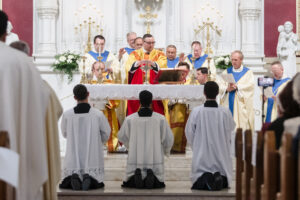
During Holy Week, bishops bless sacred oils in the diocesan cathedral at a special liturgy known as the Chrism Mass. In the Diocese of Camden, the Chrism Mass will be celebrated at 3:30 p.m. March 26 at Saint Agnes Church, Our Lady of Hope Parish, Blackwood.
The oil of chrism is used during baptisms, confirmation, ordination and the consecration of altars. The oil of catechumens is used at the Easter Vigil. The oil of the sick is used to anoint people during the sacrament of the anointing of the sick.
The oils are then distributed to the parishes for sacramental celebrations throughout the year.
As part of the liturgical reforms of Vatican II, the renewal of priestly promises was incorporated into the Chrism Mass.
The Chrism Mass is an ancient celebration that traditionally takes place on Holy Thursday morning. But in recent years, many dioceses celebrate the Chrism Mass on an evening earlier in Holy Week so that more people can attend.
Wednesday of Holy Week
Readings: Is 50:4-9a; Mt 26:14-25
This day is traditionally referred to as “Spy Wednesday” because it recalls the decision of Judas to betray Jesus for 30 pieces of silver.
Holy Thursday Mass of the Lord’s Supper
Readings: Ex 12:1-8, 11-14; 1 Cor 11:23-26; Jn 13:1-15
The Mass of the Lord’s Supper commemorates the Passover meal that Jesus shared in the Upper Room with the apostles on the night before he died. Before the meal, he washed their feet to impress upon them the call to serve others. The Church recognizes the Last Supper as the institution of the Sacrament of Holy Orders.
During the meal, Jesus also instituted the Eucharist by transforming bread and wine into his own body and blood.
After the meal, Jesus went to Gethsemane, where he suffered the agony in the garden, the betrayal of Judas and the brutality of being arrested.
The Mass of the Last Supper is a dramatic liturgy with the priest washing the feet of 12 parishioners.
After Communion, the altar and sanctuary are stripped and there is a procession with the Blessed Sacrament, which is taken to a separate altar of repose, usually located on a side altar or in a chapel. There is no dismissal or final blessing. It is the last time the Eucharist will be celebrated until the Easter Vigil.
People leave in silence, but continue to keep a vigil with Jesus in their hearts in anticipation of the events that will take place.
Good Friday
Readings: Is 52:13-53:12; Heb 4:14-16; 5:7-9; Jn 18:1-19:42
The Celebration of the Lord’s Passion on Good Friday is a somber service that commemorates the Crucifixion, Death and Burial of Jesus. Because it is considered a continuation from the night before, the liturgy begins in silence. The priest enters and lies prostrate at the foot of the altar.
The service begins with the Liturgy of the Word, which includes a reading about the suffering servant in Isaiah, a psalm, a reading from the book of Hebrews, and the account of the Passion and Death of Jesus from the Gospel of John. During this part of the liturgy, there are special prayers for all the people in the world.
The second part of the liturgy is the veneration of the cross, an ancient practice that allows each person to touch or kiss the instrument of torture that leads to salvation.
The third part of the liturgy is a Communion service with hosts that were consecrated the night before. Afterward, the tabernacle is left empty and open. The lamp or candle usually situated next to the tabernacle, denoting the presence of Christ, is extinguished.
People leave the church in silence.
Easter Vigil
Readings: Gn 1:1-2:2/ Gn 1:1, 26-31a; Gn 22:1-18/ Gn 22:1-2, 9a, 10-13, 15-18; Ex 14:15-15:1; Is 54:5-14; Is 55:1-11; Bar 3:9-15, 32–4:4; Ez 36:16-17a, 18-28; Rom 6:3-11; Mark 16:1-7
The mystery and ritual of the Easter Vigil touch the deepest part of people’s souls with elements of darkness, light, silence, music, fire, water and oil, along with bread and wine that become the body and blood of the risen Lord. They are reminded that new life in Christ can never be overcome by darkness or death.
In the first century, the early Christians celebrated every Sunday in commemoration of the Resurrection of Jesus. By the second century, they established a particular day for the celebration of the Resurrection, which was connected to the Jewish Passover.
Their observance began at sundown on Saturday evening. They called it the Night of the Great Vigil, a time of remembrance and expectation that lasted throughout the night so they could sing “alleluia” at dawn on Easter morning. It was during the Night of the Great Vigil that new Christians were received into the Church.
By the fourth century, it became customary for people to make pilgrimages to Jerusalem to celebrate what was called the “Great Week.”
Over time, the practice of observing Holy Week spread throughout the Christian world, with prayers, historical re-enactments and special liturgies. During the Middle Ages, the celebration of the Easter Vigil gradually fell out of practice.
In 1955, the Vatican re-established the Easter Vigil as an important part of Holy Week observances.
During the Second Vatican Council (1962-1965), the bishops called for the restoration of the early Christian rituals for receiving new Christians into the Church at the Easter Vigil. In 1988, the Rite of Christian Initiation of Adults was issued.
Today, the Easter Vigil begins the Easter fire, the lighting of the paschal candle, the readings of salvation history, the celebration of the sacraments of initiation for catechumens and renewal of baptismal promises for the faithful.
The Exultet, an ancient song of proclamation that gives thanks and praise to God, is sung. During the Liturgy of the Word, Scripture readings and psalms help people reflect on all of the wonderful things God has done throughout salvation history.
Easter Sunday
Readings: Acts 10:34a, 37-43; Col 3:1-4; Jn 20:1-9
For the early Christians, the celebration of Masses on Easter morning developed as a way to accommodate people who were unable to attend the Easter Vigil.
Today, Easter Sunday Masses are joy-filled celebrations of the risen Lord with the singing of the Gloria and alleluias, the renewal of baptismal vows, and a sprinkling with Easter water. After sharing in the Eucharist, people go forth strengthened in faith to serve the Lord and one another.
Easter Sunday marks the beginning of the Easter season, which will last the next 50 days and include the celebration of Jesus’ ascension and the descent of the Holy Spirit on Pentecost.
By Lorene Hanley Duquin




 at the bottom and then tap “Add to Home Screen”
