





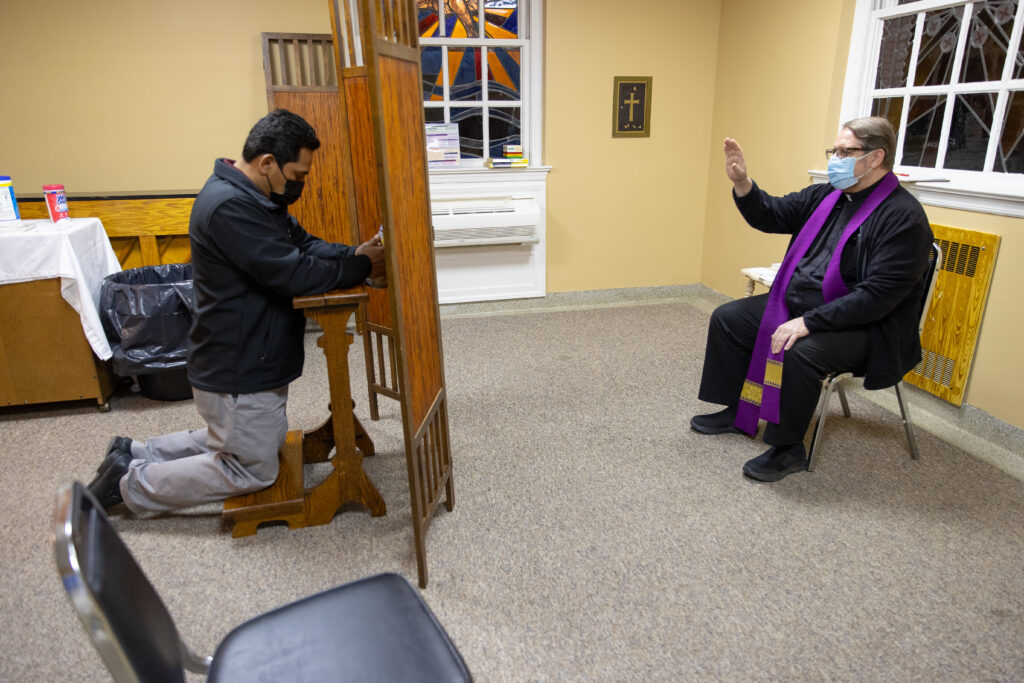
Our diocese has a Lenten tradition called “The Light is On.” It is the sacrament of reconciliation (confession or penance) celebrated in every parish, every Wednesday evening beginning at 7 p.m. “The Light is On” is an open door, a place of welcome, a light in the darkness. It is like the lighthouses along the shores of our diocese that shine upon a foreboding ocean or bay leading vessels to safe shores.
Reconciliation is a light for the Catholic lost, afraid or living in the darkness of one’s sins. It is an invitation to peace and to trust in Jesus’ merciful love. Reconciliation is the cornerstone of the church’s ministry of forgiveness. In the Greek of the New Testament, “ministry” connotes “service.” Jesus refers to himself as “servant” and invites his disciples to imitate him as such (see Jn 13:12-15).
The ministry of forgiveness, entrusted to the Apostles and passed on in the church, manifests in the “here and now” Jesus as Servant, as Good Shepherd who seeks the lost sheep, and as Divine Physician who did not come “to call the righteous, but sinners to repentance” (see Lk 5:27-32). Personally, when I face the shame of my own sins, it is wonderful to hear the words of absolution (forgiveness) bestowing pardon and peace. A weight is lifted and, as Father Michael Schmitz says, “One leaves the confessional victorious!”
The sacraments of the church, her liturgy, her teachings, as well as her works of mercy, justice and peace manifest Jesus ministering today. When Jesus came to save humanity (see Jn 3:16-18), he did not come to bestow knowledge that merely illumines minds — a sort of exclusive doctrine leading to salvation. Rather, he fully immersed himself in the human experience, becoming human himself, except in sin. He proclaimed repentance and the Kingdom of God combining these with actions that touch mind, body and spirit. He changed water into wine, giving joy to the wedding guests. He touched the shunned, leprous man, healing him. He embraced children, blessed them, and placed his hands upon them (see Mk 10:16). He multiplied bread and fish for the crowds. He described himself as the Good Shepherd seeking the lost sheep. He is “the Bread of Life” given entirely in the Eucharist (see Jn 6:48-59). He called disciples personally and formed them to become friends and partners in mission (the Twelve, the 72 disciples and the women). He sent out the Twelve to baptize and heal with oil (see Mt 28:16-20 and Mk 6:13) and the 72 in pairs to proclaim the Gospel.
The followers of Jesus, at Pentecost, became “church,” that is, those called together and sent. In confession Jesus continues this same personalized method of ministry. When a bishop or priest extends his hand in absolution pronouncing words of pardon and peace, the penitent sees and hears Jesus himself forgiving. Jesus, through the church, brings not only “soul salvation,” but “whole salvation” to mind, body and spirit.
“Once a Catholic, always a Catholic.” I have heard confessions of Catholics being away 40 years or more. It is moving to see the Holy Spirit drawing them to the healing grace of reconciliation. The sacrament of reconciliation is the Parable of the Prodigal Son in action (Lk 15:11-32). Penance is the merciful Father who “here and now” searches for and runs to the lost, embracing them, saying: “You are my child, not a servant!” Confession also reconciles the penitent with the church community in which the Father insists to the older, unforgiving son that his lost brother is truly his brother and part of the family [the church].
Occasionally I hear: “I don’t need a priest for forgiveness; I go directly to God.” It is ironic that we tell (perhaps even brag about!) our sins to buddies, to the bartender, to the hairdresser; we even post them on Facebook, Twitter, etc. However, we rebuff going to a priest who represents the Divine Physician. It takes humility to go before another and confess one’s sins. I feel the uneasiness at times. Still, when a penitent makes the sign of the cross, I invite her or him to gaze upon the crucifix and unburden their sins upon the Crucified One who bore them (see 1 Pt 2:21-24). I, the priest, am a sinful disciple, yet chosen. I, too, like the Apostles, am carrying on what Jesus had commanded them to do as he breathed on them saying: “Receive the Holy Spirit. If you forgive the sins of any, they are forgiven; if you retain the sins of any, they are retained” (see Jn 20:22-23). The Apostles, who denied and abandoned Jesus only days before, are the first men entrusted with the ministry of forgiveness, a ministry that continues through very human bishops and priests; a ministry that has healed Catholics over 2,000 years and us today (see Jn 20:19-23).
Finally, reconciliation is a ministry of peace. Through the words of absolution and through the wise counsel of the minister, one often finds calm. The conscience is clear, and encouragement is instilled. Like anything in life, whether worldly or religious, we are in a state of being perfected. Confession is an opportunity to grow.
Bishop Robert Barron stated, “I wouldn’t see it [confession] as a burden. I see it as a wonderful gift; it’s a wonderful grace and opportunity!” In turn, the penitent can become “light and salt” (see Mt 5:13-16) in a wounded and divided world, so ready to judge rashly and, like the older son (see Lk 15:25-32), refusing to recognize the other as brother or sister.
Our society needs the sacrament of reconciliation. In turn, forgiveness can transform into heroic love: “Love is patient, love is kind. It is not jealous, (love) is not pompous, it is not inflated, it is not rude, it does not seek its own interests, it is not quick-tempered, it does not brood over injury, it does not rejoice over wrongdoing but rejoices with the truth” (1 Cor).
Father Matthew Weber is pastor of Holy Cross Parish, Bridgeton.




 at the bottom and then tap “Add to Home Screen”
