


Click Here to Subscribe

Photo Gallery: OLMA Graduation

Bishop's Schedule

The Bishop’s Schedule, May 26 – June 2

by Staff Reports
May 21, 2026
0
ShareTweet

Featured

New Jerseyans urged to push for nonpublic school security funding

by David Karas, Correspondent
3 days ago
0
ShareTweet

The Ascension, like death, not a departure, but a lifting

by Father Michael A. de Leon, AM
3 days ago
0
ShareTweet

Bishop connects with staff, mission at SSJ Neighborhood Center

by Staff Reports
5 days ago
0
ShareTweet
  • Contact
  • Advertise
  • Subscribe
  • Home
Sunday, May 24, 2026
Catholic Star Herald
  • News
    • From Bishop Williams
    • Parish Life
    • Diocesan News
    • Sports
    • Columns
      • From Bishop Sullivan
    • Obituaries
    • World/Nation
  • Catholic Schools
  • Español
  • Features
    • Special Supplements
      • Thank You Bishop Sullivan
      • Welcome Bishop Williams
      • Jubilarians
    • Entertainment
      • Movie Reviews
    • Photo Galleries
    • Talking Catholic
    • Latest Videos
    • Health and Wellness
  • Advertise
  • More
    • Classified
    • Subscribe
    • Contact Us
  • News
    • From Bishop Williams
    • Parish Life
    • Diocesan News
    • Sports
    • Columns
      • From Bishop Sullivan
    • Obituaries
    • World/Nation
  • Catholic Schools
  • Español
  • Features
    • Special Supplements
      • Thank You Bishop Sullivan
      • Welcome Bishop Williams
      • Jubilarians
    • Entertainment
      • Movie Reviews
    • Photo Galleries
    • Talking Catholic
    • Latest Videos
    • Health and Wellness
  • Advertise
  • More
    • Classified
    • Subscribe
    • Contact Us
No Result
View All Result
Catholic Star Herald
No Result
View All Result
Home Growing in Faith

The pope who made a fateful decision about Christ’s will

admin by admin
June 4, 2010
in Growing in Faith
Reading Time: 4 mins read
0
0
VIEWS
Share on FacebookShare on Twitter

An important, if underappreciated, figure in the history of the papacy is Pope St. Martin I, who served as pontiff from 649 until he was deposed in 653, although he was to live two years longer in exile, suffering tremendous mistreatment and persecution.

A Basilian monk, Martin, like many popes of the period, had served as apocrisiary, or papal legate, to the Emperor in Constantinople. When he was elected pope, he immediately sent reverberations throughout Europe by celebrating his consecration without seeking the imperial mandate from the Emperor that was customary at the time.

Tensions between East and West had increased in over what was called the monothelitist (“one-will”) controversy. Some theologians, among them the Patriarch of Constantinople, Sergius, and a former pope named Honorius I, had endorsed a position that Christ, while having two natures, had only one will. They asserted that this single divine will had dictated Christ’s activities in his earthly life.

It was a conciliatory attempt at a compromise position surrounding the difficult arguments over Christ’s nature and mission which had raged since Chalcedon. However, monothelitism left many philosophical questions unanswerable.”What sort of human being could Christ be if he lacked a human will, and therefore could not make truly human decisions, take truly human risks? How could human beings be enabled to practice virtue, how could they be purified from a crooked and sinful will, if the Savior who was their medicine and their model himself lacked a human will?” (Saints and Sinners, 75). It became apparent in the West, that in seeking an end to division and banning discussion of Christ’s human and divine wills for the sake of a tenuous peace, Pope Honorius had compromised the orthodoxy of Chalcedon’s pronouncements.

Martin sought to rectify the situation and called a synod, since referred to as the Lateran Council of 649. In this meeting of over 100 bishops, Martin and the famed theologian Maximus the Confessor decried the heretical nature of monothelitism, and through it the church’s growing subservience to the Emperor in the East.

Needless to say, the court at Constantinople was not pleased. Emperor Constans II ordered Olympius and Theodore Kalliopis to travel to Italy to reinforce the moratorium on debate about Christ’s dual wills, and failing that, to arrest (and possibly attempt to assassinate) Martin. The pope, by this time chronically ill, was taken prisoner and brought to Constantinople. Martin went peacefully, even knowing that in all likelihood he would never return and that the church would be pressured to nominate a successor more amenable to the Emperor’s will.

Martin suffered both physical and spiritual torments while in Constantinople. The pontiff, sick with dysentery, was confined in prison with little food, drink, warmth or bathing for months at a time. He was stripped of his vestments, dragged in chains throughout the city to the jest of the multitudes, and publicly flogged. He never renounced his position that Christ had a human and a divine will, and therefore could make real decisions like those facing men and women of every time and place. Never being officially condemned to execution by the Emperor, Martin was sent to Crimea and died in present-day Ukraine as a result of his torments.

Martin’s remains were later transferred to Rome and are today in the Basilica of San Martino ai Monti. Many miracles have been attributed to prayers at the tomb of this last pope to be given the title of martyr for the faith. As a prayer to St. Martin says, “Merciful God, Our Father, neither hardship, pain, nor the threat of death could weaken the faith of Pope St. Martin. Through our faith, give us courage to endure whatever sufferings the world may inflict upon us.”

Martin serves as a powerful exemplar to remain steadfast to the church’s teachings and message of freedom in Christ, even when elements of secular society would find them lacking or explicitly attack them. Certainly, Christians of today can look to Martin for inspiration in refusing to cower before the sinful trends and hateful mentality of certain aspects of the world, which continue to challenge us and in these difficult times.

Michael M. Canaris of Collingswood is a Ph.D. candidate in systematic theology at Fordham.
Previous Post

God is always richer than our concepts and language

Next Post

Operation Let the Fire Fall for Catholic soldiers

Related Posts

Statue of Santa Eulalia in historic city Merida, Spain
Columns

Teaching future generations to recognize roots of past

July 28, 2022
Pope Francis elevates the host as he celebrates Mass at the GSP Stadium in Nicosia, Cyprus, Dec. 3, 2021. On June 29, 2022, the pope issued issued an apostolic letter insisting Catholics need to better understand the liturgical reform of the Second Vatican Council and its goal on promoting the "full, conscious, active and fruitful celebration" of the Mass. (CNS photo/Paul Haring)
Columns

Pope Francis and the truth in sacramental signs

July 14, 2022
CNS photo/Luis Echeverria, Reuters


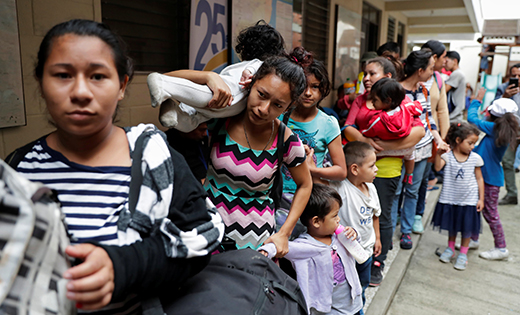
Honduran migrants, who are part of a caravan trying to reach the U.S., wait in line Oct. 17 to enter a shelter in Guatemala City. This year’s annual interfaith program “Breaking Bread Together,” sponsored by the Jewish-Christian-Muslim Dialogue of Southern New Jersey, is presenting a timely presentation on the issue of immigration titled, “From Refugee to Neighbor — Local Refugees Share their American Stories.”
Columns

Accompanying migrant populations can be mutually transformative

November 18, 2021
hands of a just married couple with the wedding rings and bouquet
Columns

Two human beings trying to share the journey of faith

March 17, 2026
Facebook Twitter Instagram LinkedIn Youtube RSS

No Result
View All Result

Latest News

Father Edward Heintzelman, longtime pastor in Mays Landing, dies

Bishop Williams urges Knights of Columbus: Be confident evangelizers

New Jerseyans urged to push for nonpublic school security funding

Faithful gather for spiritual renewal ahead of Pentecost

Father Naticchione celebrates first Mass in Ventnor

Latest Videos

View Ordination of Nickolas B. Naticchione in Cathedral

The legacy of Pope Francis

Pope Leo’s first Easter message

See livestream of Bishop Williams celebrating annual Chrism Mass

Pope Leo XIV’s first Palm Sunday

Around the Diocese

  • The Diocese of Camden
  • Talking Catholic Podcast
  • Catholic Charities
  • Advertise
  • Catholic Cemeteries
  • VITALity Healthcare Services
  • Housing Services
  • Camden Deacon
  • Camden Priest
  • South Jersey Catholic Schools
  • Man Up South Jersey
  • Catholic Business Network

Additional Resources

  • New Jersey Independent Victim Compensation Fund
  • Quick Guide to Reporting Sexual Abuse
  • List of Credibly Accused Priests and Parish Resources
  • Bishop’s Commission Report on Catholic Schools

Reorganization of the Diocese

  • Chapter 11 Claims filing info
  • Chapter 11 Prime Clerk Filing

© All Rights Reserved | May 24, 2026 | Catholic Star Herald of the Diocese of Camden

En español/Sa Tagalog

Add the Catholic Star Herald to your home screen

For Android users(Chrome) tap the at the top right vertical 3 dots then tap “Add to Home Screen”

For iPhone tap:at the bottom and then tap “Add to Home Screen”

  • This field is for validation purposes and should be left unchanged.

If you need assistance with submitting your subscription, please call Neal Cullen at 856-583-6139, or email Neal.Cullen@camdendiocese.org

No Result
View All Result
  • News
    • From Bishop Williams
    • Parish Life
    • Diocesan News
    • Sports
    • Columns
      • From Bishop Sullivan
    • Obituaries
    • World/Nation
  • Catholic Schools
  • Español
  • Features
    • Special Supplements
      • Thank You Bishop Sullivan
      • Welcome Bishop Williams
      • Jubilarians
    • Entertainment
      • Movie Reviews
    • Photo Galleries
    • Talking Catholic
    • Latest Videos
    • Health and Wellness
  • Advertise
  • More
    • Classified
    • Subscribe
    • Contact Us

© All Rights Reserved | May 24, 2026 | Catholic Star Herald of the Diocese of Camden