




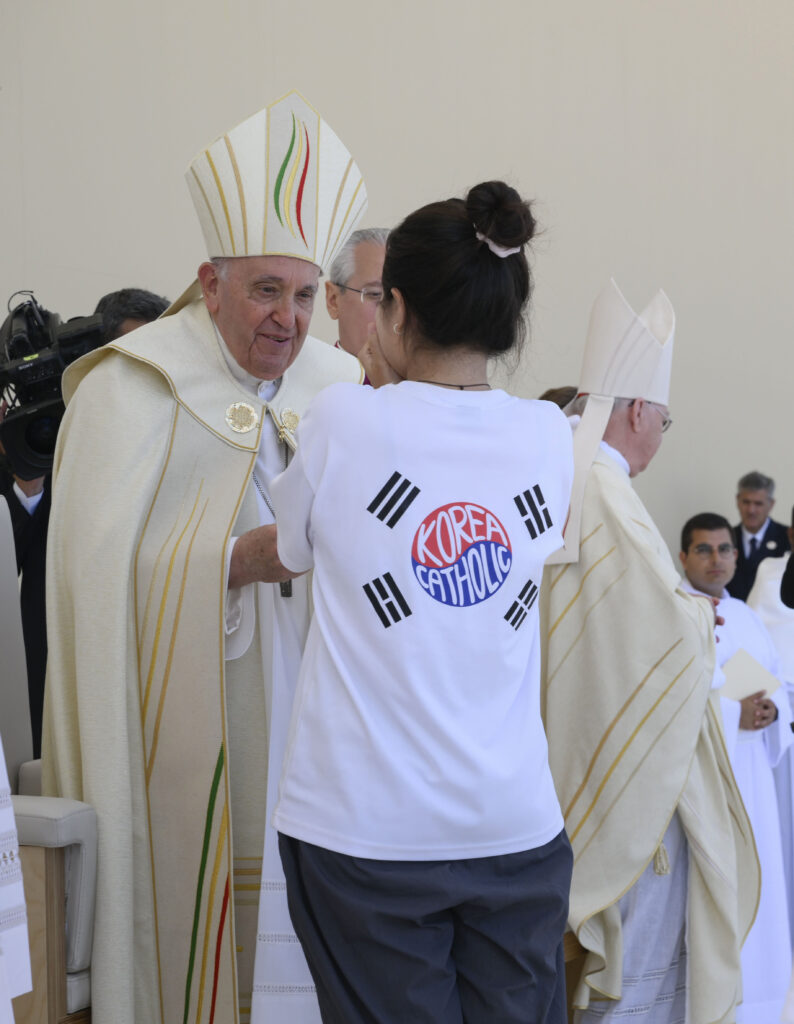
The history of World Youth Day has its roots in Christian gatherings that were taking place for young people in Poland in the early 1980s. Eventually, Pope John Paul II organized what he thought would be a small meeting on Palm Sunday in Rome in 1984 to focus on youth during the closing days of the Holy Year of Redemption. The response was enormous and led him to officially launch what we now know as WYD in 1985. But the pope always saw his role in this now-longstanding tradition as responding to the dynamic agency of the world’s young people. As he put it: “No one invented the World Youth Days. It was the young people themselves who created them.”
As Pope Francis continued the tradition this week in Lisbon, Portugal, his comments highlighted exactly this active role embodied in the youthful face of the Church:
“To you, young people, who have experienced this joy … [in] this meeting with us; to you who cultivate big dreams but sometimes have them obscured by the fear of not seeing them come true; to you, who sometimes think that you will not have sufficient capacities, a little pessimism that sometimes creeps into all of us; to you, young people, tempted at this time by discouragement, perhaps by judging yourself as failures or by trying to hide the pain by disguising it with a smile; to you, young people, who want to change the world – and it is good that you want to change the world – and who want to fight for justice and peace; to you, young people, who put enthusiasm and creativity into life, but who think that it is not enough; to you, young people, that the Church and the world need [as] the earth needs the rain; to you, young people, who are the present and the future; Yes, precisely to you, young people, [Jesus] says today: ‘Do not be afraid’.”
The meeting was once again an opportunity for the global youth to express their commitment to Christ and derivatively to the Church as a community of disciples in public, positive and sometimes almost ecstatic ways.
Michelle Mesiano, a photographer representing a team of young adults from the Diocese of St. Petersburg in Florida, told me from Lisbon: “The week has been an intense mix of fascination, energy, chaos, exhaustion and inspiration. From the travel to the crowds to the weather, it’s amazing to see what people will endure to be witnesses to their faith, and to be near the pope. As it’s my first time in a setting anywhere near this size for a religious event, it will certainly leave an impression on me for years to come.”
On the closing day of the meeting, the pope announced that the next iteration of the event will be held in 2027 in Seoul, South Korea, only the second time WYD has been hosted in Asia. As the Church continues to look eastward with renewed attention and vigor, conversions and religious vocations boom in pockets there, albeit in religiously and ideologically pluralistic settings (e.g. think of the vastly different situations in Vietnam, India, Iran, China, Indonesia and the Philippines, not to mention across the Korean peninsula itself). Many experts agree this reality could present a rich mine of potential resources not only for the people of the continent themselves, but for global Christianity and the universal Church in the modern world. Perhaps this is among the reasons why the pope’s next trip will be to visit the statistically tiny population of Christians in Mongolia for the first days of September, the first pontiff to ever set foot there while in office.
“The WYD choice is a momentous announcement for the Church in Korea,” commented my good friend Dr. Hansol Goo, assistant professor of Liturgical Theology at St. John’s University in Minnesota. “The youth in Korea are facing seemingly insurmountable challenges due to lack of employment opportunities and extreme polarization between the rich and poor, realities that are crippling an entire generation. WYD will bring new rays of hope to young Catholics experiencing dark times there.”
“Personally, I also hope that this event will be an occasion for young believers on the peninsula and in the diaspora elsewhere to be reaffirmed in their Korean, Catholic heritage,” she told me. “It presents a significant and historic opportunity for young Koreans and all people to realize that there is much more to our culture than K-Pop and K-Drama. It’s a chance for the entire world to recognize a rich Christian heritage, which has borne many fruits since its founding days of martyrdom and evangelization.”
This is a message that can undoubtedly benefit the entire Church, and inspire a new generation of heroes for Christ, particularly since so many who have suffered and died for the faith there were young laypeople themselves.
Originally from Collingswood, Michael M. Canaris, Ph.D., teaches at Loyola University, Chicago.




 at the bottom and then tap “Add to Home Screen”
