








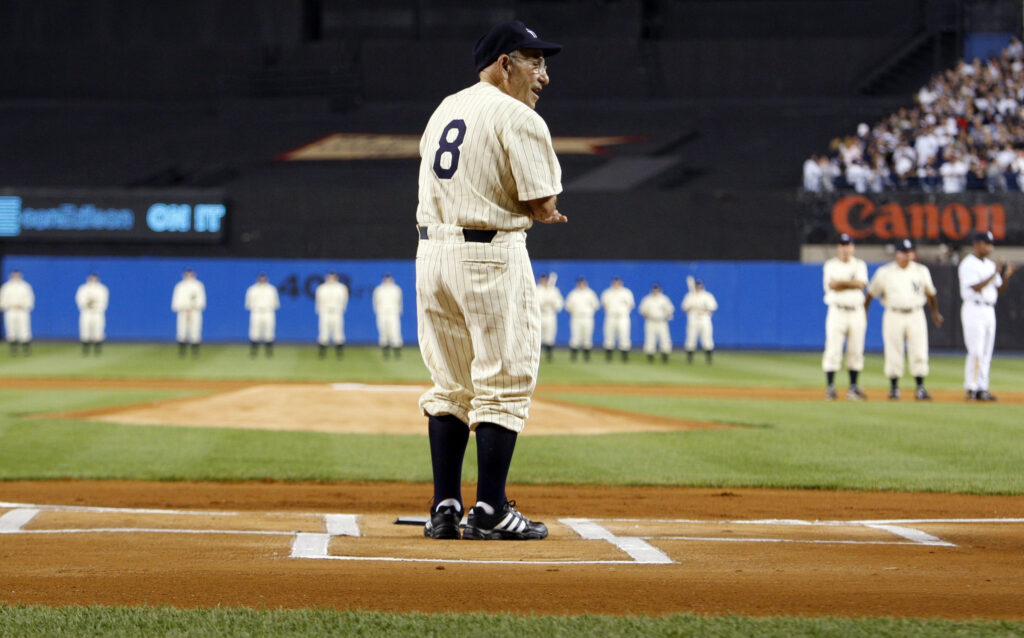
Unfortunately, Yogi Berra never played for the Phillies. But he was a Catholic. At his funeral in 2015, Cardinal Timothy M. Dolan of New York reportedly compared Yogi and Pope Francis’ humble beginnings, their humility and, jokingly, their large ears.
An amiable and unpretentious man, the baseball Hall of Famer would have been delighted. Once, when told he was ugly, he responded, “So what? I don’t hit with my face.”
This is Yogi’s recollection of a conversation he had with Cardinal Francis Spellman, former archbishop of New York: “When I returned home from Italy, Cardinal Spellman asked me if I had an audience with the pope. I said, ‘No, but I saw him.’ Then I was asked what I had said to His Holiness. I couldn’t remember exactly, but he said, ‘Hello, Yogi,’ and I responded: ‘Hello, Pope.’”
A recently released documentary focuses not only on Yogi’s baseball career but also on his family life and his fundamental decency. This was a man who was wounded in World War II but didn’t apply for a Purple Heart because he didn’t want to worry his mother.
The film, “It Ain’t Over,” takes its title from Yogi’s endlessly quoted observation, “It ain’t over till it’s over.” Such “Yogi-isms,” as they came to be called, are often met with an amused “Huh?” A pause. Then an understanding nod of approval.
For example, “The future ain’t what it used to be.”
“It Ain’t Over” opened in theaters in May, just a few weeks after another film about a famous athlete. “Air” recreates the story of Nike’s endorsement deal with the future basketball superstar Michael Jordan. Yet Jordan is barely in the film. Instead, the movie focuses on the world that surrounds him. It’s a world of agents and salesmen, persuasion and intimidation, business and celebrity culture.
At a climactic moment, a Nike sales executive (Matt Damon) gives an impassioned, impromptu sales pitch to Jordan. He says that everyone gathered at their meeting will be forgotten soon, but he, Jordan, who is going to be a spectacular athlete, will be “remembered forever.”
“The rest of us just want a chance to touch that greatness,” he says.
Touching that “greatness” – even from the ankles down – generates staggering sums of money.
For those (like me) who have a hard time understanding America’s near-reverence for its best athletes, consider former Chicago journalist Bob Greene’s 1992 book about Jordan, “Hang Time.” In the second chapter, the author describes the book’s origin.
Greene was not a sports writer or even much of a basketball fan. He had been covering the story of two brothers horrendously abused by their mother and her boyfriend – Lattie McGee and Cornelius Abraham. Cornelius was 6 years old when Lattie, 4, died from torture. Cornelius had to testify in court against his own mother. He was 9 by the time his tormentors were sent to prison.
In one of his newspaper stories, Greene mentioned that Cornelius had a passion for basketball. That led to an invitation from the Chicago Bulls for Greene and Cornelius to sit court side at a game and to meet Jordan beforehand.
“You have to understand, for a long time, the only adults Cornelius had any contact with were adults who wanted to hurt and humiliate him,” Greene writes. “And now Michael Jordan was saying, ‘Are you going to cheer for us today? We’re going to need it.’”
During the game, when Jordan made a spectacular shot, Greene describes Cornelius laughing out loud with joy.
But the night was also was a turning point for the writer. Twenty years of reporting on the harshness of life had taken a toll on him. After that first game with Cornelius, he started following Jordan and the Bulls, and he claims the sport became an “escape” from the ugliness that had consumed so much of his time.
Like music, sports can be not just a distraction from life’s hardships, but a way to endure them. An athlete at the top of his game can be a symbol of hope, a flesh and blood example that – before our eyes – thrillingly demonstrates what an individual can achieve with mental discipline, physical training and the help of teammates.
Another way of dealing with life’s blows is with humor. While sports emphasizes human potential and ambition, humor can bring us down to earth. It can remind us of our shared frailties and weaknesses.
Put the two together – outstanding athletic achievement and good-natured humor – and you have Yogi Berra: a five-foot, seven-inch power hitter who drank Yoo-hoo, read comic books and believed, “If the world was perfect, it wouldn’t be.”
Carl Peters is former managing editor of the Catholic Star Herald.






 at the bottom and then tap “Add to Home Screen”
