




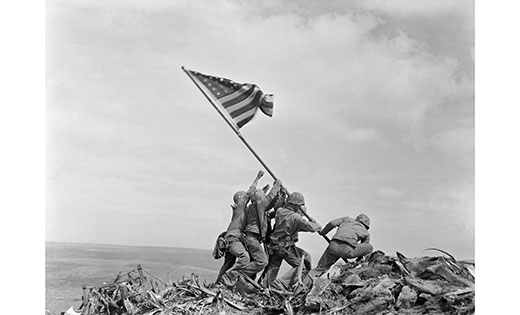
Last Sunday, Feb. 23, was the 75th anniversary of the raising of the United States flag on Mount Suribachi on the tiny Japanese island of Iwo Jima. The moment was captured in an iconic photo by Joe Rosenthal. An epic battle for the island was raging at the time and the photo displayed extraordinary symmetry and, more importantly, a powerful sense of unity, determination and purpose in the face of tremendous odds.
The battle would continue to rage for more than another month, ending on March 26. To give a sense of the ferocity of the battle, there were over 44,000 casualties (killed, wounded and missing) on and around an island a little larger than the City of Bridgeton.
Of the six men who raised the iconic flag, three were killed on the island; one was badly wounded; and the three survivors bore heavy, emotional, life-long scars. The flag-raisers came from different parts of our country, and one, Sgt. Michael Strank, was an immigrant from Czechoslovakia (now the country of Slovakia); another, Ira Hayes, was a Pima Indian from Arizona.
While stationed in Michigan, I was blessed to know one Marine who was on Suribachi when the flag was raised, Joe Rodriguez. I ministered to Joe during his long stays in the hospital and knew his family well. Joe was part of a group photo taken just after the flag-raising; he is on the left of the photo with his thumbs in his pockets. Joe was wounded twice in the battle and, at the second time, Sgt. Strank died by his side.
Joe was taken off the island and eventually went home to Michigan to marry and raise a family.
Joe Rodriguez died on this day in 2003, the 58th anniversary of the flag-raising. The immeasurable sacrifice of these men and countless others would lead to victory and to a period of peace. However, the cause for peace, justice and freedom has been and is still a daunting challenge in the 75 years after World War II. The extraordinary sense of solidarity displayed in the famous Iwo Jima flag-raising photo is a model to us, as followers of Jesus and as his church, of unity of purpose.
Ethnicity, one’s provenance or role does not matter when we are united in one purpose for justice, peace, love and the proclamation of the Gospel message. The words of the Second Vatican Council, a meeting of the world’s bishops from 1962 to 1965, reflect this: “The joys and the hopes, the griefs and the anxieties of the men of this age, especially those who are poor or in any way afflicted, these are the joys and hopes, the griefs and anxieties of the followers of Christ.”
And another document from the Vatican, published in 2004, Compendium of the Social Doctrine of the Church, states: “The message of the Church’s social doctrine regarding solidarity clearly shows that there exists an intimate bond between solidarity and the common good, between solidarity and the universal destination of goods, between solidarity and equality among men and peoples, between solidarity and peace in the world” (article 194).
As we solemnly remember the united mission of a group of men, let us work in unity as a church, using our talents, time and energies for the spread of the Gospel and in solidarity with all humanity.
Father Matthew Weber is pastor of the Parish of the Holy Cross, Bridgeton.



 at the bottom and then tap “Add to Home Screen”
