




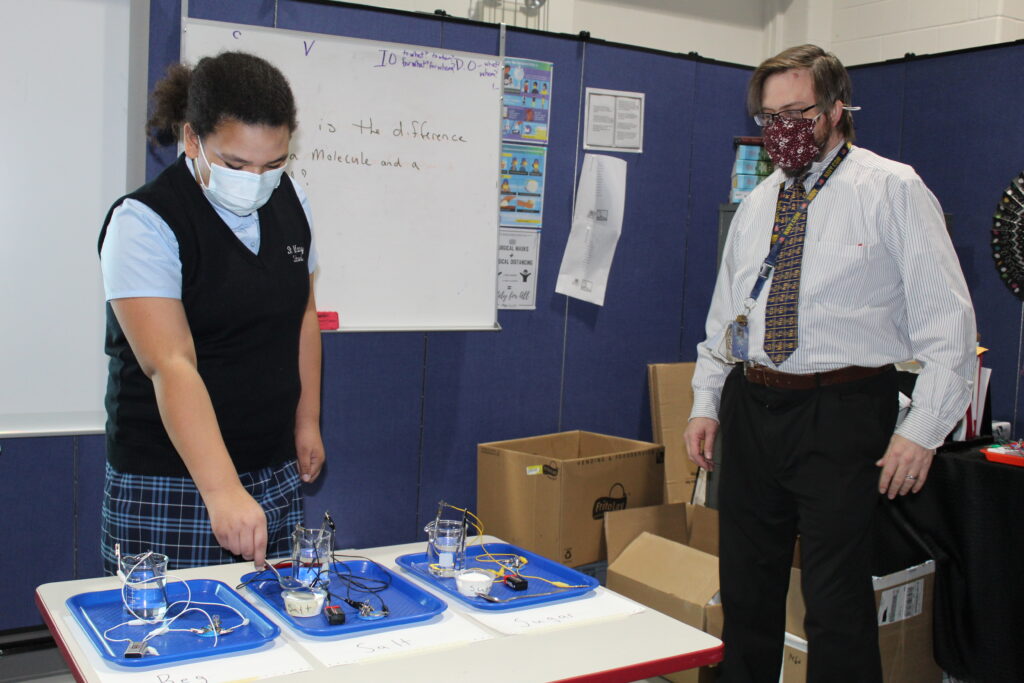
Brian Wolf has spent the last 12 years teaching at Saint Mary School, Williamstown, and a total of 22 years with the Diocese of Camden. Like every teacher, Wolf brings unique talents and perspective to his seventh grade science classroom.
“I became a teacher to share my ideas, views and love of God with everyone I come in contact with. I love to teach,” he said.
Wolf is a strong advocate of the diocese’s science curriculum. He believes its strength is grounded in the way it was developed.
“We started at the end,” said Catholic Schools Superintendent Dr. Bill Watson, who led the curriculum design effort when he was Director of Curriculum and Assessment. “The development teams identified what students should know in a given subject area by the end of high school and worked backwards.”
As many as 60 diocesan teachers in each major subject area worked collaboratively with the Alliance for Catholic Education (ACE) at the University of Notre Dame to design a curriculum that encompasses grades Kindergarten through 12. Wolf, a member of the team that revamped the science curriculum, appreciates that curriculum objectives are detailed, while offering maximum flexibility with instruction.
“My lesson plans are not concrete. They are modified each year to focus on the strengths of the students,” said Wolf. “Some years I have the ability to increase the rigor of my lessons to challenge a more advanced class, while other years I may need to spend more time focusing on the basic skills and concepts.”
Wolf also values the freedom he has in choosing his own teaching tools and resources.
“Not all students learn the same way,” he said. “Some students may be great readers, others may not. Some grasp the concepts and skills very easily while others struggle. It’s important to teach a lesson using a variety of different methods that offer all students the ability to be successful … to be scientific thinkers.”
Wolf sees the benefits of collaborating with other teachers to ensure curriculum objectives are met. “Understanding what skills were taught in previous years helps mold future lessons,“ he said.
Curriculum with flexibility
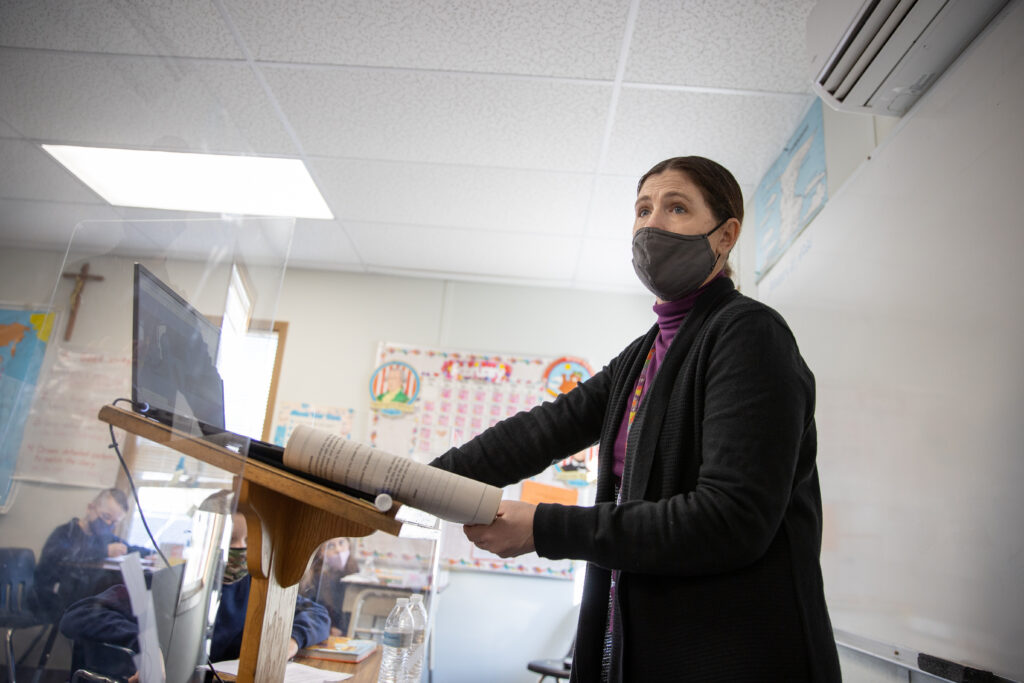
At Saint Michael the Archangel Regional School in Clayton, third grade teacher Julie Meloni agrees. She said it’s important for her to know the strengths and challenges of students coming from second grade and to understand the expectations for fourth grade.
Meloni also appreciates that the curriculum is “very spelled out … but how you teach it is your choice.” She sees technology as a great asset for teachers, especially when it comes to meeting individual needs and learning styles.
“Not everyone is going to be in the same place in third grade,” she said, noting that technology offers an abundance of tools and resources to help teach her students and assess their progress.
“In Catholic school we stop, reteach, make sure everyone gets it. We approach [education] in a different way,” she said.
New parents at Saint Michael’s have told Meloni they didn’t know what they were missing academically until they made the switch to Catholic school.
Many teachers who have experience teaching in Catholic and public schools note that, while curriculum content is similar, Catholic schools are not “teaching to a test,” with prescribed, one-size-fits-all course materials.
“Our curriculum incorporates state and national curriculum standards, but we are able to do so much more,” said Superintendent Watson. “Involving our teachers in curriculum development has given them a real sense of ownership. They share ideas with other teachers in their schools and across the diocese. They bring faith and Gospel values to class with them every day. Our students benefit from a very holistic approach to learning.”
‘It’s so freeing’
Debbie Laricks, seventh and eighth grade language arts teacher at Bishop McHugh Regional School in Cape May Court House, began her career as an English teacher in a public high school. She admits she was surprised by what she sees as a more progressive curriculum in Catholic school.
“It’s so freeing. I can choose the resources I want,” she said, adding that “the smaller class size is just phenomenal. I feel like I can give more one-on-one attention and provide more thorough feedback.”
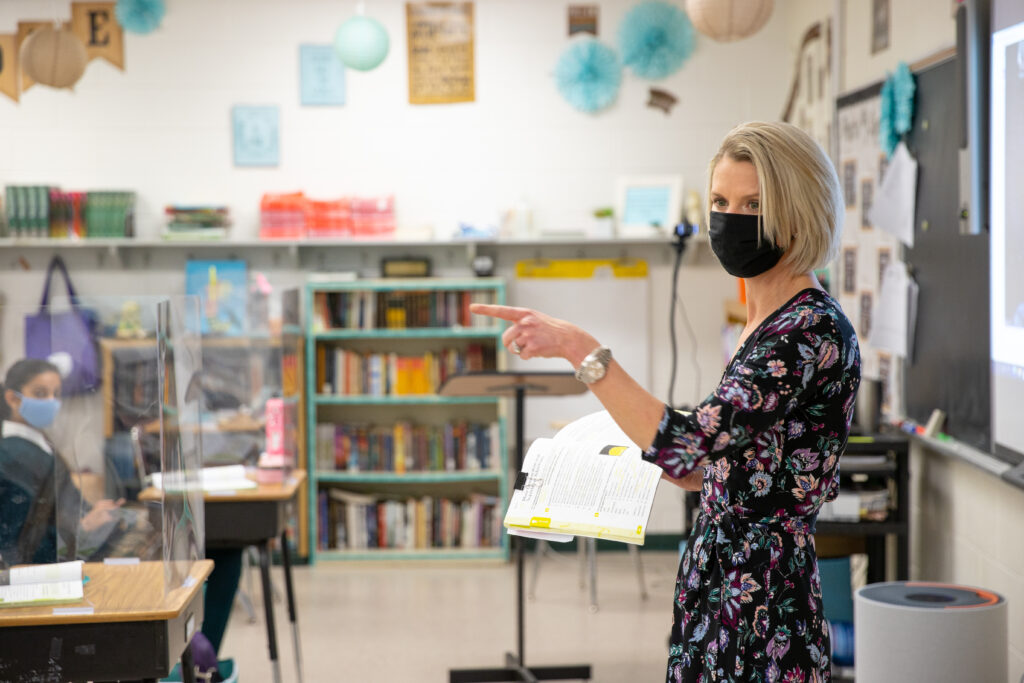
Laricks also said she values the role faith plays in the classroom. She recently assigned a different book by Mitch Albom to three separate groups of eighth grade students. While Albom’s references aren’t necessarily Catholic, Laricks was able to explore common themes through a Catholic lens. And by having students read different, but similar, books, she was able to generate small group discussions at various levels and ensure everyone had a voice.
“It becomes so natural to the kids that [faith] is a part of their daily life. When morality and values come up, it’s comfortable. We can talk about it.”
Laricks also likes to link language arts with other subject areas, for example, choosing literature related to what her students are learning about in social studies class. She places a high emphasis on grammar and writing assignments as well.
“I tell [my students,] ‘this is your high school boot camp.’” And she knows they are well prepared.
Transition to high school
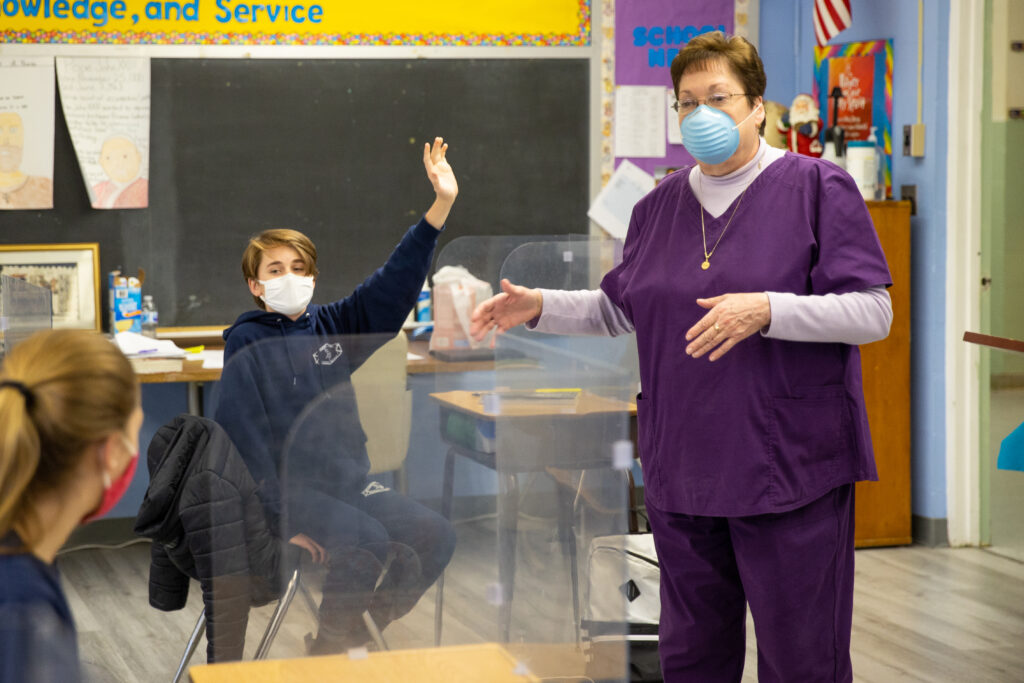
At Saint Vincent de Paul Regional School in Mays Landing, Eva Marie Quattrochi teaches middle school — sixth, seventh and eighth grade social studies, and eighth grade language arts.
Quattrochi most recently served on the social studies curriculum development team and was on the language arts team as well.
“What a neat thing to be a part of,” she said. “We sat down in groups based on grade band and discussed what we liked in certain curricula. We picked out what we thought was the best from five different curricula [for social studies]. We know what we’re teaching in our schools. We know what our students are learning.”
Quattrochi said high school teachers suggested areas in which rising freshmen could be better prepared. “That information helped to guide us grammar school educators in our efforts to create a more seamless transition for students who are entering high school,” she said.
Quattrochi likes that “the curriculum tells us what we need to cover, but not how we have to cover it. It’s up to us as educators to figure out the best way to do that.” She stressed the importance of choosing resources that reflect the needs and personality of her classes from year to year.
A self-described storyteller, Quattrochi loves presenting social studies in her own words. But she relies on other tools as well, including videos and online resources with built- in assessments to gauge understanding.
“I work until I find something that appeals to [a given] student in some way. There is something that every child will respond to. You just have to keep digging until you find it,” she said.
Preparation for college
If the curriculum in South Jersey Catholic Schools is designed to take students to the end of an academic journey — ready to launch into college — high school math teacher Art Martin is one of the ultimate beneficiaries. Chair of the Math Department at Camden Catholic High School in Cherry Hill, Martin currently teaches Honors Geometry, Honors and Advanced Placement Calculus, and Finite Math. He is used to working backwards when it comes to talking about math.
“Freshmen parents will ask, ‘How do I get my son or daughter to calculus?’ And we create a road map for them to get there,” he said.
A placement test before freshman year determines whether students will start with Algebra, Honors Algebra or Honors Geometry. While the path to Calculus is straightest for students who test into Honors Geometry, the ultimate goal isn’t impossible for a student who performs well and is willing to double up on math classes or attend summer school.
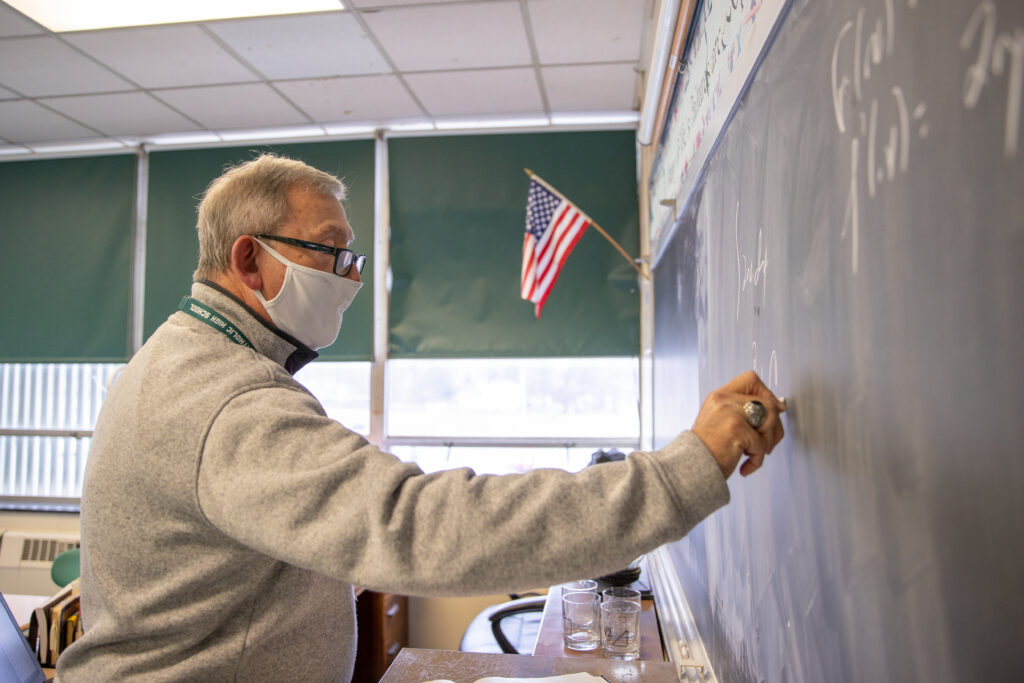
No matter how far a student progresses in high school math, Martin, who spent many years teaching at the college level, said the goal is to prepare students for college.
“There is not a year that I haven’t had a graduating senior come back and say they were well prepared,” he said. Students who struggled in his class have told him they got As in college. One student said they used their notes from Martin’s class to help with a college course.
“I like to think of my seniors as young adults,” he said. “They won’t be coddled [in college.]”
Martin goes beyond typical problem solving with his calculus students. One year he had them read and write an essay about “Flatland,” a novella that explores geometric forms and multi dimensions while satirizing the hierarchy of Victorian culture. A colleague from the English Department helped him create a rubric for the essay. This year’s writing assignment was based on an excerpt from a book about how calculus was used to fight HIV/Aids.
“The overall culture here is conducive to learning,” he said. “This is not a job for me. This is fun.”
Sharing experiences and ideas
Last August, Dr. Bobby Lockwood joined South Jersey Catholic Schools as Director of Curriculum and Assessment. He is working closely with teachers and principals to address all needs related to curriculum, instruction, assessment and professional development. Lockwood holds regular Zoom sessions so teachers throughout the diocese can meet with subject and/or grade level peers in different schools to share experiences and ideas for teaching during COVID-19 and beyond. He also keeps up with the extensive educational resources available through a variety of vendors. With teachers, he is evaluating how the pandemic may have affected curriculum objectives.
“Curriculum isn’t something that goes in a file or a drawer,” says Lockwood. “It’s dynamic and there is always room for evaluating, tweaking and updating. The collaborative process adopted by the Diocese of Camden will continue to ensure the strength of our academics in South Jersey Catholic Schools.”



 at the bottom and then tap “Add to Home Screen”
