



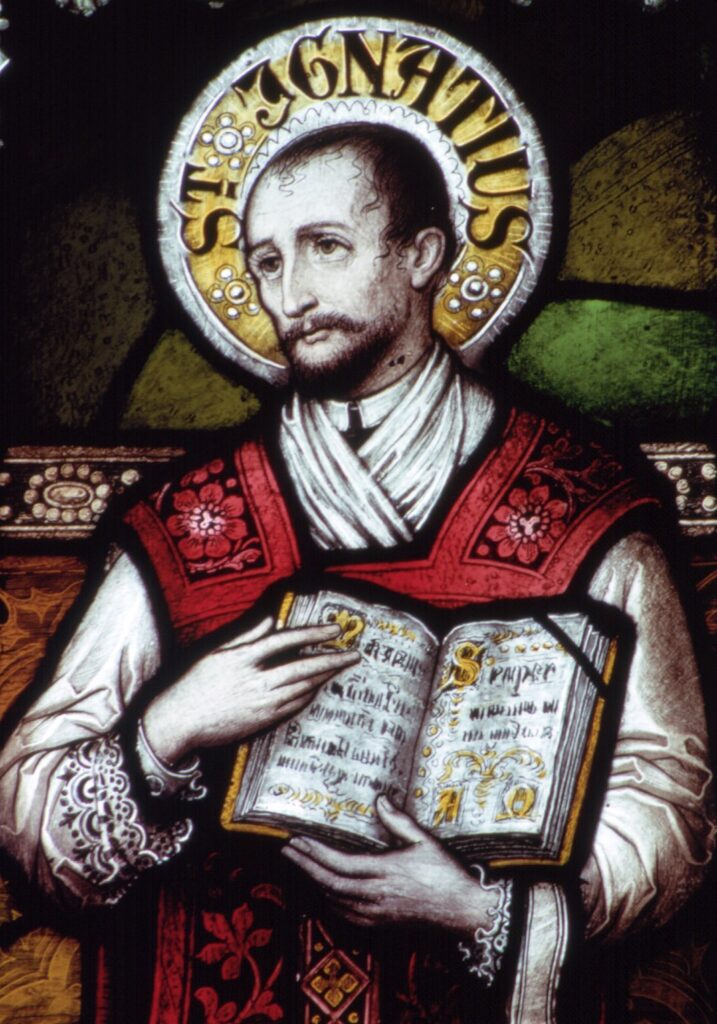
May 20, 2021 marked the 500th anniversary of the injury of Iñigo (he was not yet Ignatius) of Loyola on the battlefield at Pamplona. The event was marked by a beautiful Mass in that city’s cathedral, opening what the Society of Jesus is calling “The Year of Ignatius.” The theme of these 12 months of events is “Seeing All Things New in Christ.”
When Iñigo’s leg was shattered by a French cannonball, his extensive physical recuperation planted the seeds of his conversion, away from a life pursuing worldly glory and vanities, instead toward an interior freedom to follow Christ in pioneering and unconventional ways.
As soon as he could walk, he travelled to lay his sword and dagger at the feet of Our Lady of Montserrat, in the Catalan hills after an all-night vigil renouncing his former ways of life and priorities. He then spent 10 months wresting with his inner demons, and with God, in Manresa, before realizing the soul-searching insights he stumbled upon could be shared with others. In light of them he would eventually transform his own remaining days, the Roman Catholic Church, and to be quite candid, the entire world. No parallel network of global and interconnected educational institutions and apostolates exists on earth today.
In his homily in Pamplona, Ignatius’s successor, current Superior General Arturo Sosa referred to the universal apostolic preferences, the Jesuits’ intentional priorities for the coming decade, which aim to allow this unique brand of spirituality cultivated over the last half-millennium to permeate contemporary applications in the modern world. They are
— to show the way to God through the Spiritual Exercises and Discernment,
— to walk with the excluded, the poor, the outcast and the discarded of the world,
— to accompany the youth in the creation of a hope-filled future, and
— to care for our common home, the created cosmos.
All of these are the logical outgrowth of the care of souls and the care of the whole person that mark Ignatian approaches to education and ministry.
The Ignatian year is an opportunity for each of us to explore a set of common questions posed frequently in Jesuit classrooms, retreat centers and parishes.
“What is your cannonball moment, when you have experienced not doctrines or teachings or second-level reflections about God, but the experience of divine proximity in direct, unprecedented, and transformational ways?
What have you done for Christ as a result?
What are you doing for Christ now?
What will you do for Christ moving forward?”
Ignatius referred to himself in his autobiography as “the pilgrim.” I have now spent decades journeying from one Jesuit campus to another, and even as a tenured professor, still find myself restless in my Quixotic quest to ride alongside the Spaniard into uncharted intellectual and pastoral territories, and to see the world through his singularly revolutionary eyes ever more clearly. I hope that this anniversary year, in this unique current moment in the church under the first Jesuit pope, helps introduce others to the riches of Ignatius’s spiritual patrimony, and bestows on them the courage and grace to join him in his ongoing charge to “find God in all things.”
Originally from Collingswood, Michael M. Canaris, Ph.D., teaches at Loyola University, Chicago.




 at the bottom and then tap “Add to Home Screen”
