






While of course such a statement would meet with fierce resistance from some opinionated contrarians, many people argue that the best coffee in Rome is found in the Sant’Eustachio neighborhood of the city. The eponymous café there has been serving its closely guarded secret recipe for the perfect espresso for almost a century. The discarded yellow paper cups with the stag’s head matching the one adorning the top of the nearby basilica are a familiar site to anyone who’s visited the Pantheon.
The connection with the deer’s antlers can be traced to the area’s namesake (Saint Eustace in English), whose feast was traditionally celebrated in the Catholic and Orthodox world on Sept. 20, though the post-conciliar reforms de-emphasized some of these legendary figures in favor of those saints with more historically verifiable vitas.
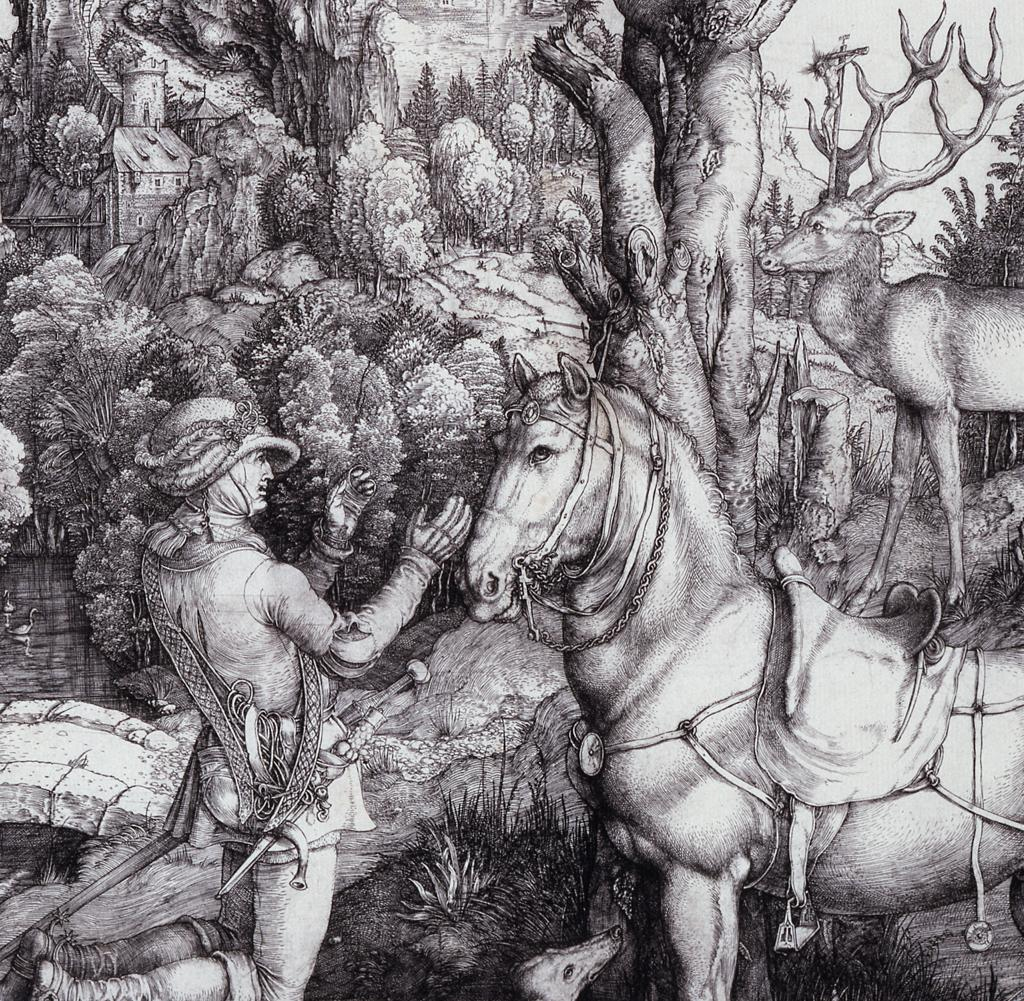
According to Jacobus de Varagine’s “Legenda Aurea,” a medieval collection of the lives of the saints known in English as the “Golden Legend,” Eustachio was originally named Placido and was a Roman soldier, possibly even a general. While deer hunting, he saw a stag whose horns held a luminous crucifix intertwined within them. Upon seeing such a mystical vision, he supposedly renounced his pagan life, was baptized along with his wife, and took on the Latinized form of the Greek word for “abundance” as a name. There might have been some irony in this name, as his story includes the loss of his possessions, lands, family and dignity in a tragedy reminiscent of Job.
Eventually, he was called before the Emperor Hadrian, and when he refused to recant his faith in Christ, he was alleged to have been roasted alive inside a bronze bull, which was designed so that the screams and groans emanating from within would sound like the animal’s bellows. A later emperor, Constantine, was alleged to have a strong devotion to him. Eustace is one of the Fourteen Holy Helpers whose collective veneration was sought during the bubonic plague, which ravaged Europe and killed more than a third of the population in the 1300s.
The cross-in-the-deer-horns imagery also appears on the marketing for the popular German liquor Jägermeister. Both Saints Eustace and Hubert are associated with this symbol, and their iconography and legends as co-patrons of hunters are indistinguishable from each another after centuries of entanglement. While I am not particularly devoted to these obscure figures, I do deer hunt every year at Menantico Gun Club in South Jersey, and often bring Italian cigars and liqueurs made from local monks back from Rome for my friends there. Perhaps I would have more luck in the woods if I invoked the two of them more frequently.
The Catholic high school in Pennsauken, Bishop Eustace, is named for the first bishop of Camden, Bartholomew J. Eustace. As the son of Irish immigrants, the bishop’s family very likely may have been tied to veneration of Saint Eustachio at one point, as was the case with last names like Martin and Fitzpatrick, which also had obvious Christian roots.
Artistic tributes to Eustace abound; Beyond Rome they are found in the Louvre, Vézeley and even St. Louis and Cleveland. The British Museum in London has a beautifully crafted reliquary sculpted to look like the Roman military fighter’s head, which while being cleaned in 1956, was discovered to have carefully preserved fragments of bone in it. The museum kept the artifact but returned the bones to Basel in Switzerland, where they had been housed until the 19th century.
Some of these figures, while sometimes seeming fantastical to us in the modern world, did inspire real ecclesial and geopolitical events, when the Christian imagination and religious beliefs had profound cultural and even economic currency. Pilgrimages to the sites of people like Sant’Eustachio once held powerful sway in the social Christian imagination, providing believers both hope and collective identity in the midst of persecution and natural disaster. Today we can still celebrate his enduring memory, even if primarily in the cappuccinos and after-dinner drinks that serve as his sublime contemporary patrimony.
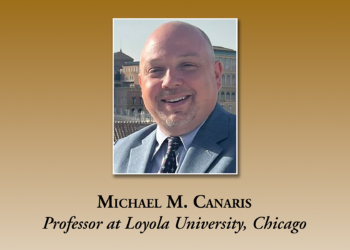
Originally from Collingswood, Michael M. Canaris, Ph.D., teaches at Loyola University, Chicago.




 at the bottom and then tap “Add to Home Screen”
