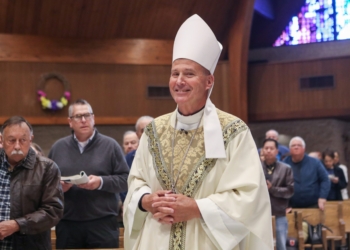




As a recently ordained priest for the Diocese of Camden, Father Paul Abbruscato admits that when he celebrates the Liturgy, he is in awe.
Holding high the Body and Blood of Christ during Mass can be a moment of true wonderment, and sometimes “I simply think, ‘Wow’ as I look at the Lord,” he says.
“The Eucharist comforts my soul, and I think it comforts the souls of the people, that Jesus is truly here, not to condemn, but to sanctify us and save us from sin,” he says. “I have a responsibility to feed God’s people, and strengthen their faith. If Jesus declares that the Eucharist is his Body and Blood, who are we to say otherwise?”
Father Abbruscato, parochial vicar at Holy Child Parish, Runnemede, is one of five men ordained to the priesthood in May by Bishop Dennis Sullivan. His fellow new brothers in Christ acknowledge not only the importance of being able to celebrate the Eucharist, but their role in bringing Christ to others in Holy Communion.
After six years of seminary formation, Father Logan Nilsen admits that the full meaning of the mystery of the transubstantiation – whereby, through the actions of the priest guided by the Holy Spirit, bread and wine become Jesus’ Body and Blood – “hasn’t hit me yet.”
At the same time, he acknowledges the “responsibility to celebrate the Eucharist reverently. … It doesn’t make sense if it’s just a symbol,” says Father Nilsen, who serves part-time as both parochial vicar, Saint Elizabeth Ann Seton Parish, and director of Catholic Identity, Holy Spirit High School, Absecon. “In the Scriptures, at the Last Supper, Jesus tells his disciples, ‘This IS my Body. … This IS my Blood. Do this in remembrance of me.’”
Father Christopher Myers, parochial vicar at the Catholic Community of Christ Our Light in Cherry Hill, says he has always believed that the Lord was truly present in the Eucharist, which puts him among the 30% of Catholics identified by a 2019 Pew survey who carry such a belief; 69% of Catholics, the survey showed, believe the bread and wine at Mass are only “symbols of the body and blood of Jesus Christ.”
“It’s good and healthy to be reminded how important the Eucharist is,” Myers says. “The world is so in need of Christ right now.”
He also admits that before the consecration, “I get nervous, because I don’t feel worthy.” After every Mass, though, “I thank God, that he’s chosen me to do this work … participating with God in the divine action and bringing him to others.”

The fact that the Lord utilized two simple items – bread and wine – in this salvific action is proof of his love, humility and desire to bond with humanity, the new priests agree. Bread and wine were common items for those who gathered together to share meals in Jesus’ time. At the Last Supper, these two served as “a mediation” so humanity could comprehend Jesus’ divinity and eternal message, notes Father Abbruscato. Broken, blessed and shared, Jesus shares himself fully with humanity, in agape – selfless, sacrificial, unconditional love.
“The more we enter [into this mystery], it becomes ever more saving,” he says.
Your Eucharist Questions Answered
During the national, three year Eucharistic Revival, the Catholic Star Herald is asking readers to submit questions they have about the Eucharist; they will be answered by one of the Diocese’s priest experts. Below, Father Robert Hughes, Vicar General of the Diocese of Camden and Moderator of the Curia, responds to a reader.
QUESTION: What is the best response to the consecration/Eucharist being just a remembrance of Christ’s words? I am 80 years old, brought up in a Catholic home, and I am a daily church-goer. A sister brought up just as I was, who had gone the way of her husband to a born again church, is adamant about the Eucharist not being the real presence of Christ.
ANSWER: The best response to those who state that the presence of Christ in the Eucharist is not real but rather symbolic or connected to whether the recipient believes or not is to remember what Jesus said. At the Last Supper, he was clear. The words of institution found in the Gospel state: “This is my body. … This is my blood.” Jesus did not say, “This is a symbol of my body or blood.”
Have questions about the Eucharist? Email or mail your question to Jennifer.Mauro@camdendiocese.org or write to 15 North 7th St., Camden, N.J., 08102-1147.


 at the bottom and then tap “Add to Home Screen”
