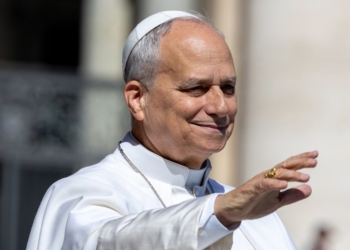




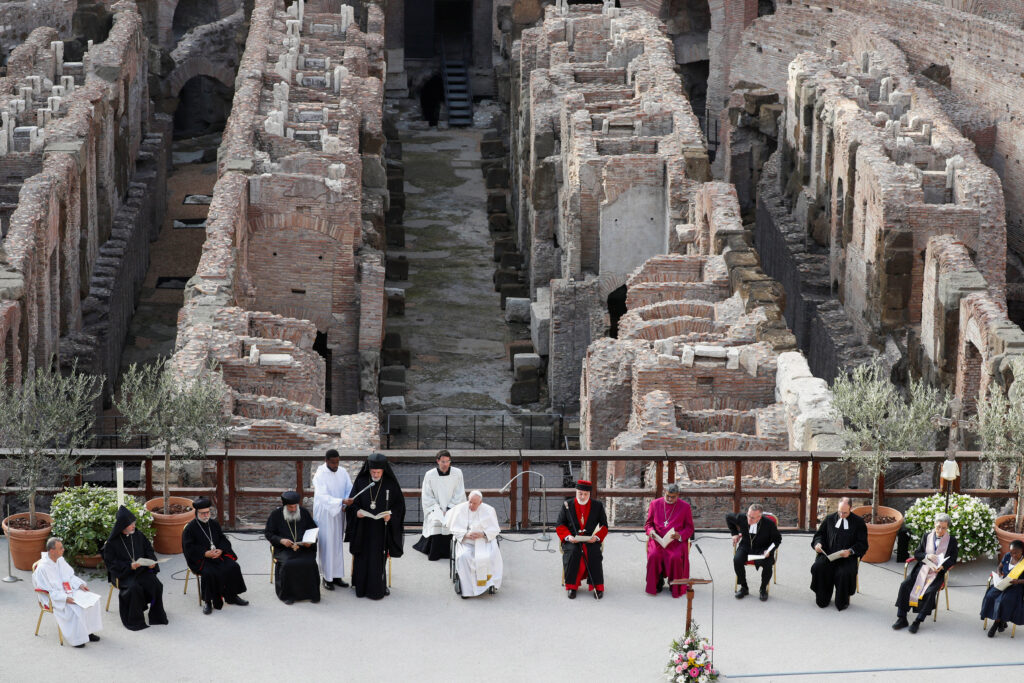
Many world and religious leaders joined Pope Francis on Oct. 25 for the annual interreligious prayer at the Colosseum in Rome.
The day began with members of different world religions spread throughout the ancient structure separately praying in their own tradition for peace and eventually meeting with Pope Francis to pray together and issue a plea for a cessation of war and violence across the globe.
The prayer gathering is part of a three-day interreligious summit called “The Cry for Peace” that is organized by the Community of Sant’Egidio. The community has held an international conference on peace every year since the first World Day of Prayer for Peace in Assisi, Italy, in 1986, which was presided over by Pope John Paul II.
The thoughts and prayers of many who attended this year’s gathering were certainly tuned in to the conflict and suffering taking place in Ukraine. French President Emmanuel Macron was in attendance and said that Ukraine should not be pressured into making peace and accepting terms from Russia. That, he said, would be tantamount to “consecrating the law of the strongest.” He added, “We all know how the Orthodox religion today is being manipulated by the Russian authorities to justify its acts.”
“Talking about peace and calling for peace today can be unbearable for those who are fighting for their freedom, and it can give them the feeling of being somehow betrayed,” he said. While peace is always the highest and supreme good that often requires some compromises on all sides, “if the terms are dictated from outside, they enshrine injustice and sow the seeds for future unrest.”
Pope Francis addressed the religious leaders – Jewish, Muslim, Hindu, Sikh and Buddhists – saying, “Peace is at the heart of the religions, their sacred writings and their teaching. That plea for peace is often stifled, not only by hostile rhetoric but also by indifference. It is reduced to silence by hatred, which spreads as the fighting continues.”
With the specter of nuclear weapons being employed by Russia, prayers for peace were heartfelt in the gathering’s participants. Pope Francis began his address to the world’s secular and religious leaders by reminding all of the message of Pope Saint John XXIII from Oct. 25, 1962, during the Cuban Missile Crisis: “We plead with all government leaders not to remain deaf to this cry of humanity. Let them do everything in their power to safeguard peace. They will thus spare the world the horrors of war, the terrible conclusions of which cannot be foreseen.” Agreeing with this statement, he added, “We are not neutral, but allied for peace, and for that reason we invoke the ‘ius pacis’ as the right of all to settle conflicts without violence.”
Marco Impagliazzo, president of the Sant’Egidio Community, also quoted Pope Saint John XXIII’s message: “We recall the grave duties of those who have the responsibility of power. And we add: Let them hear the anguished cry that, from all points of the earth, from innocent children to the elderly, from individuals to communities, rises to hear: Peace! Peace!”
While not forgetting (as the world is doing) other wars in the world, such as in Ethiopia, Syria, Yemen, South Sudan, Haiti, Myanmar, Nicaragua and elsewhere, most participants were fixated on the war in Ukraine and possible use of nuclear weapons. Pope Francis observed, “Today peace has been gravely violated, assaulted and trampled upon, and this in Europe, on the very continent that in the last century endured the horrors of two world wars. Sadly, since then, wars have continued to cause bloodshed and to impoverish the earth. Yet the situation that we are presently experiencing is particularly dramatic. That is why we have raised our prayer to God, who always hears the anguished plea of his sons and daughters.”
Those in attendance signed an agreement stating that the world is at a crossroads, one in which people today have the choice to be “the generation that lets the planet and humanity die, that accumulates and trades weapons, under the illusion of saving ourselves against others, or instead the generation that creates new ways of living together, does not invest in weapons, abolishes war as a means of conflict resolution and stops the abnormal exploitation of planetary resources. Humanity must put an end to wars, or war will put an end to humanity.”
Father Joseph D. Wallace is diocesan director of Ecumenical and Inter-religious Affairs and pastor of Christ the Redeemer Parish, Atco.



 at the bottom and then tap “Add to Home Screen”
