






At this time of year, it is common and justifiable to focus much of our attention and ecclesial energy on the major feasts and solemnities of Catholic life in the busy month of December: Advent, Saint Nicholas, the Immaculate Conception, Our Lady of Guadalupe as the Patroness of the Americas.
But sometimes lost in the pre-Christmas holiday shuffle is an incredibly important and fascinating doctor of the Church whose impact is still felt around the world, particularly through one of his prized disciples.
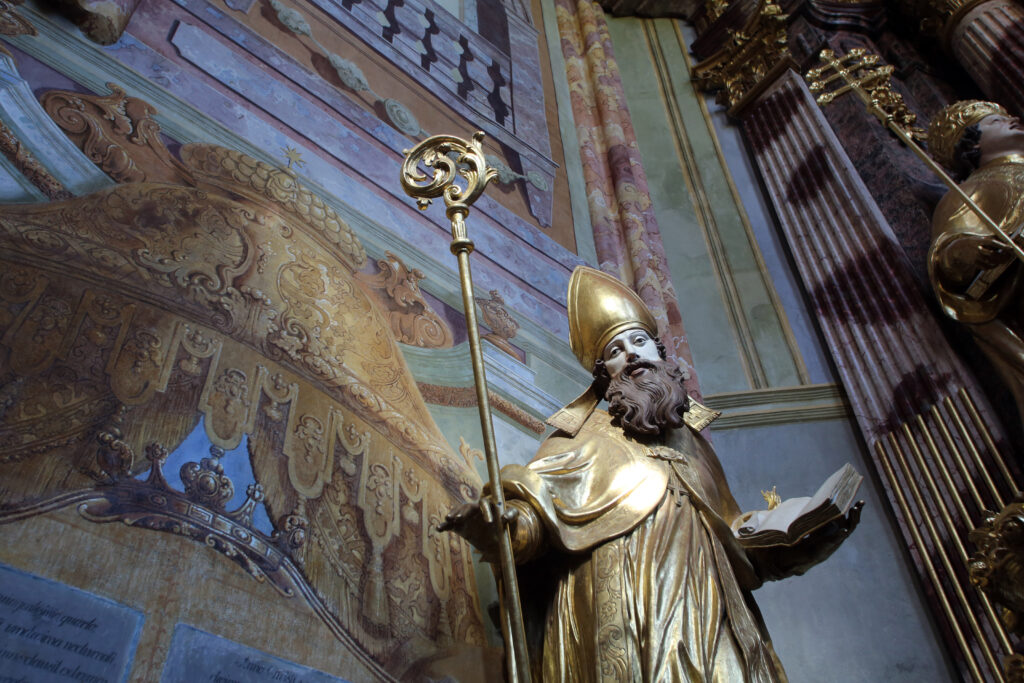
On Dec. 7, 374 A.D., the Roman consular governor of the regions of Emilia and Liguria in Northern Italy, Aurelius Ambrosius, acquiesced to the attestations of the people of Milan who had spontaneously nominated him as bishop through acclamation in the preceding days. Though initially hesitant to accept the charge, the unbaptized Roman officer (who was still a Christian catechumen from a relatively noble family that included two saint-siblings, Marcellina and Satyrus) agreed to receive the Sacraments of Initiation along with his immediate ordination as bishop. We know him today as Saint Ambrose, or Sant’Ambrogio as he is still referred to in the city most associated with him, Milan. We mark his feast day each Dec. 7 in veneration of this momentous occasion, when the people in his local church recognized the potential for spiritual leadership among one of their own.
Ambrose is probably most remembered for playing a decisive role in the conversion of Saint Augustine, famously telling his devoted mother, Monica, that a child of so many tears – which she had poured out over her son’s dissolute lifestyle for decades – would never be lost. Ambrose proved prophetic in his consoling remarks, as his student became one of the greatest teachers in the history of Christianity.
But the reason that Augustine and Monica were drawn to him in the first place was because of his rhetorical brilliance and wide-ranging erudition, which enabled him to confront the Arian heresy with conviction and stamina. The spread of Arianism was one of the most pernicious, long-lasting and influential events of the first centuries of the faith, reaching even into tiers of bishops, scholars, emperors and empresses. It took generations of thinkers, such as Athanasius and his theological protégé Ambrose, to root out a stubborn unwillingness to recognize the co-eternity of the Father and Son, which if it had succeeded, would have rendered the doctrine of the Trinity moot, making idolaters out of those who worshipped Christ.
Ambrose is often depicted with bees or beehives because of the longstanding legend that his father, who was the Roman prefect of Gaul, once found his infant son’s face covered with a swarm of bees. He was shocked that they departed without injuring the boy, but did leave a drop of honey on the child’s lips, foreshadowing the preaching that would one day flow sweetly from his mouth. Such medieval legends of miraculous premonitions or portents were not uncommon, though we obviously cannot allow our appreciation for Ambrose’s ongoing theological relevance to hinge on their veracity or falsity.
Ambrose is recognized as one of the four primary (but by no means only) doctors of the Western Church, along with Saint Jerome, Saint Augustine and Saint Gregory. As such, his writings are regularly cited by popes, bishops, councils and theologians, even into the contemporary period. In fact, Pope Francis’ use of Ambrose’s analogy in his Hexaemeron that the Church should, like the moon, not illuminate itself but rather reflect the glow of the always greater Sun of Justice, is widely interpreted as one of the factors that led his fellow cardinals to vote for him for pope, when he cited it in the pre-conclave conversations in 2013.
Ambrose was instrumental in the discovery of the relics of two martyred twins, Gervasio and Protasio, who were the children of Saint Vitale and Saint Valeria. He held a strong devotion to them, planning for an elaborate basilica to be constructed in their honor and arguing for their inclusion in the Litany of Saints. Ambrose eventually asked to be buried alongside them, which is where he can still be found and revered in the same Milanese basilica since named for him.
So while Dec. 7 can rightly be recognized on our shores as a perpetual “day of infamy” as Franklin Roosevelt once said, it is also a day of immense honor, celebrating one of the greatest minds and orators in the history of Catholicism.
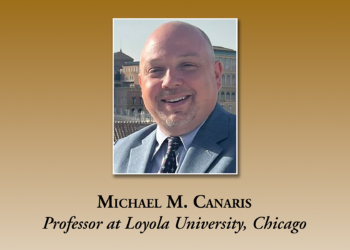
Originally from Collingswood, Michael M. Canaris, Ph.D., teaches at Loyola University, Chicago.



 at the bottom and then tap “Add to Home Screen”
