




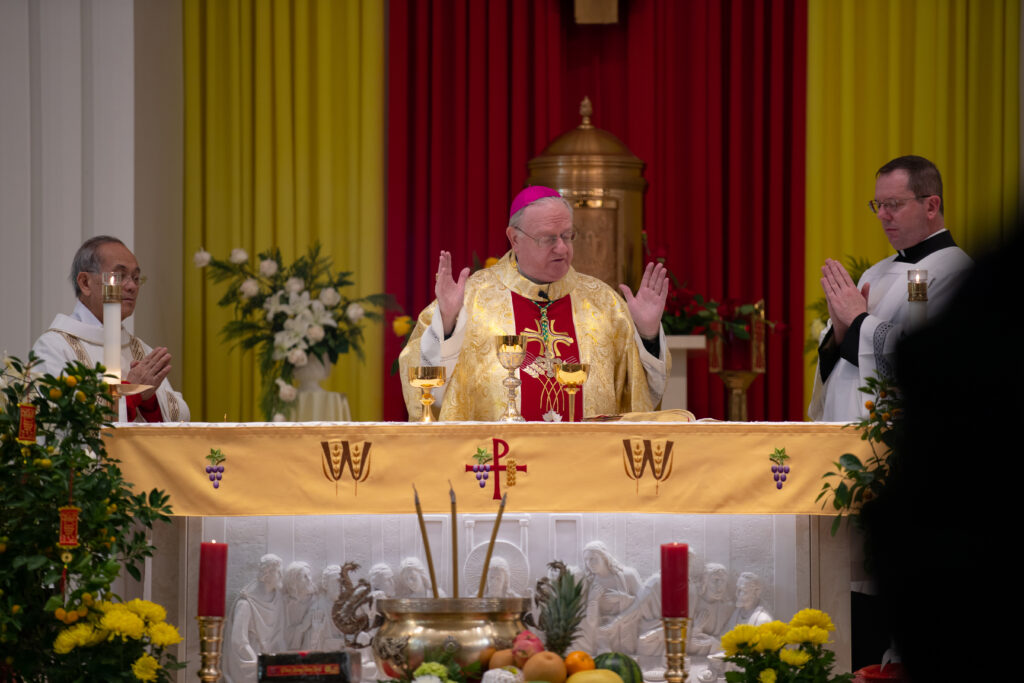
The National Eucharistic Revival is underway. In this Diocese, the revival began last year on the solemnity of Corpus Christi with a Eucharistic procession along the boardwalk in Atlantic City. This was followed by Eucharistic talks given throughout the Diocese. As part of the revival, the parishes of the Diocese participated in a program for understanding the Mass – all for the purpose of emphasizing the Real Presence of Jesus in the Eucharist.
The focus on understanding the Mass, why Catholics do what they do during Mass and what it signifies, remind this author that the focal point of the Mass, of the church building, is the altar. A Catholic church would not be a Catholic church, or even a sacred place, without the altar. This in no way is to diminish the sacredness of our Lord, present in the Blessed Sacrament reserved in the Tabernacle. Rather, it is to highlight that the church building is for the purpose of a sacred, liturgical, action – that action takes place on the altar. This action is the reason for the building; the reason for bringing the community together.
The Catholic philosopher Josef Pieper, in his book “In Search of the Sacred,” came to this conclusion, writing: “The altar is not a mere piece of furniture, nor a mere depository for books and utensils; it is not at all ‘a table like any other table found, let us say, in the confirmation classroom’… Rather, the spiritual symbolism centered on the altar make it a twofold reality: the altar, on the one hand, serves as table for the ritual meal, and on the other, constitutes a ‘stone of sacrifice.’” (Ignatius Press, 1991. pages 105-106)
The sacred action that takes place upon the altar is sacrifice. That which is sacrificed is then partaken in by way of a ritual meal. The altar, however, is not, as Pieper states, just a table for a meal. Rather, the altar is truly a stone of sacrifice.
For there to be sacrifice, there must be a priest to offer the sacrifice and a victim to be offered. The priest is an ordained man, who through the power of holy orders, acts in the person of Jesus. The victim is Jesus, who, through the action of the priest, becomes present under the form of bread and wine.
That Jesus’ Death is a true sacrifice and the breaking of the bread a true partaking in his one sacrifice is evident from Jesus’ words at the Last Supper. When Jesus took the bread, he said, “Take this, all of you, and eat of it; this is my body, which will be given up for you”; this sacrifice establishes a new and everlasting covenant: “Take this, all of you, and drink from it, for this is my blood, the blood of a new and everlasting covenant which will be shed for you and the many for the forgiveness of sins.” (cf. Mt 26:26-27; Mk 14:22-24; Lk 22:19-20) Jesus commanded that we do this in memory of him.
In First Corinthians, chapter 10:16-21, Saint Paul compares the partaking of the Eucharist with the partaking of other foods used in sacrifice to idols. He states in verse 21: “You cannot drink the chalice of the Lord and the chalice of the devils; you cannot be partakers of the table of the Lord and of the table of the devils.” This presupposes that the Eucharist is a sacrifice and the table is an altar, a place of sacrifice. Saint Paul also states that the partaking of the chalice and the bread is a partaking in the body and blood of the Lord. (cf. verse 16) From this, we understand that the sacrificial meal in which we partake, allowing us to partake in the sacrifice offered, is that of Jesus. For this to be, Jesus must be substantially present in that which is offered and received.
The Catechism of the Catholic Church, drawing upon what the Church has understood from the beginning, teaches that the “sacrifice of Christ and the sacrifice of the Eucharist are one single sacrifice.” (par. 1367) The Catechism draws on the teaching of the Council of Trent, which stated: “The victim is one and the same: the same now offers through the ministry of the priests, who then offered himself on the cross; only the manner of offering is different.” (Council of Trent, “Doctrine and canons on the most holy sacrifice of the Mass,” chapter 2) Jesus has established that his sacrifice on the cross be made present in a real, but unbloodied way, so that we, who make up his body, may participate in his sacrifice, in both offering and receiving the sacrament.
This ability to participate in the sacrifice of Christ means that the Eucharist is the sacrifice of the Church. “The lives of the faithful, their praise, sufferings, prayer and work, are united with those of Christ and with his total offering, and so acquire new value.” (CCC par. 1368) The faithful offer themselves with Jesus, Jesus, who “thought equality with God was not something to be grasped at … but was obedient to God, humbly accepting even death, death on a cross.” (Phil. 2:6, 8)
Jesus willingly offered himself on the cross due to his charity; that is, his love for the Father and his love for us, sinful as we are. His free self-offering upon the cross as the sacrificial lamb has brought about the forgiveness of sins. This grace is applied to us through the sacraments, particularly, baptism, confession and Holy Eucharist.
The altar, the center of a Catholic Church and focal point of the Mass, reminds us that we, too, through Jesus’ presence in the Eucharist, participate in Jesus’ perfect sacrifice upon the cross. During this phase of the National Eucharistic Revival, may the altar remind all of us to unite ourselves with Jesus in his sacrifice so that “bearing about in our bodies the mortification of Jesus, that the life of Jesus may also be manifested in our bodies.” (2 Cor. 4:10)
Father Jason Rocks is chancellor of the Diocese of Camden and pastor of Holy Eucharist Parish, Cherry Hill.





 at the bottom and then tap “Add to Home Screen”
