



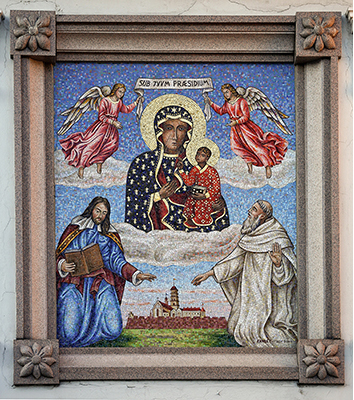
This is a special time of year for Catholics in Poland or of Polish descent around the world as the feast of Our Lady of Czestochowa was celebrated Aug. 26 and the anniversary of Pope Clement XI’s 1717 pontifical coronation of the image falls shortly after, on Sept 8.
Since New Jersey has more than double the national average of Polish American families (at around 5% of the general population), this is a beloved celebration for many people in the area.
The image traditionally ascribed to Saint Luke’s painting on a table top created by Saint Joseph, albeit with meager historical evidence for this, is a classic portrayal of the Virgin Hodegetria. This classic posture is one where Mary holds the child Jesus and gestures toward Him as the “way” that leads to salvation. This Greek word is also interestingly etymologically connected to “synodality,” which comes from syn-hodos, roughly translated into English as “being together on the way.” Other examples of this type of icon are the Mother of Perpetual Help and the Russian Theotokos of Tikhvin.
The Polish virgin housed in the Jasna Gora Monastery in Czestochowa is a “Black Madonna,” like those of Montserrat in Spain, Einsiedeln in Switzerland and dozens of examples elsewhere around the world. Most striking about Our Lady of Czestochowa are the three scars on the image, one on her throat that was supposedly accidentally inflicted in the midst of battle, and two intentionally made during the internecine conflict with the followers of Jan Huss in the 1400s. Supposedly, various attempts by experts to repair or remove these violent slashes have proved unsuccessful.
Whether legend or “fact,” the stubborn permanence of these scars can lead us to some profound theological and spiritual truths. First and foremost, one would be hard-pressed not to connect such wounds with the traditional seven swords that pierced Mary’s heart under her veneration as Our Lady of Sorrows (the Mater Dolorosa in Latin, from which we get the name Dolores). These moments of intense suffering in her earthly journey are usually described as: the prophecy of Simeon, the flight to Egypt, the loss of the child Jesus in the Temple of Jerusalem, the meeting on the path to Calvary, the Crucifixion, the descent from the Cross and the Burial of Jesus.
Though Catholic tradition argues that Mary perfectly conformed her will to God’s at every moment of her life, she was not spared tremendous pain and even bewilderment (cf. Lk 1:29, when she is described as “greatly troubled”). Following God’s path for one’s life is never the same thing as knowing its twists and turns in advance. As nearly all of the spiritual guides of Christian history make clear, the trek to the heights of Sinai cannot but pass through the bitterness of the desert.
And as always in the Catholic tradition, Mary leads us to Christ. When the eventual saint but early skeptic Thomas hears that the others have seen the Lord after the discovery of the empty tomb, he – perhaps begrudgingly – returns to the community in the midst of his uncertainty and reservations. Luckily, the other disciples do not bar him from their presence when he refuses to accept their version of events. He is welcomed to be present with them in the midst of his doubt, and thus becomes the first to acknowledge Jesus as both “Lord and God” (Jn 20:28). But importantly, Thomas makes this creedal assertion at the invitation of Jesus to touch his still existent wounds, which have perdured even after the Resurrection. (All the famous artwork aside, the biblical text never says explicitly whether Thomas actually takes Jesus up on this offer or not. (Perhaps the mere proposition was enough). But, the mutilations and traumas of Jesus’ life are not magically erased in Thomas’ presence or eventually in ours. Jesus’ testimonies to his sufferings are rather perfected and transformed. When Christ is raised up from the dead, these enduring scars and attestations to his ongoing humanity become symbols not of disfigurement and weakness, but of ultimate victory and sovereignty.
The “blemishes” on the Virgin of Czestochowa speak profoundly to the historical suffering of the people of Poland, who have persevered in the faith despite perhaps the most diabolical moment in our planet’s history at the routinization of dehumanization culminating in Auschwitz’s death factories erected within their borders. It’s likely for all of these reasons that Pope John Paul II revealed that he whispered his eventual pontifical motto “Totus Tuus” (“I am totally yours”) in prayer countless times before this image.
Originally from Collingswood, Michael M. Canaris, Ph.D., teaches at Loyola University, Chicago.




 at the bottom and then tap “Add to Home Screen”
