



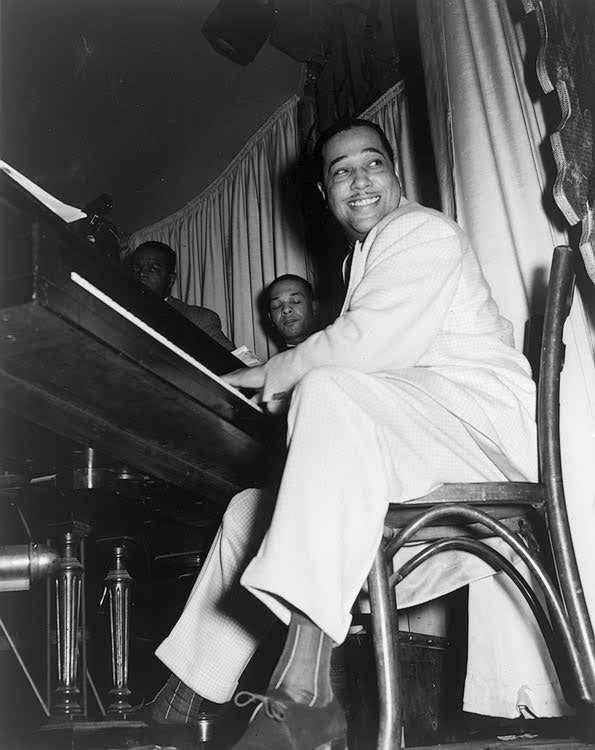
One of his biographers recorded that Edward Kennedy Ellington, like other youngsters, sometimes overslept. His mother or aunt would have to shake him awake and push him to quickly get ready for school.
But, once dressed, he would call to them. Standing at the foot of the stairs, he would slowly announce he was “the great, the grand, the magnificent Duke Ellington.” He would bow for the approving women, and then command, “Now applaud, applaud.”
Then he would run off to school.
The self-assured young man who had the approval of the women of his childhood home would eventually gain fans all over the world. He came to be admired by such diverse music lovers as Lawrence Welk, Charles Mingus, Leopold Stokowski and Richard Nixon. Orson Welles reportedly described him as the only genius he’d ever met, other than himself.
That telling anecdote of Ellington as a young man is included in “Duke Ellington,” the first of many biographies about him. It was the first book written by Barry Ulanov, a son of Russian immigrants who became a respected scholar and taught at Juilliard, Princeton, and Columbia University. A few years after his 1946 Ellington book, Ulanov converted to Catholicism, helped establish the Saint Thomas More Society and began writing about religion as well as music.
Duke Ellington didn’t always live a saintly life but, like Ulanov, his career also included an explicit turn to religion. He was in his mid-60s when he premiered his first sacred concert at the Episcopal Grace Cathedral in San Francisco in 1965. He described it “the most important thing I’ve ever done.”
He composed his Second Sacred Concert three years later and his Third Sacred Concert in 1973, the year before his death.
In performances of the Second Sacred Concert, Ellington often recited the “four freedoms” he composed when his friend and collaborator Billy Strayhorn died.
“Strayhorn does a lot of the work, but I get to take the bows,” Ellington sometimes said of the shy and mild-mannered man who worked with him as a composer and arranger for some 25 years. (Strayhorn composed “Take the A Train,” which became the Ellington band’s theme.)
Ellington listed what he considered Strayhorn’s “four major moral freedoms”:
• freedom from hate, unconditionally;
• freedom from self-pity (even through all the pain and bad news);
• freedom from fear of possibly doing something that might help another more than it might himself, and
• freedom from the kind of pride that might make a man think that he was better than his brother or his neighbor.
On his 1995 visit to the United States – our self-proclaimed “land of the free” – Saint John Paul II promoted his vision of freedom, which bears some similarity to Ellington’s view. “Every generation of Americans needs to know that freedom consists not in doing what we like, but in having the right to do what we ought,” the pope said at Baltimore’s Camden Yards.
On his 1987 visit, at an ecumenical service at the University of South Carolina, he said modern life encourages a false notion of individual freedom, “as if we could be free only when rejecting every objective notion of conduct, refusing to accept responsibility or even refusing to put curbs on instincts and passions!”
“Instead,” he continued, “true freedom implies that we are capable of choosing a good without constraint. This is the only truly human way of proceeding in the choices – big and small – which life puts before us.”
The man born Karol Józef Wojtyła had experience with oppressive political regimes before he appeared to cheering crowds on the balcony of Saint Peter’s Basilica as Pope John Paul II. His moral stance against communism and dictatorships became a hallmark of his papacy.
The young man who stood on his steps while his mother and aunt applauded became a recipient of the Presidential Medal of Freedom. But as a Black man born in 1899 who appeared on countless stages throughout the country, he knew about racism and prejudice. (So did Strayhorn, who was Black and gay. He was actively involved in the Civil Rights Movement and became friends with Dr. Martin Luther King Jr.)
Both the Polish priest and the Black American musician knew enough about the world to insist that true freedom must be in harmony with moral responsibility and faith.
Ellington, who communicated best through music, once said, “Every man prays in his own language, and there is no language God doesn’t understand.” On that point also, the ecumenically-minded pope would have agreed with him.
Carl Peters is former managing editor of the Catholic Star Herald.



 at the bottom and then tap “Add to Home Screen”
