
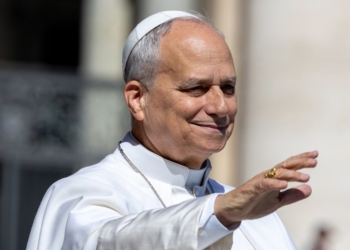




In his homily for his 2005 Inaugural Mass, Pope Benedict XVI said, “The external deserts in the world are growing because the internal deserts have become so vast. Therefore, the earth’s treasures no longer serve to build God’s garden for all to live in, but they have been made to serve the powers of exploitation and destruction.”
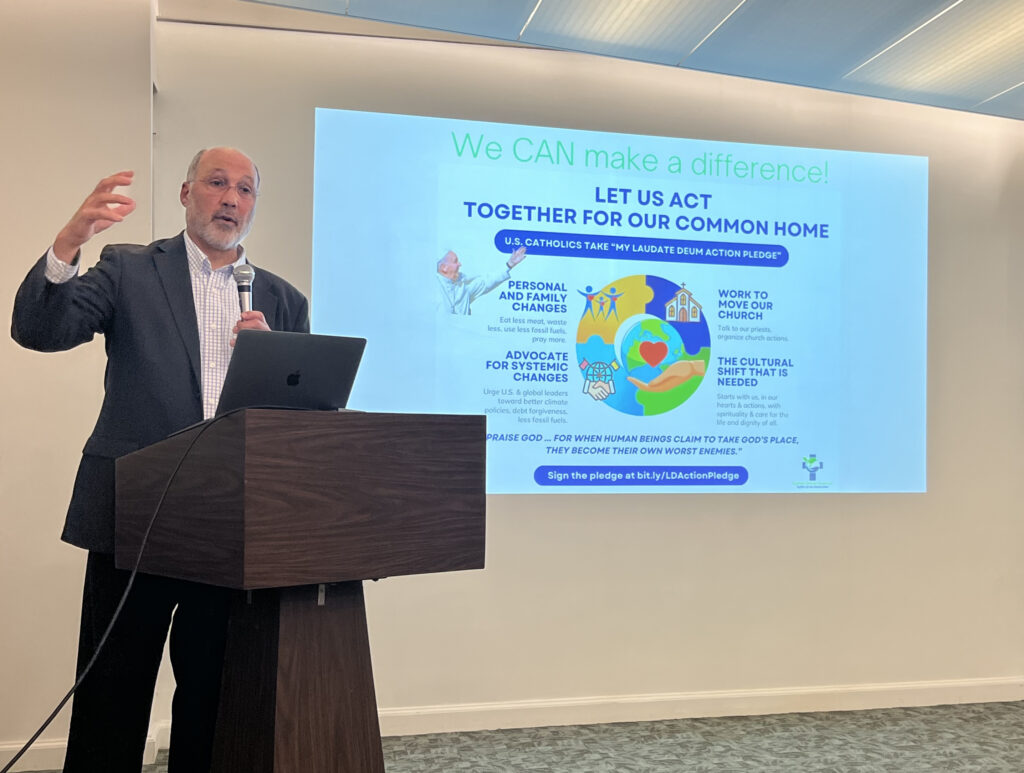
Utilizing such Catholic social teaching, Dan Misleh, founder of the Washington, D.C.-based nonprofit Catholic Climate Covenant, visited the Diocese of Camden last month to explain how faith action can play a critical role when it comes to caring for the environment.
He cited studies on the increasing rising sea levels and number of wildfires, flooding and storms, as well as the world’s dependence on fossil fuels and the repercussions of global warming, such as struggling crop productions.
“This is not new science,” he said, explaining that a “Popular Mechanics” article from 1911 quoted scientists as saying that if society continued to burn fossil fuels, it would have a devastating effect on the future. “So this didn’t just happen back in the 60s or 70s or 80s. Scientists have known about this for a long time. Right now, carbon dioxide is being released into the atmosphere faster than any time in at least the last 66 million years.”
“We have about 10 years, the scientists think, to cut emissions by 50%,” he continued. “That’s a tall order.”
Addressing the nearly 50 parishioners from across the Diocese gathered in the parish hall of Saint Thomas More, Cherry Hill, he stressed that sharing – and living – authentic Catholic teaching on the environment could lead to solutions regarding climate change.
“What Pope Francis says in ‘Laudato Si’ is that there are three relationships that we have to pay attention to,” he said. “We have to first pay attention to our relationship with God. We have to pay attention to our relationship with one another. And we have to pay attention to our relationship with nature, with our surroundings.”
Reflecting on the Bible and the story of creation, Misleh reminded the crowd that mankind was given the task of caring for the planet and its creatures. “We’ve been at this for a long time as people of faith. What’s happened is that we’ve forgotten that this is part of our faith.”
What has led to this forgetfulness, he said, referencing the teachings of Pope Francis: “When human beings place themselves at the center, all else becomes relative. … When we fail to acknowledge as part of reality the worth of a poor person, a human embryo, a person with disabilities … it becomes difficult to hear the cry of nature itself. Everything is connected.”
To be a change in the world, he suggested multiple plans of action including wasting less, reducing fossil fuels, advocating for environmentally friendly resources and praying. For more resources, he suggested visiting catholicclimatecovenant.org and laudatosiactionplatform.org.
And of great importance: pray. “Faith matters,” he said. “We’re trying to save this planet, ourselves and all creation from our own hubris.”
The recording from Misleh’s talk, sponsored by the Diocese of Camden’s Office of Life & Justice Ministries and Saint Thomas More Parish, is available on YouTube.
For additional resources, visit catholicclimatecovenant.org/resources/the-faith-voice-at-cop28/.
Catholic social teaching quotes on the environment
“At its core climate, global climate change is not about economic theory, or political platforms, nor about partisan advantage or interest group pressures. It is about the future of God’s creation and the one human family.” ~ U.S. Catholic Bishops, 2001
“There is a growing awareness that world peace is threatened not only by the arms race, regional conflicts and continued injustices among peoples and nations, but also by a lack of due respect for nature, by the plundering of natural resources and by a progressive decline in the quality of life.” ~ Pope John Paul II, World Day of Peace Message, 1990
“Man is suddenly becoming aware that by an ill-considered exploitation of nature, he risks destroying it and becoming in his turn the victim of this degradation.” ~ Pope Paul VI, 1971 apostolic letter
“Living our vocation to be protectors of God’s handiwork is essential to a life of virtue; it is not an optional or a secondary aspect of our Christian experience.” ~ Pope Francis, Laudato Si’




 at the bottom and then tap “Add to Home Screen”
