








During World War II, after the victory of the Allies in the Battle of Sicily, Gen. George Patton met with a military governor. The governor praised the general lavishly for his valor and bravery, to which the general replied, “Sir, I am not a brave man. The truth is, I am an utter craven coward. I have never been within the sound of gunshot or the sight of battle in my whole life that I wasn’t so scared that I broke out into a cold sweat.”
Patton would later comment that he had learned early on in life never to let his fears get the best of him.
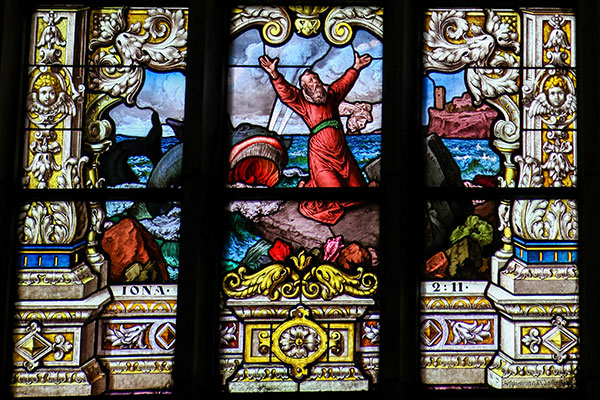
The prophet Jonah was also scared when the call of God came to him to preach to the people of Nineveh about God’s anger with them because of their wickedness. However, unlike Patton, Jonah did let his fears get the best of him, at least at first.
The Book of Jonah is very short, only about two full pages in the Bible. It is challenging and consoling – amusing sometimes, too. Rather than a prophecy, the work is considered to be a didactic story, a teaching work for God’s people. Of course, when we hear the name Jonah, we automatically think about a man swallowed by a whale, but the story is much more than that.
Nineveh was a great city in the ancient world of the Middle East. The Scriptures say it was enormous, taking three days to walk through. It also had a large population – 120,000 – which was huge for Biblical times. Nineveh was the capital of Assyria, Israel’s powerful enemy and eventual conqueror. The Assyrians were renowned for their militarism and ruthlessness. No wonder Jonah was petrified when God called him to go to Nineveh and preach God’s wrath against them.
So what did Jonah do? He closed his ears to God’s call and ran as far away as he could in the opposite direction from Nineveh, right to the Mediterranean Sea. Boarding a ship there, Jonah hoped God would forget about him and find someone else more suitable for the task.
Once out on the high seas, a violent storm came up, and the mariners prayed frantically to their various gods to calm the waters and save them. When nothing changed, the voyagers asked Jonah if he had done anything to offend his God. When Jonah replied in the affirmative, he told them to cast him overboard to appease God. They did, and the storm abated right away.
Now alone in the sea, Jonah was swallowed by a great fish and remained in its belly for three days. He used that time well, however, to pray: “The waters swirled about me, threatening my life; the abyss enveloped me.”(2:6) Then, anticipating his deliverance, he continued: “But you brought my life up from the pit, O Lord, my God. When my soul fainted within me, I remembered the Lord.” (2:7-8) In this last verse, Jonah acknowledged, in effect, that God’s grace trumps all fears. And the fish finally spewed him upon the shore.
Then came the call of God to Jonah for the second time to go to Nineveh and announce that God intended to destroy the city in 40 days. Jonah is now ready to fulfill this mission without delay. It is at this point that the first reading for the Third Sunday in Ordinary Time begins.
Jonah fearlessly began to preach God’s word of condemnation to a very powerful and fierce people. He was able to accomplish his mission successfully because God’s grace trumps all fears. In fact, Jonah’s preaching was so successful that the king and the whole population – even the animals! – covered themselves in sackcloth and fasted. In his great mercy, when God saw their acts of repentance, he did not carry out his original design.
In the Gospel for this same Sunday, we hear Mark’s account of the call of the first Apostles. They were four fishermen, Simon (Peter) and his brother Andrew, and James and his brother John. Unlike the prophet Jonah, when they received the call from Jesus, they responded without the slightest hesitation. God’s grace trumps all fears.
We know from the biography of Saint Teresa of Calcutta that she was indeed apprehensive when she decided to leave the security and comfort of her walled-in convent in India to live and work among the poorest of the poor. But she did it anyway. Like Gen. Patton, she refused to let her fears get the best of her. God’s grace trumps all fears.
It goes without saying that to live the life of a committed Catholic today requires courage and determination in the face of almost relentless opposition from the world, the flesh and the devil. Like the first apostles, Mother Teresa and the chastised prophet Jonah, let us embrace the challenge, and with joy. Remember, God’s grace trumps all fears.
Father Edward Kolla is a retired priest of the Diocese.



 at the bottom and then tap “Add to Home Screen”
