



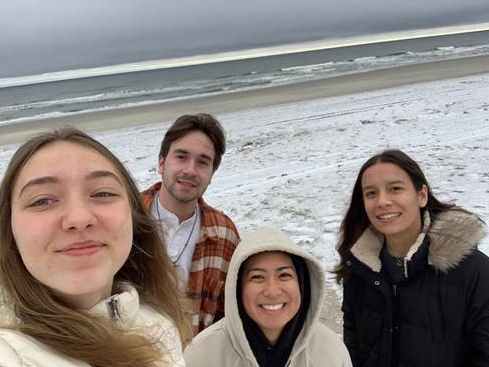
Khrystyna Svystovych is living the typical freshman life at Stockton University, Atlantic City campus. Like many of her fellow students, she is making friends, taking classes and exploring extracurriculars – finding her niche and charting her path toward her degree and the start of her professional career.
And while Krystyna – Khris or Krissy, for short – appreciates the opportunity to pursue her college education, she is also grateful to be living in safety, and spared from the bombings and attacks that have plagued her home country of Ukraine for more than two years.
“It is a miracle that I am still alive,” said Khris, who came to the United States in August 2021, just six months before Russia’s invasion began. “I understand that God put me in this safe place for a reason. He sent me to America right before the war started for a reason.”
The road to Stockton
Accepted into a Future Leaders Exchange Program (FLEX) launched by the U.S. Department of State, Khris came to the United States along with some 130 other students, and she stayed with a host family in a small town in Ohio. After the Russian invasion, the FLEX program was extended to allow the students to remain in the United States, but after graduating high school, Khris had limited options but to return home.
Stockton University was one of a handful of institutions that agreed to accept students from the FLEX program who, like Khris, wanted to pursue higher education in the United States. She was among 15 students who applied to Stockton, and was admitted to the Galloway-based institution along with fellow student Mykhailo Chabanovskyi, who is also from Ukraine.
When she first arrived in Atlantic City, she began searching for a local Catholic church. Having grown up in a Catholic household, she had always found solace and comfort in her faith.
“Faith means a lot to my family,” she said, recalling how her dad would teach her and her siblings “how faith can change your whole situation.”
Someone at Stockton shared that there was a campus ministry program at the university.
“When I came here, I did not want to lose touch with my faith,” she said. “My faith right now, it is the only thing that I have left from home, and it is the only thing that feels like home.”
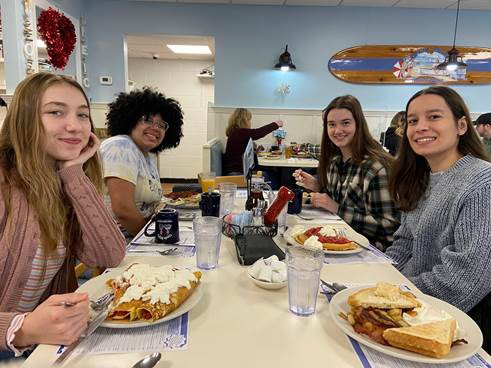
She found that sense of home – and family – at the university’s Newman Club. “It just feels like family. I don’t have to be someone specific,” she said. “Even though I come from such a different background, they still accept me, and they want me to feel comfortable. They understand my situation, and they understand that I need a lot of support right now.”
Britany Shields, Catholic Campus Minister at the Newman Center, said the group is truly blessed to have her as a member.
“Ever since Krissy joined us last year, she has brought incredible warmth and enthusiasm to our community. Right from the start, Krissy showed a genuine eagerness to be involved, always asking how she could help out more,” Shields said. “Whether it’s lending her voice to our music ministry, reading for Mass, welcoming new students or attending events, Krissy’s dedication is truly inspiring.”
Shields also shared that Khris’ true devotion to faith is apparent to others, and that she is an inspiration to her peers.
“Beyond her invaluable service to the club, Krissy radiates a profound faith, effortlessly sharing her spiritual depth with those around her,” she said. “She embodies the essence of prayerful devotion and authenticity, inspiring us all with her unwavering commitment to her beliefs.”
Campus community unites around students
Indeed, that commitment to faith played a role in her journey. Khris shared that she was praying the Rosary when she learned she was first accepted to the FLEX program in the United States.
In admitting both Khris and Mykhailo, Stockton University committed to providing them with tuition, room and board, health insurance and incidentals – like bedding, pots and pans and laundry baskets – with a four-year commitment to supporting them through their college experience.
“With the help of Stockton’s Foundation, the university has provided them the financial support necessary for four years, 365 days a year,” said Natalja Manger, Stockton’s assistant director of International Recruitment and Admissions, who is a naturalized citizen from Latvia. “To host a student like that, who has very little or any fiscal support for an entire four years of their education, it’s a huge, huge investment.”
Since arriving on campus, both students have received an outpouring of support. The university’s Center for Community Engagement and Social Learning helped to organize necessities for them, and some faculty members have become like surrogate parents.

“They arrived here as children who were brave enough to travel into the unknown, but as the war began, they realized that the way they envisioned their future isn’t going to be possible anymore and they are going to have to reinvent it for themselves,” Manger said. “Where your future was a source of anxiety for you, it now becomes what you can anticipate. And that puts you at ease, and you don’t have to always be afraid of what’s going to happen next month.”
Khris said that Manger’s background put her at ease. “She knew what we were going through,” Khris said. “She did the same thing when she was young – she also moved from one country to another. She wasn’t just a faculty member looking at our applications; she was the person behind the faculty member.”
Khris is considering a major in anthropology because of her interest in learning about other cultures. She said that she continues to be struck by the diversity of her campus community – with a lot of different people, viewpoints and perspectives.
She has also felt a strong sense of acceptance and purpose. “When I came to college, I just realized more that everybody has purpose for their life, and everybody will be where they are supposed to be.”
The situation at home
Khris was born and raised in the small town of Uhniv, which is in the western part of Ukraine. Her parents moved to Poland for work, but her five siblings remain in Ukraine. While they have not seen as much fighting because of their proximity to Poland, at the start of the invasion and war, her family struggled without electricity for months.
“I miss my family so much,” she said, adding that it is difficult to come to terms with what is happening in her home country.
“It feels a little unfair because I am safe here, and then I look at home and every place that I saw just gets destroyed and looks different,” she said. “Some people that I know are dying. The airport I flew from got bombed the first night [of the invasion]. It is mind-blowing that when I come home, it won’t be the same.”
Khris said that American television coverage of the war doesn’t begin to reveal the true horrors of what is happening, including the destruction of so many historic, treasured places and the stories of too many families whose homes have been bombed.
“The TV doesn’t even show the half of what is going on,” she said. “If [people] really want to know the experience, and if they really want to help, they need to reach out to people who are there.”
She said that those seeking to help can support Ukrainians like her in their home communities. “If you cannot directly help, help them here,” she said, noting that they can support refugees and immigrants as they adjust to their new surroundings.
Khris said she is full of gratitude for all of the support she has received. “I just want to say thank you to everybody who has helped me here.”



 at the bottom and then tap “Add to Home Screen”
