





Though overshadowed in popularity, commentary and an absolute crush of visitors by his more famous series on Saint Matthew, the “Madonna of the Pilgrims” by Michelangelo Merisi (the “other” Michelangelo known by the name of his native city of Caravaggio) is perhaps the better icon for today’s ecclesial landscape in a global Church reaching from Rome to New Jersey to far-flung corners of the planet.
The Second Vatican Council famously recovered and revitalized an understanding of the entire Church as a “People on the Move.” The council fathers claim, “On earth, still as pilgrims in a strange land, tracing in trial and in oppression the paths He trod, we are made one with His sufferings like the body is one with the Head, suffering with Him, that with Him we may be glorified.” (LG 7)
The collective authors refer a number of times to the “pilgrim Church,” which is not the same thing as saying the Church is made up of individual pilgrims. It rather recognizes and highlights the collective identity that the People of God all share and exhibit as a whole, which has elements both historical and eschatological (forward-looking toward the horizon of Mystery).
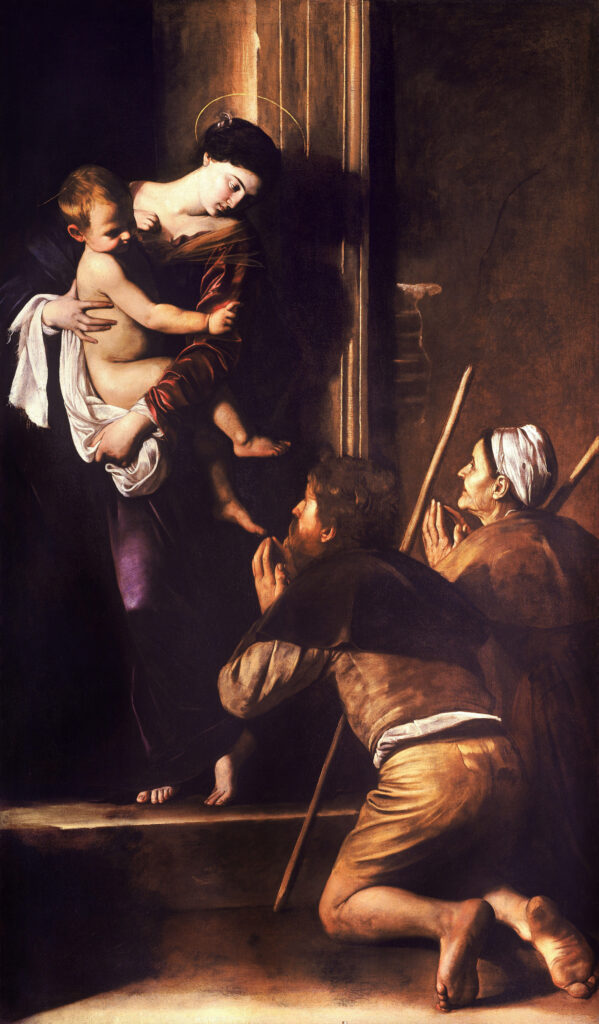
When Caravaggio – himself a perhaps uncomfortable fit in the history of Christianity due to his documented excesses and violent imperfections – was commissioned to decorate the Cavalletti Chapel in Rome’s church dedicated to Saint Augustine, he took up the theme of Our Lady of Loreto, incidentally the patron saint of air travel since the angels supposedly flew Mary’s home from Palestine to Loreto, Italy, with a layover in Croatia. But from its inception, the artist inflected the painting with the realism that shocked and outraged many of his day.
The model for the Blessed Mother is widely believed to be one of his mistresses, Lena, who also appears in another of his works, the “Madonna and the Serpent” now in the Borghese Gallery. But when imagining her as the Virgin of Loreto, he situates her not between classic Corinthian pillars in a temple or place of worship, but amidst deteriorating brickwork found in the dark and dangerous alleys of Renaissance Rome. Only a wisp of a halo separates her and the oversized child she holds from the women of the street that populated the areas around these churches, along with their often unwanted children, an occupational hazard of the world’s oldest profession. Perhaps no other image refers so clearly to “the poor Church for the poor” that Pope Francis so often talks about; one that “rushes out” from the sanctuary to the streets and peripheries.
The most famous and enduring image in the composition is the bare feet of the protagonists. Both the Madonna and the male pilgrim are noticeably unshod. On a recent visit to contemplate the masterpiece with my friend, art historian Christina Mifsud, she pointed out the incredibly small physical distance between this all-too-human depiction of the messiness of life and the altar where Mass was celebrated in the artist’s day. The theological implication is stunning in its simplicity, that even the holiest moment that serves as the “source and summit” of the entire Christian life is not removed from the grit and grime of life’s challenges.
An itinerant rabbi without a place to lay his head gifted the particularities of that Body with and for us – not a gilded-slippered, pristine or debonair one. And yet, despite their rough-hewn peasant limbs and features stained with the residue of the world, who can gaze at them and not think of the line Paul cites to the residents of the city where this work still interrogates us: “How beautiful are the feet of them that preach the Gospel of peace, and bring glad tidings of good things!”? (Romans 10:15)
Of course, Mary and Jesus are the central images in the work. But it’s the protagonism of the pilgrims that redefines the entire artistic arrangement and draws our eye, so much so that it is more frequently called the “Madonna dei Pellegrini” (Our Lady of the Pilgrims) than the specific Marian title intended by the original commission.
These themes – pilgrimage, close proximity to trauma and difficulty, the dynamic agency of the poor and underappreciated, unswerving commitment to popular piety, the wide accessibility of God and models of holiness like Mary – are all themes that define the current ecclesial moment and its connection to synodality at all levels of Catholic life.
Every inch of Rome seems to be under construction for the coming jubilee year, when estimates predict 50 million pilgrims may come to the city. For the foreseeable future, there might not be much chance to stand alone before the Caravaggio masterpiece like I was blessed to do a few times this summer. But there is perhaps no better image for such immense crowds to ponder if they hope to understand the ecclesiological shift that is underfoot in our age.
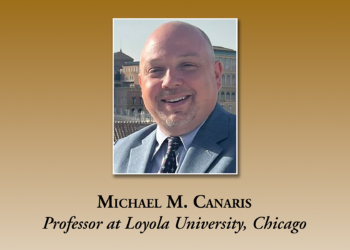
An alumnus of Camden Catholic High School, Cherry Hill, Michael M. Canaris, Ph.D., teaches at Loyola University, Chicago.



 at the bottom and then tap “Add to Home Screen”
