



HAMMONTON – Human beings are built for stories, and have been since the time of the greatest of all faith storytellers: Jesus.
“Jesus needed to engage wildly different groups of people during his public ministry,” said Donna Ottaviano-Britt, director of the diocesan Office of Discipleship and Leadership. “So he told stories that were able to draw in diverse crowds with different points of view.”
In a similar way, “Your witness is the most important thing you can share with another.”
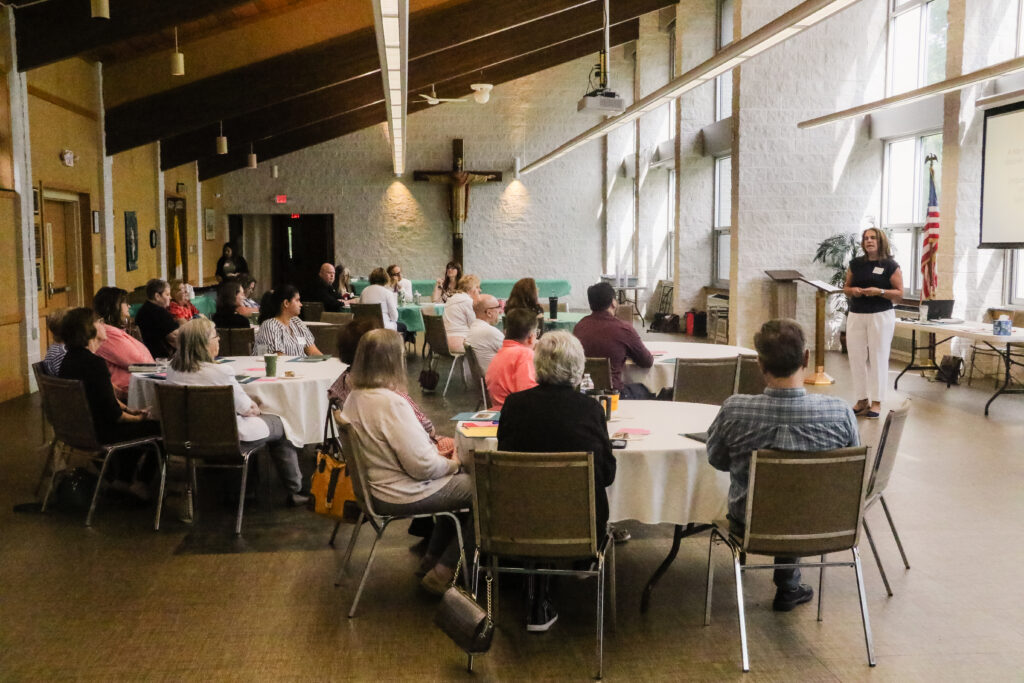
Ottaviano-Britt was among the speakers to recently address parish catechetical leaders from across the Diocese who gathered in Saint Anthony Church, Saint Mary of Mount Carmel Parish. Organized by Dr. Lee DelleMonache, diocesan director of religious education, the day aimed to help the catechetical leaders discover their own faith stories – and also feel equipped and empowered to share those stories in order to invite others to grow closer or re-engage with the Catholic faith.
After the program’s success, it was shared again a few weeks later with advancement directors from South Jersey’s Catholic schools.
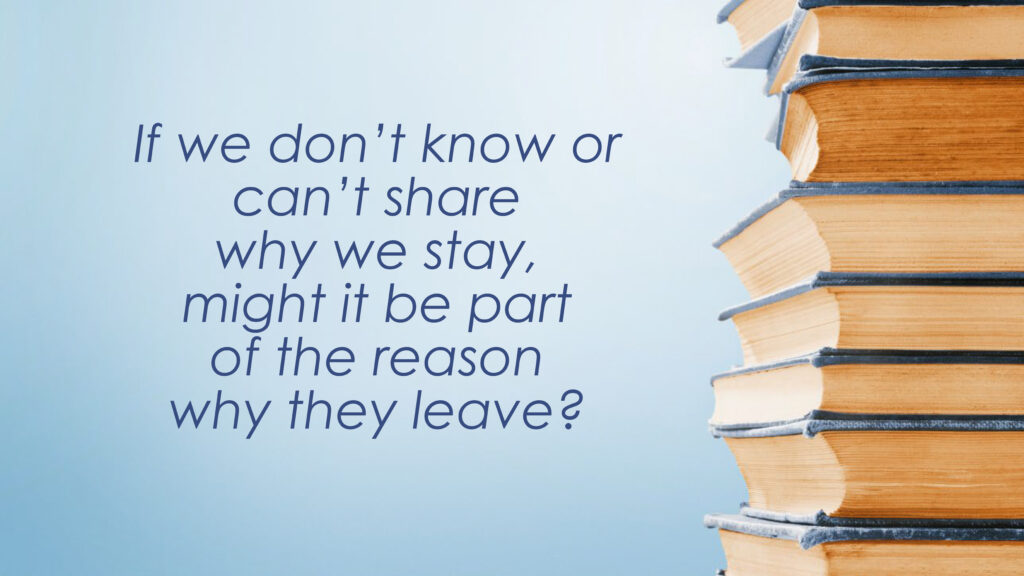
“Why do you stay?” Dr. DelleMonache said, sharing a quote from Dan Cellucci, CEO of the Catholic Leadership Institute based in Malvern, Pa. “If we don’t know or can’t share why we stay [in the Church], might it be part of the reason why they leave?”
She urged those in attendance to use the day of prayer, reflection and writing to feed their own souls. “Because how can you feed souls if your souls aren’t being fed?”
Finding the story
“Every single person has the ability – and responsibility – to evangelize. Many ask themselves, however, ‘What could I possibly say that could give someone hope in the Church?’” Dr. DelleMonache said.
Take the pressure off, she advised, by realizing that shared experiences are the key to relatability. “Relatable stories and characters share similar emotions, challenges and motivations that leave listeners thinking, ‘I’ve felt that, too,’ or ‘I’ve been through something just like that.’”
To find that relatable story or shared experience, recognize that “you have been created, called and named” by God. For those who have difficulty with that idea, “Close your eyes and imagine yourself crawling into the lap of our Father, Abba. Put your ear near his mouth and listen to him say, ‘I have made you.’ Hear him say your name.”
With that confidence, anyone can brainstorm by identifying his/her unique faith stories. Among the prompts one could consider:
• Describe the proudest moment/hardest thing you did and how your faith helped you get through.
• Describe an experience of being positively impacted by someone else’s faith or ministry.
• Think of a “first” related to being Catholic and the impact it had on your faith. For example, the first time you received a sacrament, made a pilgrimage or were particularly moved by a Mass.
All the while, Dr. DelleMonache advised, “recall the different stages in your life – childhood, young adult, adult – and see which resonates. Use a timeline and journal to map out your thoughts.”
Unleashing the story
Recognizing one’s ability to have a story and then fining the right one to tell are two different pieces of the puzzle. What comes next is putting pen to paper.
“Or a computer screen, cell phone, tablet – whatever medium you are most comfortable working with,” said Jennifer Mauro, managing editor of the Catholic Star Herald and a co-presenter.
In her presentation, Mauro offered practical writing tips and advice on how to begin writing.
“Find the time of day that works for you and a spot where you feel comfortable, one where you’ll feel inspired,” she said. “I like to write late at night or early in the morning, before sunrise – times when I feel that I’m the only one awake and won’t be disturbed by a text, call or email. That gives me the freedom to be open and honest in my writing.”
Before beginning, she said, think about the story’s purpose and the target audience, which would likely affect how one tells the story. “You wouldn’t use the same words for children as you would if you were addressing adults,” she said as an example.
When ready to write, she offered a handful of tips, including a story’s starting point. “Writer’s block is a thing – and looking at a blank page only makes it worse! So if you don’t feel inspired to start at the beginning – don’t. Start where you want to, the middle or the end, even. And don’t erase or delete until you are completely finished. Your story is still coming together as a puzzle, so just move your puzzle pieces around.”
Other advice: Avoid clichés; use short sentences; show not tell by using descriptive wording, and edit and revise.
For those who may find writing or telling a story difficult, Mauro urged using a story mountain-like template. Start at the bottom, work one’s way up to the pinnacle and then descend. Or, to put it another way: the introduction, beginning or background; the buildup or rising action; the climax, obstacle to overcome or “ah ha” moment; the falling action, and ending/resolution.
“Think about the story you want to tell. Think about the story you’ve never told,” she said.
Hear more about this presentation from the speakers themselves. Check out the June 10 episode of the Talking Catholic podcast at talking.catholicstarherald.org.



 at the bottom and then tap “Add to Home Screen”
